How to Choose a Rainwater Water Filter or Well Water Filter? A Technical Discussion with a New Zealand Distributor
In New Zealand and Australia, rainwater harvesting and well water supply are common water sources for many households. However, unlike municipal tap water, rainwater and well water often have significant differences in water quality. Therefore, choosing a suitable whole-house water filtration system requires more than just looking at filtration precision. It is also necessary to consider the actual water source, water quality, and household water consumption requirements.
Recently, a distributor from New Zealand has been evaluating our ultrafiltration systems, with the intention of using them for local whole-house rainwater and well water filtration projects.
Explore our Well Water Filter System for Whole-Home Water Filtration to learn more about our whole-house ultrafiltration solutions for private well water.
We had an in-depth technical discussion covering the selection of rainwater Water Filters and well water Water Filters, ultrafiltration membrane filtration precision, pretreatment, service life, system flow rate, and other related topics.
Below is the main content of our discussion. I would also like to take this opportunity to share some questions that distributors and end users frequently ask.
1. What Is the Filtration Precision of Ultrafiltration Membranes? Is 0.01μm an Absolute Pore Size or a Nominal Pore Size?
Customer (Question):
We are evaluating your ultrafiltration systems, mainly for whole-house rainwater filtration and well water filtration in residential applications in New Zealand and Australia.
First, we would like to understand the exact pore size of your ultrafiltration membranes. Is the 0.01-micron filtration precision an absolute pore size, a nominal pore size, or an average pore size?
ChengrongTimes (Answer):
That is a very good question.
Before introducing our products, I would like to clarify one thing: ultrafiltration membranes are not made from just one type of material. They are actually a large product family. Ultrafiltration membranes made from different materials and with different structures have significant differences in filtration precision, fouling resistance, mechanical strength, and service life.
Currently, our Chengrong ultrafiltration factory mainly offers three mainstream types of ultrafiltration membranes:
1) 0.01μm PVC Alloy Ultrafiltration Membrane (Internal Pressure Type)
This ultrafiltration membrane has a nominal pore size of 0.01–0.05μm.
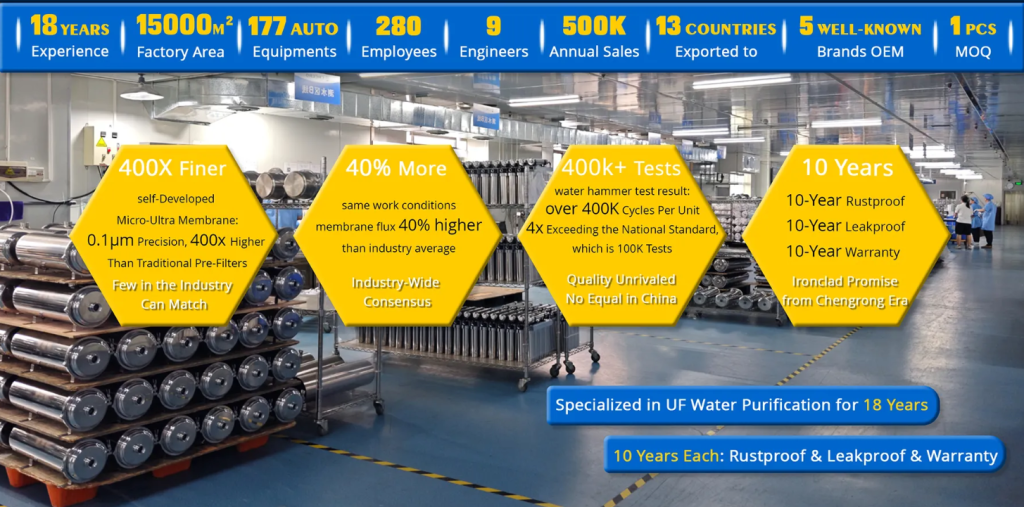
It offers relatively high filtration precision, but it has one characteristic: the membrane fibers are prone to breaking during manual washing. The PVC ultrafiltration membranes independently developed and manufactured by us have toughness and strength that are more than 40% higher than the industry average.
Among the entire ultrafiltration membrane family, the PVC alloy ultrafiltration membrane (internal pressure type) offers the highest filtration precision. It is particularly suitable for applications where the primary objective is to remove microorganisms such as bacteria from water.
For example, the residual chlorine removal ultrafiltration membrane used in our ChengrongTimes® under-sink mineral water direct drinking Water Filter is a proprietary material developed using PVC alloy membranes as its base material.
However, the filtration precision of the PVC internal pressure membrane reaches 0.01μm, and its filtration method works from the inside out. Therefore, if the raw water contains fine sand particles, proper pretreatment is essential.
The reason is simple: once fine sand particles enter the membrane fibers, they can easily cut and damage the PVC ultrafiltration membrane, eventually affecting filtration performance and even causing membrane failure.
Therefore, if customers plan to use PVC ultrafiltration membranes to manufacture rainwater Water Filters or well water Water Filters, we usually pay particular attention to the fine sand content in the raw water.
2) PVDF Homogeneous Membrane
This ultrafiltration membrane has a nominal pore size of 0.05–0.1μm.
Compared with PVC alloy ultrafiltration membranes, PVDF homogeneous membranes offer better fouling resistance and greater toughness.
However, their manufacturing costs are relatively high, and they currently account for a relatively small proportion of the household ultrafiltration Water Filter market.
3) 0.1μm PVDF ultrafiltration membrane
This PVDF supported membrane has a nominal pore size of 0.1~0.15μm.
Its biggest characteristic is that it has an internal support tube. Therefore, the membrane fibers cannot be broken by pulling them by hand, can be repeatedly washed manually, and have a relatively long filter cartridge service life.
From the perspective of the current whole-house water filtration market, PVDF supported membranes are a relatively mainstream choice.
For more information about our 0.1 μm PVDF ultrafiltration technology, see our Whole House Water Filter with 0.1 μm PVDF Ultrafiltration.
So, how should customers choose?
If customers use a whole-house water filtration system mainly to remove suspended impurities such as sediment and rust, making originally cloudy water clear, I usually recommend prioritizing filter cartridges made with 0.1μm PVDF ultrafiltration membrane.
If customers have higher requirements for filtration precision and want to further intercept microorganisms such as bacteria in the water, they can consider 0.01μm PVC ultrafiltration membrane filter cartridges, while ensuring that the necessary pretreatment is in place.
There is another easily overlooked issue here:
Ultrafiltration membranes work on the principle of physical sieving. They mainly intercept fine sediment, rust, colloids, bacteria, and other impurities in water through their membrane pores. Ultrafiltration offers very clear advantages in reducing water turbidity.
However, ultrafiltration is not a universal solution.
For water-soluble ionic substances, such as calcium and magnesium ions, which are minerals, as well as iron and manganese ions, ultrafiltration membranes have no filtration effect.
This means that if customers use well water and water quality testing reveals excessive iron and manganese levels, additional iron and manganese pretreatment processes must be installed.
If the raw water has relatively high hardness and is prone to scale formation, a whole-house water softening system will also be required.
I have always believed that when choosing a Water Filter, we should not focus solely on the specifications of a particular filtration technology. More importantly, we need to understand what problems it can solve and what problems it cannot solve.
This is not a shortcoming of ultrafiltration. Every filtration process has its own advantages and applicable range.
For example, RO reverse osmosis membranes can theoretically reject the vast majority of dissolved contaminants. However, directly using them for whole-house water filtration is not practical in real-world applications.
Therefore, whether choosing a rainwater Water Filter or a well water Water Filter, the filtration process should be determined according to the actual water quality rather than simply pursuing a particular filtration precision.
2. Are Independent Microbiological Test Reports Available?
Customer (Question):
Regarding the microbiological filtration capabilities of your ultrafiltration membranes, can you provide independent microbiological test reports?
ChengrongTimes (Answer):
Of course.
Our products have passed comprehensive direct drinking water testing conducted by the Shenzhen Institute of Metrology and Quality Inspection (SMQ).
Report Number: WT10103260146579WT1.
For general water sources, the test report covers 31 direct drinking water indicators, including microbiological and other relevant indicators. These reports can be provided to all customers for reference.
In addition, the PVDF and PVC ultrafiltration membranes independently developed and manufactured by our Chengrong ultrafiltration factory have both passed SGS material safety testing. The tests were conducted with reference to the NSF/ANSI 58-2023 standard, and it is difficult to find a second manufacturer in the industry that offers the same.
For overseas distributors, I believe test reports are extremely important.
Especially for rainwater and well water filtration projects, customers are not only concerned about whether a product can make the water clear, but also about the material safety of the product and the relevant testing standards and supporting evidence.
We can provide all these documents.
3. What Pretreatment Is Required Before the Ultrafiltration System for Rainwater Water Filters and Well Water Water Filters?
Customer (Question):
What pretreatment equipment do you recommend installing before the ultrafiltration system?
For example, is a pre-filter necessary? Do you recommend using activated carbon filtration?
ChengrongTimes (Answer):
This question needs to be answered based on the material and filtration structure of the ultrafiltration membrane.
If customers choose a 0.1μm PVDF external pressure membrane for whole-house water filtration, pretreatment is usually not required. It can be directly used to filter rainwater and well water, removing impurities such as sediment, rust, colloids, and insect eggs from the water, making originally cloudy water clear.
However, the situation is different if customers choose a 0.01μm PVC ultrafiltration membrane.
PVC ultrafiltration membranes adopt an internal pressure filtration structure. Raw water first enters the PVC hollow fiber tubes, which have a diameter of 1~2mm, and is then filtered through the 0.01-micron pores in the membrane fibers.
Because the internal space of the membrane fibers is relatively small and the filtration precision is very high, hard particles such as fine sand in the raw water can easily damage the membrane fibers.
Therefore, we recommend installing a 5-micron PP cotton large housing filter before the PVC ultrafiltration Water Filter as a pre-filter to remove fine sand and other hard impurities from the water first.
As for activated carbon, my position has always been very clear: We firmly oppose using activated carbon for whole-house water filtration.
While activated carbon adsorbs residual chlorine in water, it can also easily promote bacterial growth. If it is used in a whole-house water filtration system, it can easily lead to biofilm formation throughout the household piping system, subsequently causing secondary contamination.
Therefore, for whole-house rainwater Water Filters and well water Water Filters that need to operate over the long term, I place greater emphasis on the stability of the filtration system itself and whether each stage of filtration is genuinely necessary.
4. How Do You Determine the Specifications and Dimensions of a Whole-House Ultrafiltration Water Filter?
Customer (Question):
If a customer wants to install a whole-house ultrafiltration water filtration system, how do you determine the equipment size?
ChengrongTimes (Answer):
We do not recommend a particular model right from the beginning.
Before determining the equipment specifications, I usually first learn about the customer’s household water supply conditions.
First, we need to confirm whether the house is equipped with a water storage tank.
The water supply conditions are different for households with and without a water storage tank.
Next, we need to understand the number of permanent residents during peak water consumption periods, or the number of faucets that may be opened simultaneously.
Once we have these basic details, we can use our independently developed Chengrong Formula to calculate the minimum membrane flux required for the ultrafiltration filter cartridges. We then select the appropriate ultrafiltration Water Filter specifications based on the calculation results.
I have always believed that when choosing whole-house water filtration equipment, we should not judge it solely by its external dimensions, nor should we rely entirely on the flow rate stated by the seller.
What really matters is whether the membrane flux of the filter cartridges can meet the actual household water consumption requirements.
5. What Water Quality Requirements Do Rainwater and Well Water Have for Ultrafiltration Water Filters? How Should Turbidity, TDS, Iron, Manganese, and Hardness Be Considered?
Customer (Question):
Apart from flow rate, what other factors do you consider when selecting an ultrafiltration Water Filter?
For example, does the water source being rainwater, well water, or municipal tap water matter? Will water turbidity, total solids content, iron, manganese, hardness, and other water quality test results affect equipment selection?
What inlet water limits do you recommend? Can you provide recommended maximum levels for turbidity, total solids content, iron, manganese, and other important indicators?
ChengrongTimes (Answer):
Of course, we consider all these factors.
However, different water sources do have different characteristics.
If customers use municipal tap water, generally there is no need to consider too many additional water quality factors.
For household whole-house ultrafiltration Water Filters, I would particularly like to point out one thing: do not directly connect an ultrafiltration Water Filter behind a high-pressure deep well pump.
This may be somewhat different from what many people intuitively expect.
Unlike RO reverse osmosis membranes, ultrafiltration Water Filters are actually more sensitive to excessive water pressure because excessively high water pressure may cause membrane blockage.
You can also read our guide to Recommended Water Pressure for Whole-House Ultrafiltration Filtration Systems for more details about inlet pressure and ultrafiltration system operation.
For rainwater and well water, we need to pay much closer attention to the turbidity of the raw water and the suspended impurities it contains.
In engineering applications, our turbidity requirements are:
- PVC ultrafiltration membranes: recommended turbidity ≤20 NTU.
- PVDF homogeneous membranes and PVDF supported membranes: recommended turbidity ≤100 NTU.
If the raw water turbidity exceeds the above ranges, additional pretreatment is required to slow down excessive ultrafiltration membrane fouling.
As for TDS values, iron and manganese ions, and water hardness, these also need to be explained separately.
Ultrafiltration itself cannot change the TDS value of water, nor can it intercept iron and manganese ions in the water.
Therefore, if customers want to reduce TDS values, or if water quality testing reveals excessive iron and manganese levels, these issues must be addressed through additional pretreatment.
For example:
- Use ion exchange resin for water softening.
- Use manganese sand filtration.
- Use oxidation filtration and other processes.
There is one point I would particularly like to emphasize here:
Some filter cartridges on the market are advertised with numerous functions, making them appear capable of solving almost every water quality problem. However, their actual treatment performance is limited, making it difficult for them to truly match complex and changing on-site water quality conditions.
As a full-supply-chain ultrafiltration manufacturer with nearly 20 years of experience, we do not advocate using a so-called “all-in-one” product to solve every problem.
Instead, we insist on customizing reasonable process combinations according to customers’ raw water conditions, ensuring that every filtration stage performs its intended function.
Other important water quality indicators:
Residual Chlorine: Recommended ≤0.5 mg/L.
Excessively high residual chlorine content in water will accelerate the aging of ultrafiltration membrane materials. Of course, different ultrafiltration membrane materials also have different levels of chlorine resistance.
COD: Recommended ≤5 mg/L.
Ultimately, the core logic behind the inlet water requirements of an ultrafiltration system is actually very simple:
Through reasonable pretreatment, control turbidity, suspended solids, and harmful substances as much as possible to protect the ultrafiltration membrane, maintain stable filter cartridge flux, and ensure that its service life meets expectations.
This is also why we always need to understand the customer’s raw water conditions before designing rainwater Water Filters and well water Water Filters.
To understand how whole-house filtration works together with drinking water treatment, read our guide to the Complete Whole House Water Treatment System.
6. How Often Should the Filter Cartridges of a Whole-House Ultrafiltration Water Filter Be Replaced? What Factors Affect Their Service Life?
Customer (Question):
For normal residential use, how often do you expect the filter cartridges of a whole-house ultrafiltration Water Filter to be replaced?
In addition, what factors can shorten the service life of ultrafiltration membranes?
ChengrongTimes (Answer):
I would like to answer this question from two perspectives: actual usage and routine maintenance.
If customers choose the third-generation ChengrongTimes whole-house ultrafiltration Water Filter and regularly clean the filter cartridges by performing clean-water backwashing while simultaneously rubbing and washing them by hand, the filter cartridges can be used for at least 5 years.
If customers cannot perform clean-water backwashing while simultaneously rubbing and washing the cartridges by hand, and can only remove the ultrafiltration membrane filter cartridges for manual washing, the service life is usually 3~5 years.
There is one more point I would particularly like to mention about PVDF external pressure membranes.
Because they have an internal support layer, they offer high tensile strength. The membrane fibers are less likely to break during cleaning, and their service life is also more stable.
So, what situations can shorten the service life of ultrafiltration membranes during daily use?
Based on our actual manufacturing and application experience, there are mainly six situations:
- Excessively high raw water turbidity: A large amount of suspended sediment and impurities at the water inlet can easily cause membrane fouling.
- Excessively high inlet water pressure: Excessively high water pressure may increase the filtration burden on the membrane and affect normal operation.
- Insufficient membrane flux of the filter cartridges: The selected filter cartridge membrane flux is insufficient compared with the actual household water consumption.
- Excessively high residual chlorine content in water: This can accelerate the oxidation of ultrafiltration membrane materials.
- Lack of regular cleaning and maintenance: Failure to clean the system over a long period can easily lead to the accumulation of contaminants.
- Long-term shutdown without maintenance: Even if an ultrafiltration Water Filter is not used for an extended period, necessary maintenance is still required.
As a leading manufacturer that has specialized in the stainless steel pipeline ultrafiltration industry for 19 years, our advice to customers is simple:
Do not wait until the water flow has noticeably decreased before remembering to inspect the equipment.
During daily use, you should regularly observe whether the outlet flow rate of the ultrafiltration Water Filter remains stable. Once you notice a significant change in flow rate, you should promptly inspect the filter cartridges and inlet water conditions.
7. If a Household Needs a Whole-House Ultrafiltration System with a Flow Rate of Approximately 50L/Minute, Which Models Should Be Selected for Rainwater and Well Water?
Customer (Question):
Suppose a residential property needs a whole-house ultrafiltration water filtration system with a flow rate of approximately 50L/minute. Which model would you recommend for rainwater? Which model would you recommend for well water?
ChengrongTimes (Answer):
For rainwater filtration, I recommend prioritizing PVDF supported membrane filter cartridges.
Their advantages are that no pretreatment is required, the filter cartridges can be repeatedly cleaned and reused, and their service life is relatively long.
Therefore, if customers want to install a rainwater Water Filter for whole-house rainwater filtration, PVDF supported membranes are one of our recommended solutions.
For well water filtration, I also recommend prioritizing PVDF supported membranes.
For a practical example of how ultrafiltration can be applied to private well water, see our Private Well Water Filter: A Real Home Case Study.
However, here we need to distinguish between different customer water treatment objectives.
If customers mainly want to filter sediment, rust, colloids, and other impurities, reduce raw water turbidity, and make the water used throughout the house clearer, then PVDF supported membranes are already sufficient.
If customers want to make the removal of microorganisms such as bacteria from water their primary whole-house water filtration objective, I would recommend choosing PVC ultrafiltration membranes while ensuring that the necessary pretreatment is in place.
In addition, well water is a natural water source that is not subject to mandatory supervision. If water quality testing reveals excessive iron and manganese levels, an additional pretreatment system will also be required.
Therefore, although both rainwater Water Filters and well water Water Filters can use ultrafiltration technology, their specific configurations are not necessarily identical.
We always insist on understanding the water quality first, and then determining the membrane material and filtration solution.
Regarding the 50L/minute flow rate, I would also like to explain a few more things.
In fact, a Water Filter itself cannot control the outlet flow rate. Its outlet flow rate is only related to the raw water flow rate and the possible pressure drop.
The biggest feature of ChengrongTimes ultrafiltration Water Filters is that, through our independently developed Chengrong Formula, we can make the pressure drop caused by ultrahigh filtration precision approach zero.
There is another industry phenomenon that I think it is necessary to bring to the attention of distributors and consumers.
Some sellers on the market advertise outlet flow rates that are neither the actual outlet flow rate nor the actual membrane flux. These figures are often seriously exaggerated and have almost no reference value.
Therefore, we have always told our customers:
When purchasing an ultrafiltration Water Filter, the most important parameter is actually the membrane flux of the filter cartridges.
We are also the first brand on the market to genuinely indicate the actual membrane flux of ultrafiltration Water Filters, because we are a professional full-supply-chain ultrafiltration manufacturer.
So, how exactly should customers choose the model of an ultrafiltration Water Filter?
We recommend referring to the Chengrong Formula.
Situation 1: The household has a water storage tank.
The minimum membrane flux required for the ultrafiltration Water Filter = Daily water consumption × 5.
If customers do not know their exact daily water consumption, they can estimate it based on the maximum number of people living in the household.
The daily water consumption per person is 200L. Therefore:
Minimum membrane flux required for the whole-house ultrafiltration Water Filter = 200L × Number of household occupants × 5.
Situation 2: Direct municipal tap water supply without a water storage tank.
Minimum membrane flux required for the ultrafiltration Water Filter = Total number of faucets × 300L/H × 5.
The coefficient 5 here represents the safety margin, which is mainly used to balance the customer’s water usage experience, filter cartridge service life, and economic costs.
Therefore, for a household that requires a flow rate of 50L/minute, the specifications of the whole-house ultrafiltration Water Filter should still be determined according to the customer’s actual circumstances.
For households with a water storage tank, the calculation needs to be based on the total daily water consumption (with water pressure).
For households without a water storage tank, the calculation needs to be based on the actual instantaneous water flow rate required.
This is also why we do not recommend that customers select whole-house water filtration equipment based solely on a simple flow rate parameter.
Only by combining raw water conditions, water supply methods, actual water consumption requirements, and filter cartridge membrane flux can customers truly select a suitable rainwater Water Filter or well water Water Filter.
Chengrong Ultrafiltration: Customers Have Nothing to Worry About
10 Years Without Rust
10 Years Without Water Leakage
10 Years of After-Sales Service
ChengrongTimes® Water Filter
We Never Compromise on Quality.