Just a few days ago, the Chinese distributor of a high-end American water purifier brand officially approached ChengrongTimes to discuss a cooperation project.
The project arose from a practical industrial water treatment need: the client had to provide a drinking water purification solution for more than 1,600 factory employees while also meeting the substantial daily water demands of the factory canteen, including cooking rice, preparing soups, and other food preparation activities.
For a project of this scale, the client needed more than just a water filter. They needed a solution that could address the actual water quality problems, meet water consumption requirements, and facilitate long-term maintenance.
1. The Client’s Challenge: Turbid Municipal Tap Water Could Not Meet the Requirements of the Final Water Purification Equipment
Although the factory used municipal tap water, the water quality was relatively poor, with visible turbidity that could be seen with the naked eye.
The client’s terminal drinking water purification equipment had specific requirements for incoming water quality. If the raw water contained excessive amounts of sediment, rust, colloids, and other impurities, it would be difficult to meet subsequent treatment requirements and could increase the filtration burden on the terminal water purification equipment.
Therefore, adding a pretreatment stage before the terminal drinking water equipment to make the turbid tap water clearer became a key requirement of the entire project.
The client approached ChengrongTimes, hoping we could provide a scientific and reliable ultrafiltration water purification solution.
It is important to clarify that the purpose of this pretreatment stage was not to directly produce water that met drinking water standards. Instead, it was to remove impurities such as sediment, rust, and colloids as effectively as possible, providing more suitable incoming water conditions for the subsequent drinking water treatment equipment.
2. Why Didn’t We Select Equipment Directly Based on the Client’s Requested Flow Rate of 8–9 Tons per Hour?
Since the project involved daily drinking water for more than 1,600 employees, as well as substantial water consumption for cooking, preparing soups, and other activities in the factory canteen, the overall water demand was relatively high.
The client therefore specified that the ultrafiltration water filter must achieve a treatment flow rate of 8–9 tons per hour.
However, we believed that selecting equipment based solely on this parameter would not be the most scientific approach.
The reason is simple: the actual treatment flow rate of a water purification system depends not only on the equipment itself but also on factors such as raw water supply capacity, water pressure, pipe diameter, membrane configuration, and incoming water quality.
If the existing factory pipelines have limited water supply capacity and the raw water itself cannot reach 8–9 tons per hour, even an ultrafiltration water filter with a high rated flow rate may not achieve the expected actual treatment performance.
Furthermore, whether the equipment operates for 5 hours, 8 hours, or 24 hours per day directly affects its cumulative water production and selection requirements.
Therefore, for industrial projects like this, we focus less on a single hourly flow rate and more on the following key factors:
- Total daily water consumption: Determines how much water the equipment needs to treat each day.
- Raw water supply capacity: Includes actual water pressure, pipe diameter, and raw water flow rate.
- Equipment operating hours: Determines the continuous treatment capacity required from the system.
- Raw water quality: Affects filtration load, cleaning frequency, and long-term operating performance.
- Maintenance method: Determines whether the equipment can maintain stable operation over the long term.
During our discussions, the client informed us that the factory consumed approximately 5–6 tons of water per day.
With this information, we could further evaluate a suitable ultrafiltration equipment configuration based on the raw water conditions, operating hours, and filtration requirements, rather than simply pursuing an impressive-looking flow rate.
3. Determining the Ultrafiltration Water Filter Configuration Based on Actual Water Consumption and Filtration Requirements
According to ChengrongTimes’ equipment selection calculation method, if the client used a manually cleaned ultrafiltration water filter as the pretreatment system, the minimum required membrane throughput would be approximately 25–30 tons under the project’s current estimation conditions.
It is important to distinguish between membrane throughput and actual treatment flow rate, as these are not exactly the same parameter. The final equipment selection still needs to account for the equipment configuration, operating hours, inlet pressure, water quality, and other relevant conditions.
However, the client soon raised another important requirement: they did not want to arrange personnel to disassemble and manually clean the filter elements regularly. Instead, they wanted the equipment to support automatic backwashing and wastewater discharge to minimize manual maintenance.
This meant that meeting the filtration requirements alone was not enough. The equipment also needed to offer convenient long-term operation and maintenance.
4. Why Did We Recommend the Intelligent Rotary-Cleaning Whole-House Ultrafiltration Water Filter?
ChengrongTimes has long focused on the research, development, and manufacturing of ultrafiltration water filters. We have extensive knowledge of ultrafiltration membrane characteristics, cleaning methods, and practical application scenarios.
In response to the client’s request for automatic cleaning, we did not immediately adopt a conventional automatic backwashing solution. Instead, we further analyzed the actual performance of different cleaning methods.
For externally pressurized ultrafiltration membranes, relying solely on reverse-flow backwashing combined with wastewater discharge does not necessarily remove accumulated contaminants from the membrane surface and related areas thoroughly. Under specific operating conditions, its cleaning performance may be inferior to that of a more comprehensive cleaning method involving mechanical assistance.
Therefore, if the client was unwilling to manually disassemble and clean the filter elements but still wanted the equipment to operate reliably over the long term, we needed to consider a cleaning structure better suited to the application.
After evaluating the client’s water consumption, raw water conditions, and maintenance requirements, we ultimately recommended the Intelligent Rotary-Cleaning Whole-House Ultrafiltration Water Filter.
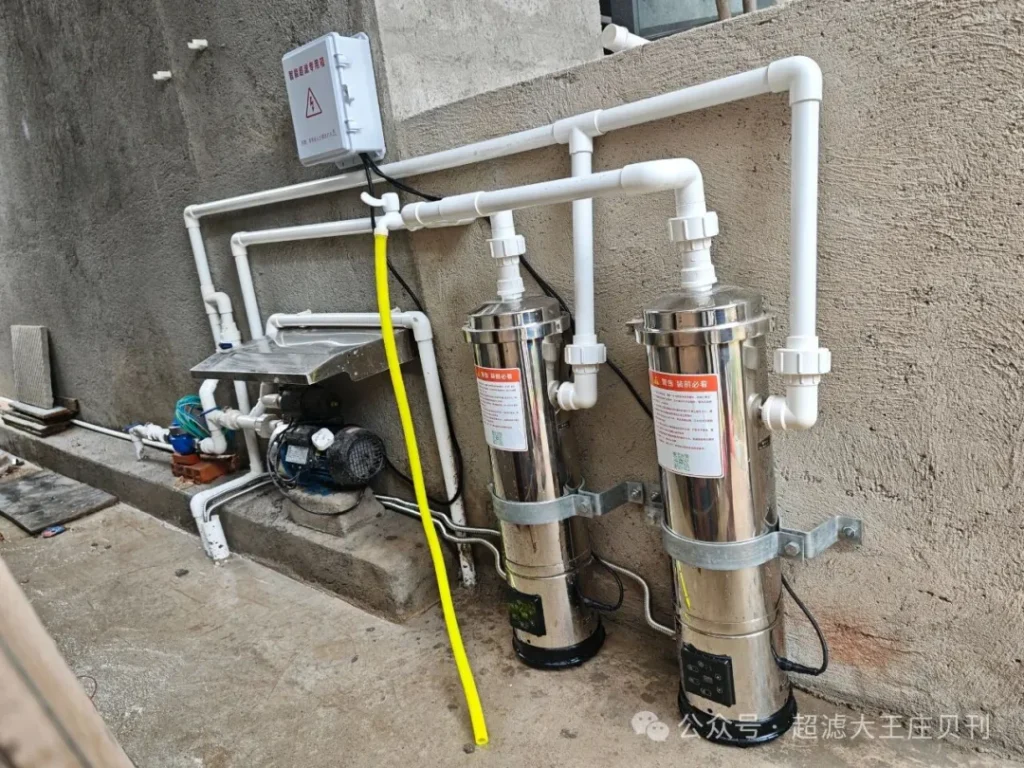
Based on the currently available project conditions, installing four units in parallel could serve as the recommended configuration to meet the pretreatment requirements. If the client’s budget allowed, five units could also be considered to provide additional treatment capacity, provided the actual operating conditions permitted it.
Of course, the final number of units and operating parameters should be determined according to the site’s water supply conditions, the equipment’s actual treatment capacity, and the results of installation and commissioning.
The core principle of this solution was not simply to increase the number of units, but to ensure that filtration capacity, cleaning methods, and actual water consumption requirements were properly matched.
5. Intelligent Rotary-Cleaning Technology: Making Ultrafiltration Water Filter Maintenance Easier
The Intelligent Rotary-Cleaning Whole-House Ultrafiltration Water Filter is independently developed by Chengrong Ultrafiltration Factory.
According to ChengrongTimes’ product positioning, the system uses a 0.1-micron PVDF externally pressurized ultrafiltration membrane and incorporates an intelligent rotary-cleaning structure to improve membrane maintenance. Its objective is to reduce manual intervention while lowering the risk of membrane fouling and blockage.
Compared with solutions that rely solely on conventional backwashing, intelligent rotary-cleaning technology places greater emphasis on combining membrane surface cleaning with routine maintenance.
For factories, commercial facilities, and other applications with substantial water consumption, ease of maintenance and long-term operating stability are just as important as initial filtration performance.
It is worth emphasizing that the actual performance of any ultrafiltration system depends on factors such as incoming water quality, operating pressure, usage intensity, and maintenance settings. Therefore, the ability of the equipment to maintain good filtration performance over the long term must still be evaluated under actual operating conditions.
ChengrongTimes has always aimed to improve product structures and cleaning technologies so that customers can meet their filtration requirements while minimizing the complexity of subsequent maintenance.
6. Why Did the Client Ultimately Choose to Cooperate with ChengrongTimes?
The client was the Chinese distributor of a high-end American water purifier brand and had high expectations regarding product quality and project delivery.
During our discussions, we discovered that the client was not primarily concerned with obtaining the lowest possible quotation. Instead, they focused on several more practical questions:
- Can the solution genuinely solve the water quality problem? The pretreatment equipment must meet the project’s filtration requirements and provide more suitable incoming water conditions for the subsequent drinking water equipment.
- Is the product reliable? The equipment needs to suit the factory’s actual operating environment rather than simply look good on paper.
- Is installation convenient? A parallel installation involving multiple units requires careful consideration of pipeline design, installation space, and on-site construction conditions.
- Can filter element maintenance be automated? The client did not want to rely on regular manual disassembly and cleaning and hoped to reduce maintenance work through a better cleaning structure.
- Does the solution meet the actual requirements? Equipment selection should be based on water quality, water consumption, and operating conditions rather than blindly pursuing high flow rates or low prices.
In response to these questions, ChengrongTimes explained the equipment selection process, the characteristics of different cleaning methods, and the application scenarios of the Intelligent Rotary-Cleaning Ultrafiltration Water Filter based on the project’s actual requirements.
We also shared real-world application cases and user experiences from other customers to help the client better understand the product’s practical value.
Ultimately, the client asked ChengrongTimes to prepare a quotation based on the best achievable filtration performance and actual operating requirements, rather than the lowest price.
This also reinforced our belief that both parties shared the same approach to cooperation: a truly valuable solution is not simply about selling equipment, but about helping customers solve real problems through professional products and technical services.
After discussions and confirmation of the proposed solution, both parties successfully reached a cooperation agreement.
7. From Focusing on Product Development to Gaining Recognition from High-End Clients, ChengrongTimes Continues to Advance
Looking back at ChengrongTimes’ development, we have consistently focused on ultrafiltration water filters and continued investing in product research and development, structural design, and manufacturing process improvements.
From our early product development efforts to now being able to undertake projects addressing the water needs of more than 1,600 employees, we have increasingly recognized that what customers truly need is not simply superior product specifications, but practical solutions that can be successfully implemented.
Gaining recognition from the Chinese distributor of a high-end American water purifier brand in this project has also demonstrated the value of our continued focus on product development and manufacturing.
We believe that earning recognition from more high-end customers cannot rely solely on marketing and promotional claims. It requires continuous improvement in product quality, technical capabilities, solution design, and service standards.
ChengrongTimes consistently holds itself to high standards, continuously striving for excellence in manufacturing quality, product functionality, and structural design. We never compromise or take shortcuts when it comes to product quality and customer service.
Because we firmly believe that only by genuinely helping customers solve their problems can we establish long-term, stable, and trustworthy partnerships.
If your factory, commercial facility, or other project is also facing problems such as turbid raw water, excessive sediment and rust, unsuitable incoming water conditions for terminal purification equipment, or high manual maintenance costs for ultrafiltration systems, please feel free to contact ChengrongTimes.
We can evaluate a suitable ultrafiltration water purification solution based on your raw water quality, daily water consumption, water supply conditions, and maintenance requirements.