Description: Learn why Water Filter water smells bad, compare RO, ultrafiltration, and nanofiltration, and discover filter maintenance tips to help prevent odors and microbial contamination.
Why Does Water from a Water Filter Smell Bad? Which Is More Prone to Problems: RO Reverse Osmosis, Ultrafiltration, or Nanofiltration?
I recently came across a video in which a user complained that the water from their Water Filter smelled bad. After contacting the manufacturer to replace the filter cartridges, the user discovered that the cartridges, which had not been maintained for two consecutive years, were extremely dirty. The user therefore believed that the manufacturer should take responsibility and recorded a video to file a complaint.
Originally, this was just an ordinary Water Filter after-sales dispute. Unexpectedly, a different voice emerged in the comments. Some people selling RO reverse osmosis Water Filters took the opportunity to promote their products, claiming that ultrafiltration and nanofiltration Water Filters would inevitably develop unpleasant odors and that only RO reverse osmosis Water Filters could prevent this problem.
Is this claim scientifically valid?
When water from a Water Filter smells bad, is it because the filter cartridges have not been replaced in time, or is there a problem with the water purification technology itself? Are RO reverse osmosis Water Filters really less likely to develop unpleasant odors?
Based on microbial contamination testing of Water Filters, relevant national standards, and filter maintenance principles, this article analyzes the causes of unpleasant odors in Water Filter output, the maintenance requirements of RO reverse osmosis technology, actual test data, and daily usage practices. The aim is to help consumers better understand the three water purification technologies: RO reverse osmosis, ultrafiltration, and nanofiltration.
1. Why Does Water from a Water Filter Smell Bad? Long-Term Lack of Filter Maintenance Is an Important Risk Factor
First, one basic fact must be clarified: Water Filters require regular maintenance, and filter cartridges cannot be used indefinitely. Regardless of whether a Water Filter uses RO reverse osmosis, ultrafiltration, or nanofiltration technology, failing to replace filter cartridges or clean the equipment for an extended period may increase the risk of unpleasant odors and microbial contamination in the output water.
Different filter cartridges serve different functions and fail in different ways. For example, activated carbon is mainly used to adsorb certain organic compounds, residual chlorine, and odor-causing substances in water. RO reverse osmosis membranes and nanofiltration membranes primarily remove corresponding dissolved substances through membrane separation. The maintenance requirements for different filter cartridges cannot be treated as identical.
In actual use, long-term failure to maintain a Water Filter may lead to the following situations.
Stage 1: Declining filtration performance.
As usage time increases, filter cartridges may become contaminated or clogged, or their adsorption capacity may decline. This may manifest as reduced water flow or changes in taste. However, these phenomena do not occur in the same sequence in every Water Filter, and water flow alone cannot determine whether a filter cartridge is still safe.
Stage 2: Declining activated carbon adsorption capacity.
After a period of use, activated carbon gradually loses its adsorption capacity. Its actual service life depends on the incoming water quality, the volume of water treated, the performance of the carbon material, and the equipment design. It is not accurate to assume that all activated carbon reaches saturation at the same time.
When activated carbon filtration performance declines, the equipment may become less effective at removing certain odor-causing substances and residual chlorine. If the filter cartridge is contaminated by microorganisms, the quality of the output water may also deteriorate.
Stage 3: Microorganisms may grow inside the filter cartridges and equipment.
The interior of a Water Filter provides a moist environment. Organic matter may accumulate on filter surfaces and other water-contact components, creating conditions that support microbial growth. Under suitable conditions involving temperature, nutrients, and water retention time, microorganisms may multiply and form biofilms.
At this point, users may notice unpleasant odors or changes in water quality. However, an unpleasant odor cannot directly prove the presence of a specific bacterium. Likewise, the absence of an odor does not mean that the water necessarily meets quality standards.
Actual Test Data: Water Filters That Have Not Been Maintained for a Long Time Deserve Attention
The problem of microbial contamination in Water Filters is not without evidence. Published tests and investigations have provided relevant findings.
1. On-site testing in 14 households in Shenzhen
In 2019, the Shenzhen Municipal Administration for Market Regulation, together with the Shenzhen Institute of Metrology, conducted on-site testing in 14 households. Among the samples collected, eight had total bacterial counts that failed to meet the relevant hygiene standards. China Quality News Network reported these findings on August 30, 2019, identifying maintenance issues such as failure to replace filter cartridges on time as important contributing factors.
It should be noted that the investigation covered only 14 households and cannot directly represent the overall situation of Water Filters in all households. Nevertheless, it demonstrates that improper maintenance of Water Filters can create real risks.
2. A 2026 survey of 349 output-water samples across four cities
According to a July 2026 report by China.com concerning research presented at the DDBP 2026 conference, a team comprising Yu Xin from Xiamen University and Ye Chengsong from Xiamen University of Technology conducted a survey involving Beijing, Shanghai, Shenzhen, and Xiamen. A total of 349 output-water samples were collected.
The report stated that nearly 60% of the samples had total bacterial counts exceeding the limit of 100 CFU/mL specified in GB 5749—2022. The proportion of samples exceeding the limit was significantly higher among machines that had been left idle overnight.
These findings suggest that Water Filter usage habits, equipment condition, and the length of time water remains in the internal piping should all be considered when evaluating output-water quality.
However, the specific research methods, sample sources, equipment types, and testing conditions should be verified against the conference materials and original research. These findings cannot be used to conclude that all Water Filters have the same probability of exceeding the limit.
Returning to the case in the video, the Water Filter had not been maintained for two consecutive years, and the condition of its filter cartridges had clearly deteriorated. Without further testing, we cannot determine the sole source of the odor based on the video alone. However, long-term lack of maintenance is clearly one of the first issues that should be investigated.
2. Can Replacing a Water Filter with an RO Reverse Osmosis Water Filter Solve the Problem of Unpleasant Odors?
The answer is no.
RO reverse osmosis technology has a strong ability to separate dissolved substances. However, this does not mean that RO Water Filters do not require maintenance, nor does it mean that using RO technology can completely prevent unpleasant odors and microbial contamination.
In fact, RO Water Filters usually require pre-filters to protect the reverse osmosis membrane, and some models are also equipped with post-activated carbon filters. Different components serve different purposes, and problems at any stage may affect the performance of the entire system.
1. RO Reverse Osmosis Membranes Are Sensitive to Residual Chlorine, Making Pre-Activated Carbon Filtration Very Important
Common household RO reverse osmosis membranes use polyamide composite membrane materials. These membranes are sensitive to free chlorine, and prolonged exposure to residual chlorine may cause oxidative damage and affect desalination performance.
Common polyamide nanofiltration membranes may also be sensitive to free chlorine. However, their specific chlorine tolerance must be determined according to the membrane material and the manufacturer’s technical documentation.
GB/T 19249—2017, Reverse Osmosis Water Treatment Equipment, specifies a free chlorine concentration of less than 0.1 mg/L for RO feed water. The relevant data sheet and technical manual for DuPont FilmTec BW30 (Form No. 45-D01569-en) also list a free chlorine tolerance level below 0.1 ppm.
Meanwhile, GB 5749—2022, Standards for Drinking Water Quality, specifies a free chlorine limit of 2 mg/L for finished water when free chlorine is used for disinfection. The residual free chlorine concentration at the ends of the distribution network must be at least 0.05 mg/L.
Two concepts must be distinguished here: residual chlorine in tap water is part of the water supply disinfection process, while RO membranes are sensitive to free chlorine. RO equipment usually requires appropriate pretreatment to reduce the concentration of free chlorine entering the membrane assembly.
Therefore, pre-activated carbon is not only used to improve taste. It is also an important component for protecting the reverse osmosis membrane in many RO systems.
If the pre-activated carbon has already failed but continues to be used for an extended period, the concentration of residual chlorine entering the RO membrane may increase, raising the risk of membrane oxidation damage.
According to relevant DuPont FilmTec technical materials, continuous exposure to a free chlorine concentration of 1 mg/L for approximately 200–1,000 hours may cause significant deterioration in membrane performance. Industry technical materials have also cited a case in which continuous exposure to 0.5 ppm residual chlorine for 30 days reduced the salt rejection rate from 99.5% to 92%. These figures are for reference only. The actual extent of damage depends on the membrane model, temperature, pH, and specific exposure conditions.
Once oxidative damage occurs, the original performance usually cannot be restored through simple cleaning, and the membrane element may need to be replaced.
Therefore, maintaining the pre-activated carbon filter is particularly important for Water Filters using RO reverse osmosis technology. The fact that the machine still produces water does not mean that all filter cartridges are functioning normally.
2. Post-Activated Carbon Can Also Become a Potential Source of Microbial Contamination
Some RO Water Filters have a post-activated carbon filter installed after the reverse osmosis membrane to improve the taste of the output water.
It should be noted that the removal of residual chlorine by the RO membrane and the protective function of pre-activated carbon do not automatically mean that post-activated carbon will inevitably support bacterial growth. However, if the post-filter becomes contaminated, is not replaced for an extended period, or the equipment provides suitable conditions for microbial growth, it may become a source of secondary contamination.
Activated carbon has a porous structure, and the interior of the filter cartridge remains moist for long periods. If organic matter accumulates, water retention time is prolonged, and disinfection barriers are insufficient, microorganisms may multiply inside the filter cartridge and downstream piping.
This is why evaluating the output-water quality of an RO Water Filter requires more than looking at the filtration precision of the reverse osmosis membrane. The pre-filters, post-filters, storage tank, piping, and maintenance conditions must also be considered.
Therefore, claiming that RO Water Filters require no maintenance is unscientific.
Likewise, attributing unpleasant odors in ultrafiltration and nanofiltration output water entirely to the technology itself is not supported by sufficient evidence. Different water purification technologies have different filtration principles and maintenance requirements. One technology cannot simply replace all other water quality management measures.
3. Is Water from a Water Filter Dirtier Than Tap Water? What Do Published Test Results Tell Us?
If we discuss only filtration principles, it is easy to overlook the actual condition of a Water Filter after long-term use. Compared with simply comparing the technical specifications of RO, ultrafiltration, and nanofiltration, examining output-water test results under actual or simulated usage conditions is more helpful for understanding the importance of maintenance.
1. Microbial Secondary Contamination Test of Water Filters by Vkan Testing in 2019
According to the White Paper on Microbial Secondary Contamination in Water Purifiers, published by China Household Electrical Appliances Online and Vkan Testing in September 2019, the research team conducted an accelerated test on four mainstream RO Water Filters, simulating six months of use and a cumulative output of 1,800 liters of water. The total bacterial counts in the output water were then tested.
The relevant data are as follows:
| Water Filter Type | Total Bacterial Count in Output Water |
|---|---|
| RO system with a post-carbon block filter and pressure tank | 3.3 × 10⁴ CFU/mL |
| RO system with a post-granular carbon filter and pressure tank | 1.9 × 10⁴ CFU/mL |
| High-flow, tankless RO system with a post-carbon block filter | 7.1 × 10³ CFU/mL |
| High-flow, tankless RO system with a post-granular carbon filter | 7.3 × 10² CFU/mL |
| Tap water used in the test | <1 CFU/mL |
According to GB 5749—2022, Standards for Drinking Water Quality, the limit for total bacterial count is 100 CFU/mL.
In the above test, the total bacterial counts in the output water of all four RO Water Filters exceeded this value. The lowest was 7.3 × 10² CFU/mL, or 730 CFU/mL, while the highest was 3.3 × 10⁴ CFU/mL, or 33,000 CFU/mL. The total bacterial count in the tap water used for the test was below 1 CFU/mL.
These data indicate that, under the conditions of this accelerated test, there were significant changes in the microbial indicators of the Water Filter output water.
However, it must be emphasized that this was a test involving specific models under simulated usage conditions. It cannot be directly inferred that all RO Water Filters will produce the same results, nor can these data alone establish that RO technology itself has a defect.
The household survey included in the white paper also found varying degrees of contamination in the filter cartridges of multistage, ultrafiltration, and RO reverse osmosis Water Filters. This further demonstrates that filter contamination is not a problem unique to any single technology.
2. Dad Evaluation’s 2026 Test of 14 Household Water Filters
A household Water Filter evaluation published by Dad Evaluation in March 2026 also attracted attention.
According to the publicly available evaluation information, six of the 14 household Water Filters tested had total bacterial counts exceeding the limit, with the highest reaching 190,000 CFU/mL, which was 1,900 times the limit of 100 CFU/mL.
The evaluation also traced the causes of the abnormal results and found that post-activated carbon was associated with some of them. After the post-activated carbon was removed, the total bacterial count decreased by four orders of magnitude.
It should be noted that removing post-activated carbon was part of the evaluation’s source-tracing procedure. This should not be interpreted as meaning that consumers can remove filter cartridges themselves. The function of post-activated carbon and whether removing it would affect the equipment’s designed performance must be evaluated according to the specific model.
This test indicates that post-activated carbon may be a component that deserves particular attention under certain equipment and testing conditions. However, it does not establish that all post-activated carbon filters have problems.
3. How Should These Test Results Be Interpreted?
Based on the two sets of publicly available test results above, three relatively clear conclusions can be drawn:
- A Water Filter cannot be considered permanently maintenance-free after installation. Filter cartridges, piping, and other components that come into contact with water require maintenance according to the product requirements.
- RO reverse osmosis Water Filters may also produce output water with abnormal total bacterial counts. Actual water quality during use cannot be judged solely by filtration precision.
- Ultrafiltration, nanofiltration, and RO reverse osmosis have different filtration principles. Actual output-water quality is also affected by incoming water quality, product design, filter condition, hygiene conditions, and usage habits.
Therefore, rather than making blanket claims that one particular technology can never produce unpleasant odors, it is better to check whether filter cartridges have exceeded their service life, whether the equipment needs cleaning, whether it has been flushed correctly after periods of non-use, and whether further water testing is necessary.
It is also important to clarify that an excessive total bacterial count does not mean that pathogenic bacteria have necessarily been detected. Total bacterial count is a microbial indicator. It cannot independently determine whether specific pathogens are present in the water, nor can it directly indicate the severity of disease risk.
4. RO Reverse Osmosis, Ultrafiltration, or Nanofiltration: Which Water Purification Technology Is Better?
When discussing unpleasant odors in Water Filter output water, it is not enough to compare which technology has the finest membrane filtration. We must also consider the actual problems consumers need to solve.
RO reverse osmosis, nanofiltration, and ultrafiltration are different membrane separation technologies. Their main differences are as follows.
| Comparison Item | RO Reverse Osmosis | Nanofiltration | Ultrafiltration |
|---|---|---|---|
| Main filtration characteristics | High removal capability for many dissolved substances | Selective removal of certain dissolved substances and multivalent ions | Primarily removes suspended solids, colloids, and particles and microorganisms within the relevant size range |
| Removal of dissolved salts | Generally strong | Selective, depending on membrane performance | Generally cannot effectively remove most dissolved salts |
| Maintenance required? | Yes | Yes | Yes |
| Possible microbial contamination? | Yes | Yes | Yes |
| Key purchasing considerations | Desalination performance, wastewater generation, filter costs, and maintenance requirements | Target contaminants, selective removal capability, and maintenance costs | Target contaminants, incoming water quality, and hygiene management |
The technical characteristics in this table are general comparisons. Specific removal rates and applications should be determined according to the relevant product test reports and technical specifications.
What Needs Are RO Reverse Osmosis Water Filters Suitable For?
If users need a high degree of removal of various dissolved substances, RO reverse osmosis is usually a solution worth considering. However, when purchasing a product, they should also consider filter replacement costs, water consumption, wastewater generation, and equipment maintenance requirements.
What Needs Are Nanofiltration Water Filters Suitable For?
Nanofiltration provides a certain degree of selective separation and has practical applications for specific water treatment needs. However, it is inaccurate to assume that all nanofiltration equipment delivers the same filtration performance. Actual performance depends on the membrane material, equipment design, and incoming water conditions.
What Needs Are Ultrafiltration Water Filters Suitable For?
Ultrafiltration is primarily used to remove suspended solids, colloids, and particles and microorganisms within the relevant size range. However, it generally cannot effectively remove most dissolved salts. Consumers should therefore determine whether it is suitable based on local water quality and their actual treatment objectives.
The truly reasonable approach is to choose a Water Filter based on incoming water quality, target contaminants, household water needs, and long-term maintenance costs, rather than making a decision solely on the name of a particular technology.
5. How to Prevent Unpleasant Odors from a Water Filter: Three Essential Daily Maintenance Practices
Regardless of the water purification technology used, daily maintenance is important. The following three points deserve particular attention.
1. Replace Filter Cartridges According to Their Service Life and Rated Total Purified Water Volume
Replacing Water Filter cartridges later is not necessarily more economical.
GB/T 30307—2023, Drinking Water Treatment Devices for Household and Similar Uses, covers product performance requirements, including the rated total purified water volume. Consumers should check product labels and user manuals to understand the recommended filter replacement intervals, rated total purified water volume, and maintenance requirements.
In general, replacement should follow the time limits and rated treatment volumes explicitly specified by the manufacturer, with replacement carried out when either applicable limit is reached first. Incoming water quality and actual usage should also be taken into account.
If a filter cartridge has exceeded its specified service life, normal water flow does not prove that its performance and hygienic condition remain acceptable.
2. Flush the Equipment According to the Instructions Before Using It Again After Long Periods of Non-Use
When a Water Filter is not used for an extended period, water may remain inside the filter cartridges, piping, and storage components for a long time.
Before using the equipment again, flush it according to the manufacturer’s instructions. For some devices, this may involve running the water for 5–10 minutes. However, this is not a universal standard for all models, and the product manual should take precedence.
If the equipment has been unused for more than two weeks, particular attention should be paid to the condition of the filter cartridges, the hygiene of the storage components, and the manufacturer’s procedures for restarting the equipment.
If persistent odors, abnormal color, or other obvious changes occur, do not rely solely on flushing to resolve the problem. Check whether the filter cartridges need replacement and, if necessary, conduct water quality testing.
3. Pay Attention to Water That Has Remained in the System Overnight and the First Glass of Water in the Morning
Water that has remained stagnant for a long time has been in contact with the equipment for a longer period. The hygiene of the piping and storage components may also affect water quality.
If the equipment manual recommends discarding the first portion of water in the morning, follow those instructions. In some usage scenarios, water that has remained stagnant for 6–12 hours deserves particular attention. However, this does not mean that all equipment will become contaminated during this period.
If unpleasant odors occur every morning or persist after running the water, inspect the equipment, piping, and filter cartridges rather than relying on prolonged flushing to conceal the problem.
For RO Water Filters, particular attention should also be paid to whether the pre-activated carbon filter has exceeded its service life and whether other components require maintenance.
Replacing a filter cartridge that costs only a few dozen yuan, especially one that plays an important role in protecting the membrane element, may help avoid more expensive repair costs. However, the actual cost depends on the specific product model and filter cartridge price.
6. Several Issues About Unpleasant Odors from Water Filters That Need Clarification
I have cited these data not to prove that RO reverse osmosis technology is inferior.
RO reverse osmosis, nanofiltration, and ultrafiltration are all water treatment technologies with practical applications, and each has its own advantages and limitations. Evaluating a Water Filter requires looking not only at the technology it uses but also at whether its product design, filtration performance, hygiene management, and ongoing maintenance are adequate.
Three conclusions need to be clarified here.
First, an unpleasant odor from a Water Filter does not mean that a particular water purification technology has failed.
Expired filter cartridges, microbial growth inside the equipment, and poor piping hygiene may all be associated with unpleasant odors in the output water. The actual cause must be determined based on the equipment structure and test results.
Second, RO reverse osmosis Water Filters are not maintenance-free products.
RO membranes require appropriate pretreatment protection, and some equipment also includes post-activated carbon filters, storage tanks, and other components. Long-term lack of maintenance may affect equipment performance and output-water quality.
Third, individual test results cannot establish that all RO Water Filters are more prone to contamination than ultrafiltration or nanofiltration Water Filters.
Published tests can help us identify risks, but conclusions must be consistent with the sample size, testing conditions, and scope of the research. An excessive total bacterial count does not mean that pathogenic bacteria have been detected. Consumers do not need to panic, but they should take water quality and equipment maintenance seriously.
What truly deserves attention is not which water purification technology consumers choose, but whether sellers use one-sided information to create anxiety in order to promote their products while failing to explain the actual maintenance requirements of the equipment.
7. Frequently Asked Questions (FAQ)
Q1: Why Does Water from a Water Filter Smell Bad or Have an Unpleasant Odor?
Possible causes include filter cartridges that have not been replaced for a long time, declining activated carbon adsorption capacity, microbial growth inside the equipment, and poor hygiene conditions in the piping or storage components. The specific cause must be determined based on the equipment structure, usage conditions, and necessary water quality testing.
Q2: If Water from a Water Filter Smells Bad, Should I Replace It Directly with an RO Reverse Osmosis Water Filter?
Not necessarily. First, investigate the filter cartridges, piping, storage components, and maintenance conditions. Switching to an RO Water Filter does not automatically solve hygiene problems inside the equipment, because RO equipment also requires regular filter replacement and maintenance.
Q3: Are RO Reverse Osmosis Water Filters Safer Than Ultrafiltration and Nanofiltration Water Filters?
This cannot be determined solely by the technology name. RO reverse osmosis has a strong ability to remove many dissolved substances, but actual output-water quality also depends on the incoming water, product design, filter condition, and maintenance. The choice of technology should be based on actual treatment needs and product test results.
Q4: How Often Should Water Filter Cartridges Be Replaced?
The following are common industry reference intervals. They are not standard replacement periods applicable to every product.
| Filter Cartridge Type | Common Reference Replacement Interval |
|---|---|
| PP sediment filter | 3–6 months |
| Pre- or post-activated carbon filter | 6–12 months |
| RO reverse osmosis membrane | 2–3 years |
| Nanofiltration membrane | 2–3 years |
| Ultrafiltration membrane | 1–2 years |
Actual replacement intervals should follow the product manual, the manufacturer’s maintenance requirements, the rated total purified water volume, and actual usage conditions. These intervals should be treated as references rather than substitutes for the maintenance instructions of a specific product.
Q5: What Should I Do Before Using a Water Filter Again After a Long Period of Non-Use?
Flush the equipment according to the instructions and inspect the filter cartridges, piping, and storage components. If the equipment has been unused for an extended period, has exceeded the manufacturer’s maintenance interval, or continues to produce unpleasant odors after being restarted, investigate the problem first. Replace filter cartridges or conduct water quality testing if necessary.
Q6: Does an Excessive Total Bacterial Count in Water Filter Output Mean That the Water Contains Pathogenic Bacteria?
Not necessarily. Total bacterial count is an indicator of microbial conditions and is not directly equivalent to the number of pathogenic bacteria. If the test result does not meet the applicable standard, investigate the equipment and water quality promptly. If the presence of specific pathogenic microorganisms needs to be determined, appropriate specialized testing is required.
Q7: If Water from a Water Filter Has No Unpleasant Odor, Does That Mean It Is Safe?
No. Odor can indicate certain water quality abnormalities, but it cannot replace testing of microbial and chemical indicators. The absence of an unpleasant odor does not mean that all water quality indicators meet the requirements. Water quality should be evaluated based on product performance, maintenance conditions, and necessary test results.
Q8: Why Must the Pre-Activated Carbon Filter in an RO Reverse Osmosis Water Filter Be Replaced on Time?
Many RO systems use pre-activated carbon to reduce free chlorine and other substances in the incoming water, thereby protecting the reverse osmosis membrane, which is sensitive to residual chlorine. If the pre-activated carbon fails, the risk of membrane oxidation damage may increase. The specific replacement interval should be determined according to the product manual, incoming water quality, and rated treatment capacity.
8. Data Sources and References
To help readers verify the information, the main standards, published test results, and research materials cited in this article are listed below.
- GB 5749—2022, Standards for Drinking Water Quality: The total bacterial count limit cited in this article is 100 CFU/mL. When free chlorine is used for disinfection, the free chlorine limit for finished water is 2 mg/L, and the residual free chlorine concentration at the ends of the distribution network must be at least 0.05 mg/L.
- GB/T 19249—2017, Reverse Osmosis Water Treatment Equipment: Relevant requirement that the free chlorine concentration in RO feed water be below 0.1 mg/L.
- DuPont FilmTec BW30 Data Sheet and Technical Manual (Form No. 45-D01569-en): Information on the free chlorine tolerance of polyamide reverse osmosis membranes and related technical explanations. The data cited in this article indicating that membrane performance may deteriorate significantly after approximately 200–1,000 hours of exposure to 1 mg/L free chlorine should be interpreted in light of the specific membrane model and exposure conditions. Industry technical materials have also reported that continuous exposure to 0.5 ppm residual chlorine for 30 days reduced the salt rejection rate from 99.5% to 92%. This figure is for reference only.
- White Paper on Microbial Secondary Contamination in Water Purifiers: China Household Electrical Appliances Online and Vkan Testing, September 2019. This article cites household survey findings and accelerated test data from the white paper.
- Dad Evaluation’s Household Water Filter Tests: Published in March 2026. This article cites information that six of the 14 household Water Filters tested had excessive total bacterial counts, with the highest reaching 190,000 CFU/mL, and that removing the post-activated carbon filter reduced the total bacterial count by four orders of magnitude. Specific testing methods and results should be verified against the original published evaluation.
- Research Report Related to the DDBP 2026 Conference: China.com, July 2026. This article cites information about a survey of 349 output-water samples across Beijing, Shanghai, Shenzhen, and Xiamen conducted by a team comprising Yu Xin from Xiamen University and Ye Chengsong from Xiamen University of Technology. Specific research details should be verified against the conference materials and original research.
- GB/T 30307—2023, Drinking Water Treatment Devices for Household and Similar Uses: Relevant performance requirements for household drinking water treatment devices, including rated total purified water volume.
- Report on On-Site Testing of Water Filters in 14 Shenzhen Households: China Quality News Network, August 30, 2019. This article cites information about testing conducted by the Shenzhen Municipal Administration for Market Regulation in cooperation with the Shenzhen Institute of Metrology.
- Reference Values for Filter Cartridge Replacement Intervals: PP sediment filters, 3–6 months; activated carbon filters, 6–12 months; RO and nanofiltration membranes, 2–3 years; and ultrafiltration membranes, 1–2 years. These are common industry reference intervals and do not represent universal requirements for all products.
Note: This article cites publicly available standards, test data, and industry materials to help consumers understand unpleasant odors from Water Filters and related maintenance issues. Different studies may use different samples, testing methods, and usage conditions. The relevant findings should not be generalized without considering their specific conditions.
9. ChengrongTimes Water Filter Solutions
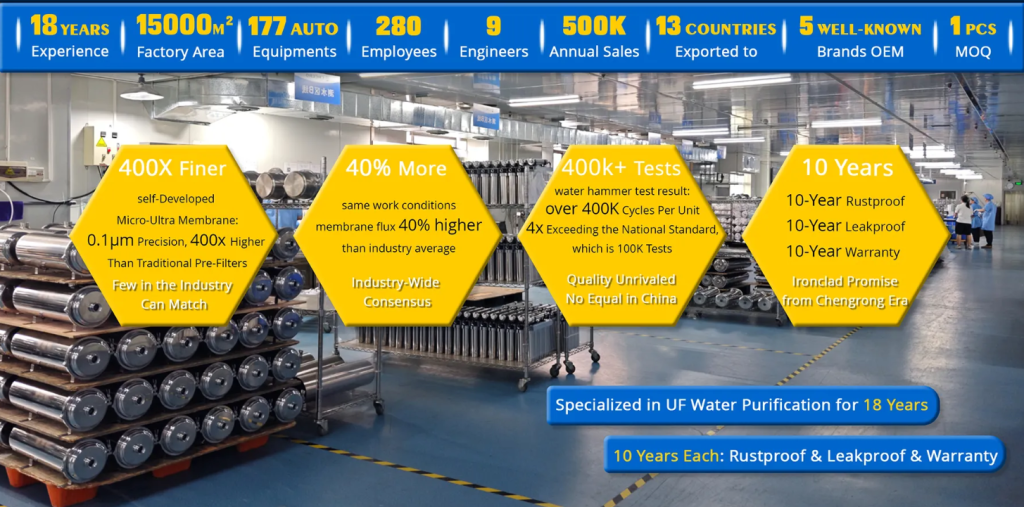
ChengrongTimes specializes in ultrafiltration Water Filter systems, offering whole-house filtration and under-sink drinking water solutions.
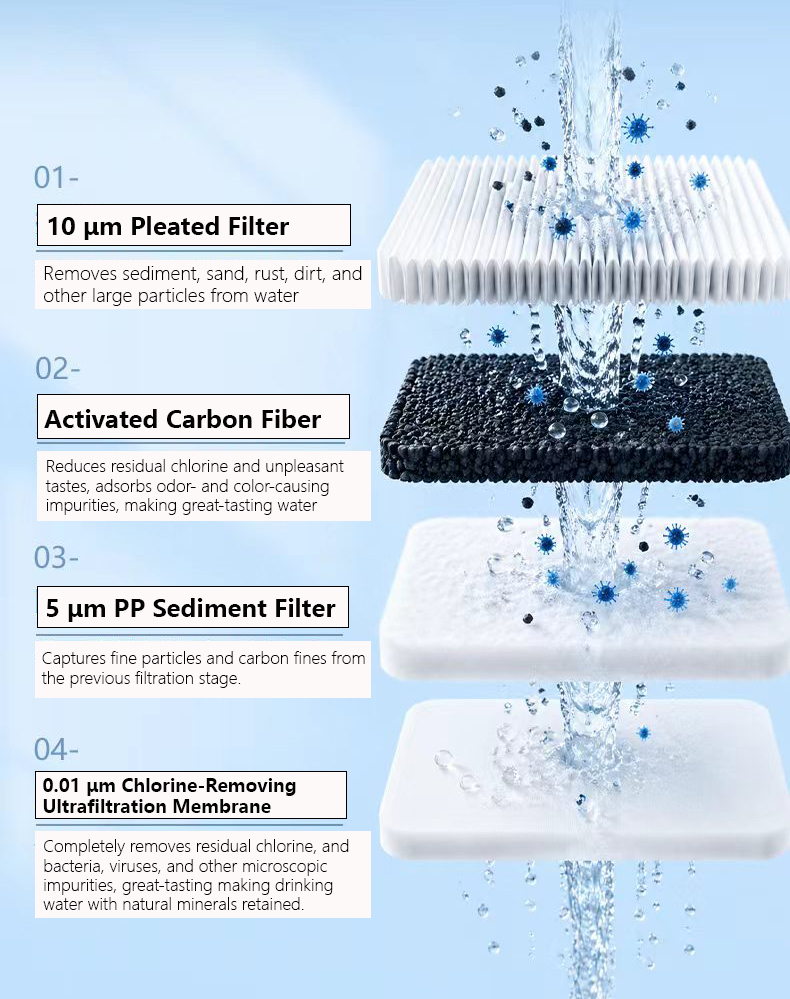
Its main products include a 0.1 μm whole-house ultrafiltration Water Filter designed to reduce suspended impurities, rust, and colloids, and a 0.01 μm under-sink Water Filter designed to filter impurities and residual chlorine while retaining naturally occurring minerals.
With features such as stainless steel housings, reusable ultrafiltration membranes in selected models, and a wastewater-free under-sink design, ChengrongTimes provides alternative filtration solutions for different household needs.