
How Often Should You Replace a Water Filter Cartridge? Do You Still Need to Replace It If You Only Use It a Few Times a Year?
A water filter is only used a few times throughout the year, but the filter cartridge still needs to be replaced, and it costs several hundred yuan each time. Is this reasonable?
Recently, I saw a request for help from a netizen:
The water filter in his hometown is hardly used throughout the year, but he found that the water filter had been locked. After contacting customer service, they told him that the filter cartridge had expired and had to be replaced before he could continue using it. As a result, one filter cartridge cost several hundred yuan. The water filter was hardly used for a whole year, but the cartridge still had to be replaced, which made him feel that it was not worth the money.
This issue actually involves a question that many water filter consumers tend to overlook:
Should the service life of a water filter cartridge be calculated based on “usage time” or “actual filtered water volume”?
The answer is not simply that “the longer the time, the more necessary it is to replace the cartridge,” nor is it that “as long as it is not used, it never needs to be replaced.”
Different filter cartridges have different working principles, raw water quality requirements, actual water consumption, storage conditions, and manufacturer requirements. Therefore, before purchasing a water filter, what consumers really need to understand is the rated service life, applicable water quality, actual water usage, and replacement conditions of the filter cartridge.
If your household uses the water filter only a few dozen days a year, or if the house is left vacant for a long time, this issue is especially worth paying attention to.
1. Why Does a Water Filter Cartridge Need to Be Replaced?
Whether it is an RO reverse osmosis water filter, nanofiltration water filter, or ultrafiltration water filter, the filter cartridges inside are components that require maintenance or replacement.
Common filter cartridges include:
- PP filter cartridge
- Activated carbon filter cartridge
- RO reverse osmosis membrane
- Nanofiltration membrane
- Ultrafiltration membrane
- Composite filter cartridge
Different filter cartridges perform different functions.
For example, PP filters are mainly used to filter larger particles such as sediment and rust. Activated carbon mainly uses adsorption to deal with residual chlorine and odors. RO membranes are used for more precise membrane separation.
Therefore, it cannot simply be assumed that “if the water filter is not used, all filter cartridges will not age.”
Especially after a long period of non-use, whether the inside of the filter cartridge remains wet, whether there is accumulated water in the equipment, the ambient temperature, and the sanitary treatment before and after non-use may all affect the safety of using it again.
This is also why when purchasing a water filter, you should not simply ask:
“How long can this filter cartridge last?”
Instead, you should continue asking:
“Is the service life of this filter cartridge calculated based on time or actual filtered water volume?”
2. Why Do Some Water Filters Prompt Users to Replace the Filter Cartridge When the Time Is Up?
A common problem consumers encounter is that the water filter is used very little, but the machine displays:
“Filter cartridge expired, please replace the filter cartridge.”
Some products even use an electronic system to remind users to replace the filter cartridge after reaching a preset time or water usage.
From the perspective of product maintenance, this design does not necessarily mean that the manufacturer is “tricking consumers.”
Because the service life of a filter cartridge may depend not only on usage volume, but also on filter cartridge materials, raw water quality, storage conditions, sanitary conditions, and the manufacturer’s testing standards.
However, for consumers, one very important question is:
Is the “replacement period” set by the manufacturer the recommended replacement time, or the time when the actual performance of the product reaches its limit?
These two concepts are not exactly the same.
Therefore, when purchasing a water filter, make sure the manufacturer clearly explains the service life of the filter cartridge.
3. What Should Be Used as the Basis for the Service Life of a Filter Cartridge?
Whether you are preparing to purchase an RO reverse osmosis water filter, nanofiltration water filter, or ultrafiltration water filter, it is recommended that you ask clearly how the service life of the filter cartridge is calculated before making a purchase.
Focus on asking three questions:
1. Is the filter cartridge replaced based on time or filtered water volume?
For example:
- 12 months
- 18 months
- 24 months
- 4,000 L
- 8,000 L
- 50,000 L
These numbers do not represent the same thing.
12 months represents a time-based condition, while 4,000 L represents the rated water treatment capacity.
If the manufacturer provides both time and water volume, you should further ask:
Are the two conditions “replace when either one is reached,” or should they be judged comprehensively based on water quality and actual usage?
This is a very important point to confirm when purchasing a water filter.
4. Why Is It Easier to Understand Filter Cartridge Life Based on Actual Filtered Water Volume?
Suppose a water filter cartridge is labeled:
Rated filtered water volume: 4,000 L.
4,000 L is 4 tons of water.
If a household mainly uses the water filter for:
- Direct drinking
- Making coffee
- Making tea
- Preparing beverages
then 4 tons of filtered water may last for a long time.
But if the household also uses the water filter for:
- Washing rice
- Cooking rice
- Stir-frying
- Making sweet soups
- Making soup
- Washing fruits
- Food preparation
the actual water consumption will increase significantly.
The 4,000 L that might originally take a year or even longer to use could be consumed within several months.
Therefore, the service life of a filter cartridge should not be judged only by “how many months it has been used”; actual filtered water volume should also be considered.
5. How Should You Look at “Time Life” and “Water Volume Life” of a Water Filter Cartridge?
You can understand it in a very simple way:
Filter cartridge life ≈ Time condition + Actual processed water volume + Raw water quality + Product design conditions
For example, suppose a manufacturer tells you:
The filter cartridge has a rated filtered water volume of 4,000 L and is recommended to be replaced every 18 months.
At this point, don’t only remember “18 months.”
It is better to continue asking:
Under what raw water conditions was the 4,000 L tested?
Is 18 months a recommended replacement period or a mandatory replacement period?
If only 1,000 L has been used after 18 months, does it still need to be replaced?
If more than 4,000 L has already been used after 8 months, what should be done?
These questions are more important than simply asking, “How much does the filter cartridge cost?”
6. What Happens When the Filtered Water Volume Exceeds the Rated Capacity?
If the filter cartridge has exceeded the rated processing capacity specified by the manufacturer, you cannot simply assume:
“Water can still come out, so the filter cartridge can still be used.”
The filtration performance of a filter cartridge can be affected by usage time, cumulative water volume, raw water pollution load, and the condition of the filter material.
Some water filters with intelligent monitoring functions will provide reminders based on flow rate, cumulative water usage, or filter cartridge status.
Some of ChengrongTimes’ current under-sink water filter products use actual water usage and real-time flow monitoring to assist in determining the filter cartridge condition, rather than relying only on a fixed calendar countdown. Its product page introduces total water usage, real-time flow rate, and filter replacement reminder functions.
For households that use a water filter frequently, this type of design allows users to understand actual usage more intuitively.
7. What Should You Do If the Water Filter Is Only Used a Few Times a Year?
If your household is like the netizen mentioned at the beginning:
The water filter is hardly used throughout the year.
Then before purchasing a water filter, it is recommended that you focus on asking the following questions.
First, should the water supply be turned off when the water filter is not used for a long time?
For example:
- What should I do if I am away for one month?
- What should I do if the house is vacant for half a year?
- What should I do if my hometown house is occupied only a few dozen days a year?
Different water filter products may have different requirements, so you should follow the manufacturer’s instructions and after-sales requirements.
Second, how should the water filter be handled after being unused for a long time?
When using it again, do you need to:
- Flush the filter cartridge
- Drain water for a certain period
- Check the water pipes
- Check the filter cartridge
- Check whether the equipment is functioning abnormally
These questions should be confirmed with the manufacturer in advance.
Third, can the filter cartridge still be used after being unused for a long time?
Do not simply assume:
“It has not been used, so it must be fine.”
Nor should you simply assume:
“A year has passed, so it must definitely be replaced.”
The correct approach is to check the specific product instructions and determine whether replacement or reactivation treatment is required based on the non-use period, storage conditions, filter cartridge type, and manufacturer requirements.
8. Do Activated Carbon and PP Filters Have to Be Original Manufacturer Filter Cartridges?
This is a common question consumers ask when purchasing a water filter.
In the past, some water filtration equipment had relatively simple structures, and PP and activated carbon filter cartridges were relatively standardized. Consumers could find compatible products based on dimensions, interfaces, filtration precision, and other parameters.
However, some water filters today use:
- Special composite filter cartridges
- Special interfaces
- Intelligent identification
- Filter cartridge life identification
- Dedicated electronic modules
Therefore, whether third-party filter cartridges can be used cannot be generalized.
Especially for RO membranes, nanofiltration membranes, ultrafiltration membranes, and filter cartridges with special interfaces or intelligent identification functions, compatibility should be confirmed.
Before purchasing, it is recommended to ask the manufacturer directly:
Are the filter cartridges standard specifications?
Can third-party PP and activated carbon filter cartridges be used?
Are the membrane filter cartridges dedicated specifications?
After replacing the filter cartridge, does the equipment require identification or resetting?
How much do replacement filter cartridges cost later?
These questions may be more important than saving a few hundred yuan when purchasing the equipment.
9. How Can You Avoid Buying a Water Filter With High Filter Cartridge Replacement Costs?
When purchasing a water filter, do not only look at the price of the machine.
The actual cost that should be calculated is:
Equipment price + filter cartridge price + filter cartridge replacement frequency + water consumption + long-term maintenance costs
For example, a water filter may have a low purchase price, but if replacing the filter cartridge every year costs a lot of money, its long-term cost may not necessarily be low.
On the other hand, some equipment may have a higher initial price, but if the filter cartridges have a longer service life, maintenance is more transparent, and the long-term operating cost may be different.
Therefore, before purchasing, it is recommended that you directly ask the manufacturer for:
“A complete filter cartridge replacement cost table.”
It is best to clearly understand the following information for every filter cartridge:
- Model
- Price
- Rated service life
- Rated filtered water volume
- Replacement method
- Whether the original manufacturer’s cartridge is mandatory
- Whether it will be easy to purchase later
Ask all of these questions clearly.
10. Why Consider ChengrongTimes Ultrafiltration Water Filters?
If you do not want your water filter to rely solely on fixed-time replacement reminders, and you want to pay attention to actual water usage, flow rate, filter cartridge life, mineral retention, and long-term maintenance costs, you can learn more about ChengrongTimes’ ultrafiltration water filter products.
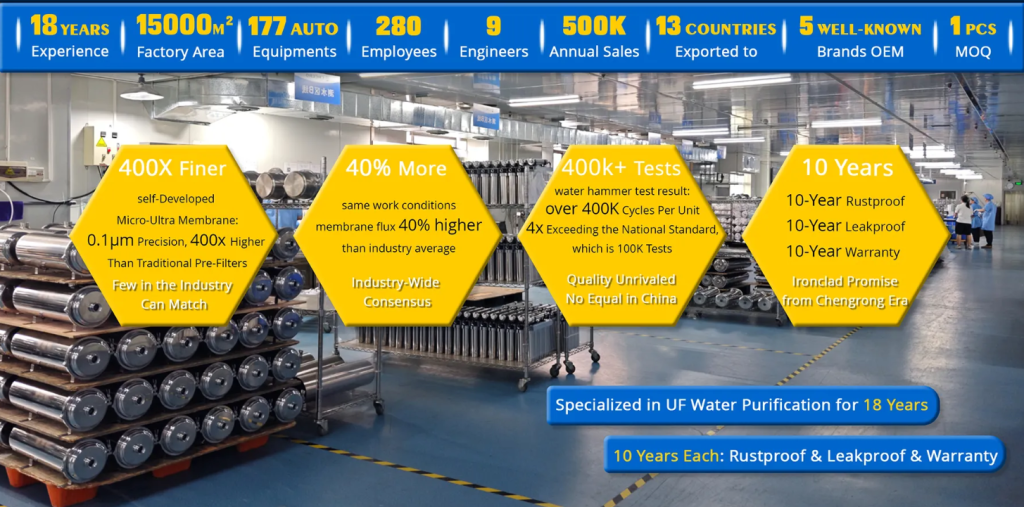
ChengrongTimes currently focuses on ultrafiltration (UF) water filtration technology, stainless steel water filtration equipment, whole-house water filtration, and under-sink water filtration systems. Its official website shows that its whole-house ultrafiltration systems use 0.1μm/0.01μm membrane filtration and provide 316L stainless steel product solutions. The website also introduces its UF membranes, system designs, and complete equipment manufacturing capabilities.
For kitchen drinking water and cooking applications, you can pay particular attention to its 4-in-1 Under Sink Water Filter.
This product uses the following four-stage composite filtration structure:
10μm pleated filter → Activated carbon fiber → 5μm PP filter → 0.01μm dechlorination ultrafiltration membrane
The product page states that the system can reach a maximum flow rate of 660 L/h, uses a 316L stainless steel housing, and features a dual water outlet design.
What is more worth noting is that its filter cartridge management does not simply rely on a fixed calendar countdown.
The product page explains that the system monitors total water usage and real-time flow rate, and uses actual usage conditions to assist in determining filter cartridge status. The manufacturer gives a maximum filter cartridge service period of approximately one year and lists a rated processing capacity of approximately 100,000 L for the activated carbon fiber. The actual service life should still be determined based on actual water quality, water usage, and the manufacturer’s specified operating conditions.
This is particularly worth considering for households that use their water filter only a few times a year.
11. What Are the Features of the ChengrongTimes Under-Sink Water Filter?
From the product design perspective, you can focus on the following aspects:
1. 0.01μm Ultrafiltration Membrane
The product uses a 0.01μm ultrafiltration membrane as the final filtration stage.
2. 4-in-1 Composite Filter Cartridge
It integrates:
10μm filtration + activated carbon fiber + 5μm PP filtration + 0.01μm UF
into one composite filter cartridge.
3. Retention of Natural Minerals
UF and RO work differently.
Ultrafiltration is not primarily designed to remove dissolved substances in the same way as RO reverse osmosis.
ChengrongTimes’ product positioning is based on UF technology rather than RO desalination, and it emphasizes retaining naturally occurring minerals in the water.
4. High-Flow Design
The manufacturer’s stated maximum flow rate is:
660 L/h
Actual household flow rate will be affected by water pressure, piping, filter cartridge condition, and other factors.
5. 316L Stainless Steel Housing
The product uses a 316L stainless steel housing and specifies a 10-year rust-proof and leak-proof warranty. Specific warranty conditions should be subject to the manufacturer’s official terms.
6. Dual Water Outlet Design
The product is designed with different water outlet paths for drinking water, cooking, and other kitchen water applications.
7. No RO Wastewater
Because the product uses UF technology instead of RO reverse osmosis, it does not have the concentrate discharge method used by traditional RO systems. The official website positions it as a zero-wastewater design.
12. Ask These 10 Questions Before Buying a Water Filter
If you are preparing to buy a water filter, you can save this checklist.
1. What is the filter cartridge service life?
2. Is the filter cartridge life calculated based on time or filtered water volume?
3. What is the rated filtered water volume?
4. What should I do with the filter cartridge if the water filter is not used for a long time?
5. How long should the water be flushed after long-term non-use before using it again?
6. Are the PP and activated carbon filters standard specifications?
7. Are the RO membrane, nanofiltration membrane, or UF membrane dedicated filter cartridges?
8. How much does it cost to replace the complete set of filter cartridges?
9. Can the filter cartridges be purchased easily for a long time in the future?
10. When the filter cartridge expires, does the system only remind users to replace it, or will the equipment stop working?
If the seller cannot clearly answer these questions, you should carefully consider the purchase before making a decision.
FAQ: How Often Should You Replace a Water Filter Cartridge?
1. Does a water filter cartridge have to be replaced once a year?
Not necessarily.
The specific replacement time depends on the filter cartridge type, manufacturer requirements, raw water quality, actual water usage, and the rated processing capacity of the filter cartridge.
Some products use time-based management, while others consider both cumulative filtered water volume and time.
2. If a water filter is only used a few times a year, does the filter cartridge still need to be replaced?
It cannot be determined based only on the number of times it is used.
After long-term non-use, you need to determine whether replacement or flushing is necessary based on the specific filter cartridge type, non-use period, storage conditions, and manufacturer’s instructions.
3. Should a water filter cartridge be replaced based on time or water volume?
Both methods exist.
When purchasing, you should ask the manufacturer:
“What are the conditions for time and filtered water volume respectively? Which condition means that the cartridge needs to be replaced?”
If the product can monitor actual water usage, consumers can understand actual usage conditions more intuitively.
4. What does 4,000 L of filtered water mean?
4,000 L is 4 tons of water.
For example, if a filter cartridge has a rated filtered water volume of 4,000 L, it theoretically means that under the testing conditions specified by the manufacturer, it can process approximately 4,000 L of water.
However, actual service life will also be affected by raw water quality, usage methods, and other conditions.
5. What is the difference between RO membranes, ultrafiltration membranes, and activated carbon filter cartridges?
Simply speaking:
PP filter: Mainly used for larger particle filtration.
Activated carbon: Mainly uses adsorption to deal with residual chlorine, odors, and other substances.
Ultrafiltration membrane (UF): Mainly performs finer membrane filtration.
RO membrane: A membrane separation technology with a higher rejection capability, which can reduce various substances, including some dissolved substances.
Different technologies do not have an “absolutely best” option regardless of the application. They should be selected according to raw water quality and actual water filtration needs.
6. Does an ultrafiltration water filter remove minerals?
UF and RO work differently.
Ultrafiltration mainly filters suspended solids, colloids, and some microorganisms, and unlike RO, it is not primarily intended to reduce dissolved substances.
ChengrongTimes’ under-sink product uses a 0.01μm UF ultrafiltration membrane and highlights the retention of naturally occurring minerals as one of its product design features.
7. Does a water filter always produce wastewater?
Not necessarily.
RO systems generally produce concentrate wastewater, while UF ultrafiltration systems can use different system designs.
ChengrongTimes’ current under-sink UF product uses a zero-RO-wastewater design, so it does not require the wastewater discharge connection used by traditional RO systems.
8. What type of household is an under-sink water filter suitable for?
If the main needs are:
- Drinking water
- Cooking
- Making soup
- Coffee
- Tea
- Food preparation
then an under-sink water filter can be used as a point-of-use water filtration solution.
If you want the entire household’s showering, laundry, kitchen, and other water to be treated, you should consider a whole-house water filtration system.
9. Does ChengrongTimes offer whole-house water filtration systems?
Yes.
ChengrongTimes’ official website currently showcases whole-house ultrafiltration water filtration systems and introduces features including 0.1μm/0.01μm UF membrane filtration, 316L stainless steel, and washable membrane filters.
10. What should you look at most when buying a water filter?
Do not only look at the brand, price, or number of filter cartridges.
More importantly, consider:
Raw water quality → Filtration technology → Target contaminants → Rated filtered water volume → Flow rate → Filter cartridge life → Replacement cost → After-sales service and filter cartridge supply.
Only by considering these factors together can you determine whether a water filter is suitable for your household.
Finally: What You Really Need to Pay Attention to Is Not Just “How Much Does the Filter Cartridge Cost?”
Going back to the question at the beginning:
Why does a water filter need to have its filter cartridge replaced even if it is only used a few times a year?
The real issue is not simply saying that “the manufacturer is using sales tricks,” nor is it correct to assume that “an unused filter cartridge will never need to be replaced.”
A more reasonable way to judge is:
First look at the filter cartridge type, then look at the manufacturer’s requirements; first look at the rated filtered water volume, then look at actual water usage; and at the same time consider raw water quality, non-use period, filter cartridge storage conditions, and the product’s maintenance requirements.
Especially when purchasing a water filter, don’t just ask:
“How much does this water filter cost?”
You should also ask:
“How much does the filter cartridge cost?”
“How many liters of water can one set of filter cartridges process?”
“Is replacement based on time or water volume?”
“What should I do if I cannot use it more than a few times a year?”
“How should I reactivate it after long-term non-use?”
If you want to choose a product that focuses on ultrafiltration technology, retention of natural minerals, actual water usage monitoring, high flow rate, and relatively low maintenance complexity, you can learn more about the ChengrongTimes Under-Sink Ultrafiltration Water Filter and its whole-house ultrafiltration water filtration systems. Its official website currently provides detailed product specifications and technical information.