
Looking for a kitchen water filter? ChengrongTimes offers a high-flow kitchen sink water filter and Kitchen Water Purifier with 0.01μm UF, 4-in-1 filtration and zero wastewater.
Kitchen Sink Water Filter: Complete Guide to Choosing a Kitchen Water Filter and Kitchen Water Purifier
When people search for a kitchen sink water filter, kitchen water filter, or Kitchen Water Purifier, they are usually looking for more than a simple filter cartridge. They want to know what a kitchen water filter actually removes, which filtration technology is appropriate for drinking and cooking, whether an under-sink system is better than a countertop filter, how often the cartridge should be replaced, whether natural minerals are retained, and how to choose a reliable water purification system.
The right kitchen sink water filter should therefore be selected according to water quality, filtration technology, flow rate, installation location, maintenance requirements, and the specific contaminants that need to be reduced.
The U.S. Centers for Disease Control and Prevention (CDC) recommends testing water and choosing a home water filter according to the germs or chemicals that need to be removed. CDC also explains that different filtration technologies have different capabilities, meaning that there is no single kitchen water filter that is automatically the best choice for every household.
For homeowners who primarily need filtered water for drinking, cooking, preparing food, and making beverages, an under-sink kitchen sink water filter can provide a practical point-of-use solution.
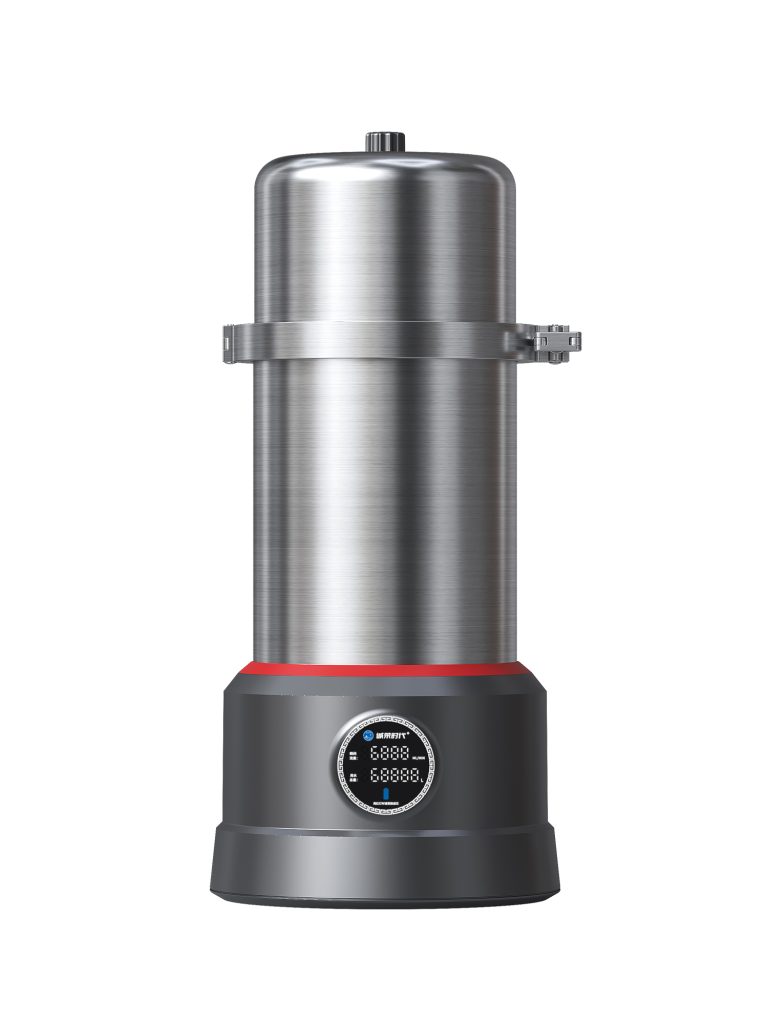
This is exactly the application addressed by the ChengrongTimes under-sink water filtration system.
What Is a Kitchen Sink Water Filter?
A kitchen sink water filter is a point-of-use water filtration system installed at or beneath a kitchen sink. Instead of treating every drop of water entering the entire house, the system focuses filtration on water used at the kitchen.
A kitchen water filter can be particularly useful when the main concern is drinking and cooking water rather than whole-house water treatment.
CDC classifies under-sink systems as point-of-use treatment systems because they deliver treated water to a specific tap, such as a kitchen sink. Whole-home systems, by contrast, treat water entering the entire house.
This distinction is important.
A whole-house filtration system and a kitchen sink water filter are not necessarily competing products. They can perform different jobs.
A whole-house system can address water quality throughout the plumbing system, while a kitchen water filter can provide an additional filtration stage specifically for drinking and cooking.
For many homes, this makes the kitchen an important location for advanced filtration.
Why Do You Need a Kitchen Water Filter?
Tap water may already meet local drinking-water requirements, but homeowners can still have reasons to install a kitchen water filter.
Common reasons include:
- Reducing unpleasant chlorine taste or odor
- Reducing sediment and rust particles
- Improving the taste of drinking water
- Providing additional filtration for drinking and cooking
- Reducing certain microorganisms when the filtration technology is designed and tested for that purpose
- Creating a dedicated source of filtered water in the kitchen
- Improving convenience compared with repeatedly purchasing bottled water
However, a kitchen water filter should not be selected simply because the specification sheet contains a very small micron number.
Water filtration is more complicated than comparing one number with another.
CDC explains that filtration performance depends on factors including pore size, the size and characteristics of the substance being removed, and the specific technology used by the filter.
Therefore, a high-quality Kitchen Water Purifier should be evaluated as a complete system rather than as a single membrane.
Kitchen Water Filter vs. Kitchen Water Purifier
The terms kitchen water filter and Kitchen Water Purifier are often used interchangeably in online searches, but they can describe systems with different levels of treatment.
A basic kitchen water filter may primarily improve taste, odor, and appearance.
A more advanced Kitchen Water Purifier can combine several filtration technologies to address particles, chlorine, microorganisms, and other unwanted substances.
For example, activated carbon is commonly used to improve taste and odor, while microfiltration, ultrafiltration, nanofiltration, and reverse osmosis provide different levels and types of filtration. CDC notes that different technologies remove different categories of contaminants.
This means consumers should not choose a Kitchen Water Purifier based only on marketing language.
Instead, ask:
- What is the source water?
- What contaminants are actually present?
- What filtration technology is being used?
- What is the pore size?
- What does the product testing demonstrate?
- What is the flow rate?
- How often does the cartridge need replacement?
- Does the system create wastewater?
- Does the system retain naturally occurring minerals?
- Is the system suitable for drinking and cooking?
These questions provide a much more useful framework for evaluating a kitchen sink water filter.
How Does a Kitchen Sink Water Filter Work?
A modern kitchen sink water filter can use several filtration stages rather than relying on one filter medium.
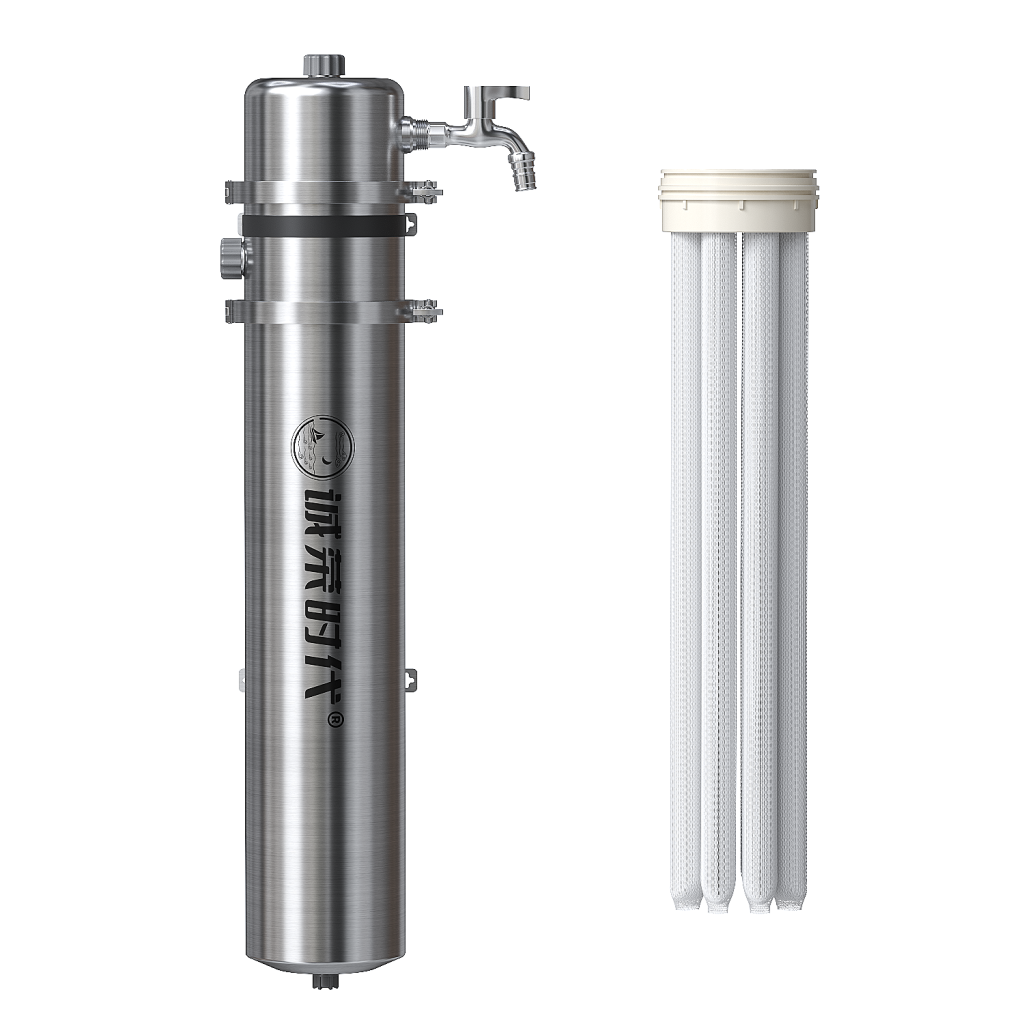
ChengrongTimes uses a 4-in-1 composite cartridge in its under-sink system:
10 μm pleated sediment filter → activated carbon fiber → 5 μm PP filter → 0.01 μm chlorine-removing ultrafiltration membrane.
Each stage has a different role.
Stage 1: 10 μm Pleated Sediment Filtration
The first stage is designed to capture relatively large particles such as:
- Sediment
- Sand
- Rust
- Dirt
- Other larger suspended particles
This first filtration stage helps protect the downstream filtration media.
A good kitchen water filter should not force the most delicate filtration membrane to handle all incoming particles. Progressive filtration can reduce the loading placed on the final membrane.
Stage 2: Activated Carbon Fiber
Activated carbon is widely used in drinking-water filtration because it can reduce substances associated with taste and odor.
In the ChengrongTimes system, activated carbon fiber is positioned before the final ultrafiltration membrane. The official product specification states that this stage reduces residual chlorine and unpleasant taste and odor while adsorbing certain unwanted substances.
This arrangement is important because carbon is being used for adsorption while the final membrane provides an additional filtration barrier.
Stage 3: 5 μm PP Filtration
The third stage uses a 5 μm PP sediment filter.
Its purpose is to capture finer particles and carbon fines before the water reaches the final ultrafiltration membrane.
This creates a progressive filtration structure:
large particles → adsorption → fine particles → ultrafiltration
For a kitchen sink water filter, this type of staged design can make more engineering sense than expecting one filter medium to perform every function.
Stage 4: 0.01 μm Ultrafiltration Membrane
The final stage uses a 0.01 μm chlorine-removing ultrafiltration membrane.
CDC identifies ultrafiltration as a filtration technology generally associated with a pore size around 0.01 micron, while noting that actual pore size can vary between products. CDC also explains that ultrafiltration can remove parasites and bacteria, while its effectiveness against viruses depends on the specific system.
The ChengrongTimes product page specifies a 0.01 μm ultrafiltration membrane as the final stage and describes filtration of fine sediment, rust, colloids, parasite eggs, bacteria, viruses and residual chlorine.
For customers researching a Kitchen Water Purifier, this final-stage filtration is one of the most important technical specifications to examine.

Why Does the Filtration Sequence Matter?
Many people compare a kitchen water filter simply by looking at how many filtration stages it has.
That is not enough.
The order of filtration stages matters.
ChengrongTimes places activated carbon fiber before the final 0.01 μm ultrafiltration membrane. According to the manufacturer’s design, this allows the final membrane to act as an additional barrier after the activated carbon stage.
This is one of the more interesting design characteristics of the ChengrongTimes kitchen sink water filter.
The filtration path is:
Sediment → Carbon → Fine sediment → Ultrafiltration → Drinking water
Rather than:
Ultrafiltration → Carbon → Drinking water
The design objective is to avoid placing activated carbon after the final membrane, where carbon fines or biological growth associated with the carbon stage could potentially become a post-filtration concern.
The final ultrafiltration membrane therefore functions as the last filtration barrier before the treated water reaches the drinking-water outlet.
Does a Kitchen Water Filter Remove Natural Minerals?
This is an important question for consumers comparing ultrafiltration with reverse osmosis.
A Kitchen Water Purifier does not necessarily need to remove dissolved minerals.
Reverse osmosis is a different treatment technology. NSF explains that NSF/ANSI 58 covers reverse-osmosis drinking-water treatment systems and includes requirements related to TDS reduction, contaminant reduction, efficiency, recovery, structural integrity, and materials safety.
CDC also explains that reverse osmosis can remove a range of dissolved substances, depending on the system and its certified claims.
ChengrongTimes takes a different approach with its under-sink kitchen water filter.
The ChengrongTimes system is designed around ultrafiltration rather than RO demineralization. According to the manufacturer’s specification, the system retains naturally occurring minerals while providing filtration through the 0.01 μm UF membrane.
For consumers who want filtered drinking water without an RO process designed to reduce dissolved solids, this can be an important consideration.
Kitchen Water Filter With High Flow Rate
Flow rate is often overlooked when choosing a kitchen sink water filter.
A filter can have excellent theoretical filtration performance but still become frustrating to use if the water comes out too slowly.
This is especially important in a kitchen because one filtered water source may be used for:
- Drinking
- Cooking
- Making coffee
- Making tea
- Preparing baby food
- Filling cooking pots
- Washing certain foods
- Preparing soups and beverages
ChengrongTimes specifies a flow rate of up to 660 L/h for its under-sink system.
That is approximately 11 L/min under the manufacturer’s stated conditions.
A high-flow kitchen water filter can therefore provide a different user experience from low-flow drinking-water systems that require users to wait for a glass or container to fill.
However, actual household flow will depend on water pressure, installation conditions, filter loading and other factors.
Dual-Outlet Kitchen Water Filter Design
Another distinctive feature of the ChengrongTimes system is its dual-water-outlet design.
One outlet provides the full 4-stage filtration path for drinking and cooking.
The second outlet provides a 3-stage filtration path for tasks such as washing food and dishes.
This creates a practical distinction between different kitchen water uses.
Not every kitchen task requires the same level of filtration.
For example, drinking water and cooking water may receive the complete filtration process, while washing vegetables or dishes can use the alternative outlet.
The result is a more flexible kitchen sink water filter rather than a system designed around a single use case.
Does a Kitchen Water Filter Waste Water?
Wastewater is another important difference between filtration technologies.
Reverse osmosis systems can produce a reject-water stream because the RO process separates water from dissolved substances. NSF’s description of NSF/ANSI 58 includes efficiency and recovery requirements specifically because these characteristics are important parts of RO system performance.
The ChengrongTimes under-sink kitchen water filter is designed without an RO membrane and does not require a wastewater drain connection. The manufacturer describes the system as a zero-wastewater filtration design.
This provides two practical advantages:
First, every drop of incoming water can be used rather than sending a portion to a drain.
Second, the system does not require the traditional RO wastewater drain connection.
For kitchen renovation projects, this can simplify installation.
Why Does No Drain Connection Matter?
A traditional RO installation commonly involves a drain connection for reject water.
The ChengrongTimes Kitchen Water Purifier does not require this type of wastewater drain connection because it is based on ultrafiltration rather than RO.
The manufacturer also positions the no-drain design as a way to reduce the risk associated with potential bacterial back-contamination from drain plumbing.
This is particularly relevant for customers looking for a clean under-sink installation without adding another drain line.
316L Stainless Steel Housing for a Kitchen Water Filter
The filtration cartridge is only one part of a kitchen sink water filter.
The housing that holds the filtration system also matters.
ChengrongTimes uses 316L stainless steel for the main housing.
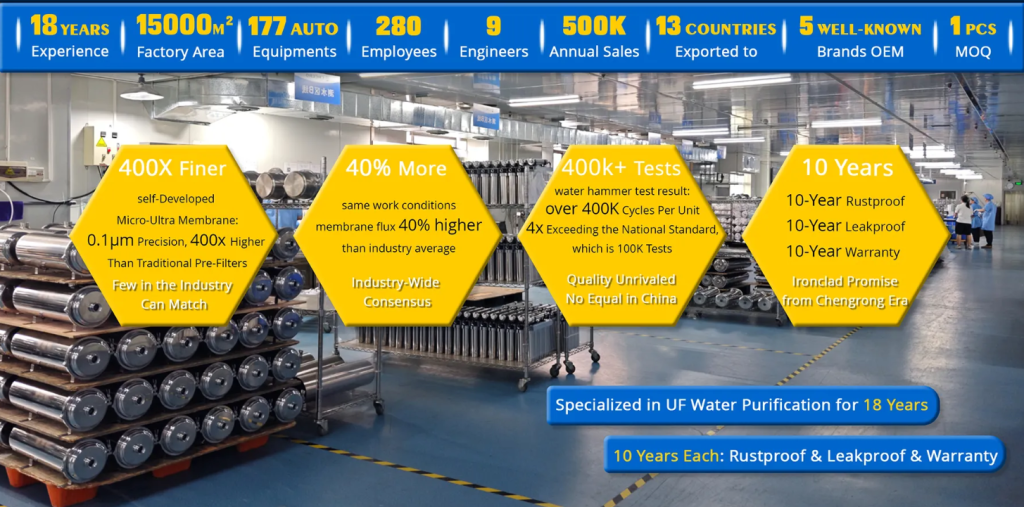
According to the product specification, the housing body is 1.45 mm thick and the lid is 1.80 mm thick. The manufacturer also specifies a 10-year warranty against rust and leakage.
316L stainless steel is known for its corrosion resistance, particularly because of its molybdenum content.
For a water filtration system installed under a kitchen sink, material durability is important because the housing remains in contact with water over a long service period.
ChengrongTimes also states that its stainless-steel housings undergo internal and external polishing and high-temperature ultrasonic cleaning before use.
These manufacturing details are not usually visible after installation, but they are part of the overall engineering quality of a Kitchen Water Purifier.
How Long Does a Kitchen Water Filter Cartridge Last?
A filter cartridge does not last forever.
Every kitchen water filter requires maintenance and eventual cartridge replacement.
CDC specifically recommends regular filter maintenance and replacement according to the manufacturer’s recommendations because proper maintenance helps keep the system functioning correctly and reduces the potential for microbial growth inside the filter.
ChengrongTimes specifies up to approximately one year of cartridge service life and uses water usage and flow information rather than relying only on a simple calendar countdown.
The system monitors:
- Total water usage
- Real-time flow rate
- Filter loading conditions
According to the manufacturer’s specifications, the activated carbon fiber reaches its stated saturation point at approximately 100,000 liters of total water usage, at which point the filter indicator changes from blue to red to signal replacement.
This approach can be more meaningful than simply telling every household to replace the cartridge after exactly 12 months.
A household that consumes less filtered water may have different cartridge usage from a large family using filtered water throughout the day.
How to Choose the Best Kitchen Sink Water Filter
There is no universal answer to the question “What is the best kitchen water filter?”
The best system depends on the water source and the specific treatment objective.
CDC recommends testing water and selecting filtration based on the contaminants of concern.
Use the following checklist when evaluating a Kitchen Water Purifier.
1. Check Your Water Source
Is your water supplied by:
- A municipal water system?
- A tested private well?
- Rainwater?
- Another source?
ChengrongTimes specifies its under-sink system for municipal water and tested potable well water.
If the source water is unknown or contaminated, do not assume that a standard kitchen filter is sufficient.
2. Identify the Contaminants
Do not choose a kitchen water filter based only on appearance.
CDC specifically warns that taste, smell, and appearance are not reliable indicators of whether water is safe.
If you use municipal water, review your local water-quality report.
If you use a private well, regular water testing is especially important.
3. Look at the Actual Filtration Technology
Ask whether the system uses:
- Sediment filtration
- Activated carbon
- Microfiltration
- Ultrafiltration
- Nanofiltration
- Reverse osmosis
- UV treatment
- A combination of technologies
Different technologies solve different problems.
A Kitchen Water Purifier should be selected based on actual performance rather than the number of stages printed on the box.
4. Check the Pore Size
Micron ratings can help explain filtration performance, but consumers need to understand whether the rating is nominal or absolute.
CDC explains the difference between absolute and mean/nominal pore sizes. A filter with an absolute pore size of 1 micron means the pores are 1 micron or smaller, while a mean pore size does not guarantee that every pore is that size or smaller.
Therefore, when comparing a kitchen sink water filter, do not look at the micron number alone.
5. Check Independent Testing and Certification
Independent testing is an important part of evaluating water filtration equipment.
CDC recommends looking for NSF certification and checking the specific claims associated with the certification.
NSF/ANSI standards cover different aspects of water treatment. For example, NSF/ANSI 42 relates to aesthetic effects such as taste and odor, while NSF/ANSI 53 addresses health-effect claims for certified drinking-water treatment units. NSF/ANSI 58 applies to reverse-osmosis systems.
Importantly, a standard number by itself does not mean that a product removes every contaminant.
Consumers should always verify the exact certified claim.
6. Compare Flow Rate
For a busy kitchen, flow rate matters.
A kitchen water filter that produces clean water but fills a cooking pot extremely slowly may not be convenient for everyday use.
ChengrongTimes specifies up to 660 L/h for its under-sink filtration system.
7. Check Whether the System Produces Wastewater
If water efficiency is important, compare filtration technologies carefully.
An ultrafiltration-based Kitchen Water Purifier can offer a different operating model from an RO system because it does not require RO reject water.
The ChengrongTimes system is designed as a zero-wastewater under-sink filtration system.
Why Choose ChengrongTimes for a Kitchen Water Filter?
ChengrongTimes focuses on ultrafiltration water treatment rather than treating a kitchen water filter as a simple commodity product.
Its under-sink system combines several technologies in one filtration cartridge:
10 μm pleated filter + activated carbon fiber + 5 μm PP filter + 0.01 μm chlorine-removing UF membrane.
The product is designed around several practical objectives:
Natural mineral retention
The ChengrongTimes system uses ultrafiltration rather than RO demineralization and is designed to retain naturally occurring minerals.
High flow
The manufacturer specifies up to 660 L/h filtration capacity.
Four-stage filtration
The composite cartridge combines sediment filtration, activated carbon adsorption, fine particle filtration and ultrafiltration.
Dual outlet
The system provides different filtration paths for drinking/cooking and other kitchen applications.
Zero wastewater
The system does not require an RO wastewater drain connection.
316L stainless steel
The housing is constructed from 316L stainless steel and is specified with a 10-year rust and leakage warranty.
Usage-based filter monitoring
The system monitors water usage and flow conditions to help determine when the cartridge should be replaced.
Kitchen Sink Water Filter for Drinking and Cooking
The kitchen is one of the most important locations for water filtration because drinking and cooking involve direct consumption.
A kitchen sink water filter can provide filtered water for:
- Drinking
- Cooking
- Soup
- Coffee
- Tea
- Baby food preparation
- Food preparation
- Ice making
- Other kitchen applications
This is why point-of-use filtration can be an efficient strategy.
Instead of treating every gallon of water entering the house, the household can focus advanced filtration on the water that is actually consumed.
CDC similarly identifies point-of-use systems such as under-sink filters as an option when the primary objective is filtering water used for drinking and cooking.
Kitchen Water Filter vs. Whole-House Water Filter
A common mistake is assuming that a kitchen water filter and whole-house water filter perform the same job.
They do not.
| Feature | Kitchen Sink Water Filter | Whole-House Water Filter |
|---|---|---|
| Installation | Under kitchen sink | Main incoming water line |
| Primary purpose | Drinking and cooking | Household-wide water |
| Treatment location | Point of use | Point of entry |
| Main target | Kitchen drinking water | Water throughout the house |
| Typical water use | Drinking, cooking, food preparation | Bathing, laundry, kitchen, appliances |
| Water volume | Lower | Much higher |
| ChengrongTimes application | Under-sink UF | Whole-house UF |
CDC defines point-of-use systems as systems that treat water delivered to a specific tap, while point-of-entry systems treat water as it enters the home.
For many households, the most complete approach may be to combine whole-house filtration with a dedicated kitchen sink water filter.
Is a Kitchen Water Purifier Better Than a Water Filter?
The answer depends on what “better” means.
If your goal is primarily taste improvement, a basic carbon kitchen water filter may be enough.
If you need filtration of microorganisms, a system using an appropriate membrane technology may be more suitable.
If you need significant reduction of dissolved substances such as certain salts, metals or other chemicals, reverse osmosis may be appropriate depending on the specific contaminant and certified claim.
CDC emphasizes that different systems remove different contaminants, and consumers should select treatment based on water testing and the specific substances of concern.
Therefore, the right question is not:
“Which Kitchen Water Purifier is the most powerful?”
The better question is:
“Which Kitchen Water Purifier is appropriate for my water and my actual household needs?”
Frequently Asked Questions About Kitchen Water Filters
What is the best kitchen sink water filter?
The best kitchen sink water filter depends on your water source, contaminants, required flow rate, installation space and filtration objectives.
For consumers looking for high-flow ultrafiltration, natural mineral retention and no RO wastewater, the ChengrongTimes under-sink system is one option worth evaluating.
What does a kitchen water filter remove?
It depends on the technology.
Activated carbon can improve taste and odor and reduce certain substances. Ultrafiltration can remove many particles and microorganisms depending on the membrane and product design. Reverse osmosis can reduce a broader range of dissolved substances.
Always check the manufacturer’s specific performance claims and independent testing.
Does a kitchen water filter remove bacteria?
Some filtration technologies can reduce bacteria.
CDC states that ultrafiltration can remove bacteria, while actual performance depends on the specific filter.
The ChengrongTimes system uses a 0.01 μm ultrafiltration membrane as its final filtration stage.
Does a kitchen water filter remove viruses?
Not every kitchen filter removes viruses.
CDC notes that ultrafiltration can be somewhat effective against viruses, while nanofiltration and reverse osmosis provide different levels of virus treatment.
Consumers should therefore verify the specific product’s tested claims rather than assuming that every “0.01 μm” filter performs identically.
Does a Kitchen Water Purifier remove minerals?
Not necessarily.
Ultrafiltration generally does not function like RO for dissolved mineral removal.
The ChengrongTimes under-sink system is specifically designed to retain naturally occurring minerals rather than using RO demineralization.
Does a kitchen water filter waste water?
Some technologies, especially RO, can produce reject water.
The ChengrongTimes under-sink UF system is designed without an RO wastewater stream and does not require a drain connection.
How often should I replace my kitchen water filter?
The replacement interval depends on water quality, water consumption and the filter’s rated capacity.
CDC recommends following the manufacturer’s maintenance and replacement instructions.
ChengrongTimes specifies up to one year of cartridge service life and uses water usage and flow information to support replacement decisions.
Is an under-sink kitchen water filter better than a countertop filter?
It depends on the household.
An under-sink kitchen water filter keeps the filtration equipment below the counter and can provide a dedicated filtered-water outlet without occupying valuable countertop space.
For kitchens where appearance, continuous access and higher flow are important, an under-sink design can be particularly attractive.
Should I choose RO or ultrafiltration?
Neither technology is universally better.
RO is appropriate when the objective includes reducing dissolved substances and TDS, and NSF/ANSI 58 specifically covers RO systems and their performance requirements.
Ultrafiltration can be more appropriate when the goal is particulate and microorganism filtration while retaining dissolved minerals.
The correct choice depends on the water source and treatment objective.
A Practical Buying Checklist for a Kitchen Water Filter
Before buying a kitchen sink water filter, confirm the following:
Water source:
Municipal water, tested well water or another source?
Target contaminants:
Sediment, chlorine, bacteria, viruses, lead, dissolved solids or something else?
Filtration technology:
Carbon, UF, NF, RO or a combination?
Pore size:
What is the actual membrane pore size, and is the rating absolute or nominal?
Flow rate:
Can the system supply enough water for normal kitchen use?
Water efficiency:
Does the system produce wastewater?
Mineral retention:
Does the filtration technology retain naturally occurring minerals?
Filter life:
How is replacement determined?
Materials:
What material is used for the water-contact housing?
Testing:
Are the performance and material claims independently tested?
Installation:
Does the system require a drain connection, power supply or major plumbing modification?
After-sales support:
Can replacement cartridges be obtained easily?
This checklist is much more useful than simply searching for the phrase “best Kitchen Water Purifier” and choosing the product with the longest list of marketing claims.
ChengrongTimes: A High-Flow Mineral-Retaining Kitchen Water Filter
For customers specifically looking for a kitchen sink water filter that combines high flow, multi-stage filtration, mineral retention and a zero-wastewater design, ChengrongTimes offers an under-sink system built around a 4-in-1 composite cartridge.
The system combines:
10 μm sediment filtration
→ Activated carbon fiber
→ 5 μm PP filtration
→ 0.01 μm chlorine-removing ultrafiltration
The manufacturer specifies up to 660 L/h flow, dual water outlets, 316L stainless-steel housing, usage-based filter monitoring, and no RO wastewater connection.
For consumers who want a kitchen water filter primarily for drinking and cooking, this configuration provides an alternative to conventional RO-based systems.
More importantly, customers can evaluate the system according to measurable factors rather than relying only on the general term Kitchen Water Purifier.
Final Thoughts
Choosing a kitchen sink water filter should begin with water quality, not marketing.
A good kitchen water filter needs to match the water source, target contaminants, household water consumption, required flow rate and desired filtration technology.
A Kitchen Water Purifier should also be evaluated according to actual filtration stages, membrane specifications, independent testing, maintenance requirements, material quality and long-term operating cost.
For households that want a point-of-use system for drinking and cooking, ChengrongTimes provides an under-sink ultrafiltration solution built around a 4-in-1 composite cartridge, 0.01 μm UF membrane, high-flow filtration, natural mineral retention, dual outlets, zero wastewater and 316L stainless-steel construction.
At the same time, authoritative guidance from the CDC makes an important point: no water filter should be selected simply because it sounds powerful. Consumers should understand their water quality and choose a system according to the specific contaminants and treatment objectives.
If your goal is clean, great-tasting water directly from the kitchen while retaining naturally occurring minerals and avoiding RO wastewater, a ChengrongTimes kitchen sink water filter is worth considering.
Learn more about the ChengrongTimes Under-Sink Water Filter with Natural Minerals Retained:
https://www.chengrongtimes.com/?p=84
Authoritative References
- U.S. Centers for Disease Control and Prevention — guidance on choosing home water filters and understanding filtration technologies.
- U.S. Centers for Disease Control and Prevention — home water treatment systems and filtration technology.
- U.S. Environmental Protection Agency — water filter selection, installation and maintenance education resources.
- NSF International — NSF/ANSI 58 requirements for reverse osmosis drinking-water treatment systems.
- ChengrongTimes — official under-sink water filter product specifications and filtration design.