
Summary
Ordinary PVC ultrafiltration membranes mainly rely on physical pore-size separation. They are effective at removing sediment, colloids, bacteria and other suspended impurities, but they cannot reliably remove dissolved free chlorine through a 0.01 μm pore structure alone.
ChengrongTimes chlorine-removing PVC ultrafiltration membrane, which is used in our under sink water filter with natural mineral retained, follows a different technical route.
A functional component is incorporated throughout the membrane matrix during membrane formation, rather than being applied afterward as a separate surface coating.
In addition to providing 0.01 μm physical filtration, the functional component reacts with residual chlorine in water through a redox process. In simplified terms, oxidizing chlorine species are converted into stable chloride ions.
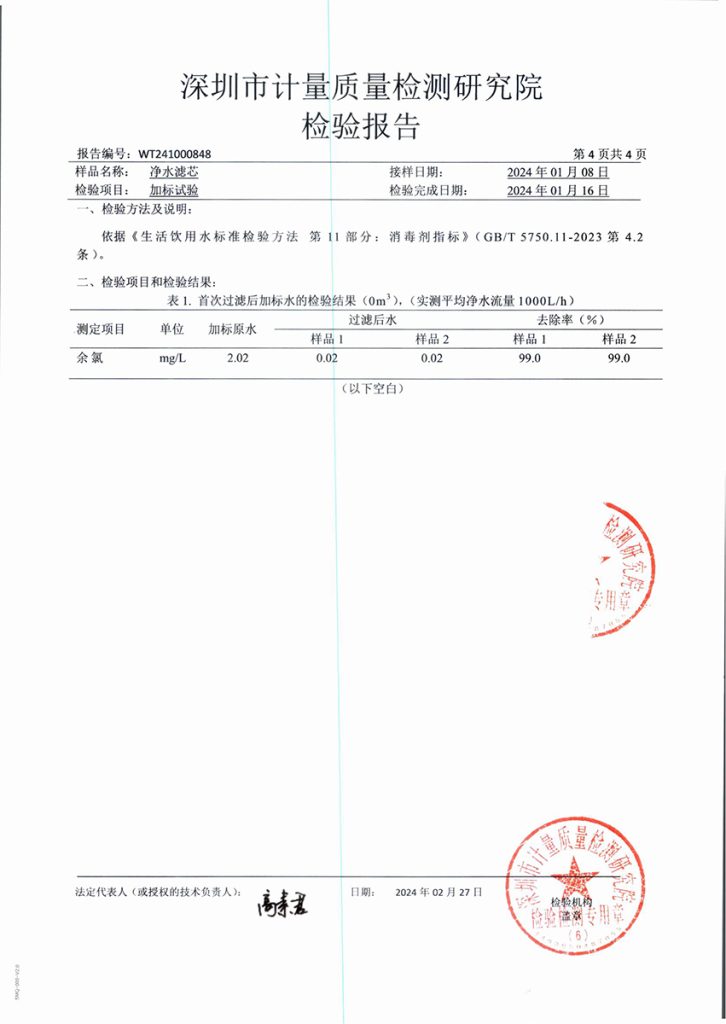
According to a third-party test conducted by the Shenzhen Academy of Metrology & Quality Inspection (SMQ), the tested membrane achieved a 99% residual chlorine removal rate when the test water was spiked to an initial residual chlorine concentration of 2.02 mg/L, under the conditions specified in the test report.
This article explains:
- Why compact household activated carbon cartridges may not completely remove residual chlorine under actual flow conditions
- How a chlorine-removing ultrafiltration membrane works
- How this membrane differs from activated carbon and RO membranes
- Why ChengrongTimes uses bulk modification of the membrane material instead of a separate surface coating.
1. Why May Activated Carbon Alone Be Insufficient for Complete Residual Chlorine Removal?
Activated carbon is widely used in whole house water filtration systems and under sink water filters to reduce residual chlorine, taste and odor, so improving the taste of drinking water.
However, actual chlorine-reduction performance depends on several factors:
- The type, quality and amount of activated carbon
- Cartridge dimensions
- Water flow rate
- Effective contact time
- Inlet chlorine concentration
- Cumulative treated-water volume
- The remaining service life of the cartridge
This is consistent with guidance from the U.S. Environmental Protection Agency and NSF certification practice. Activated carbon requires sufficient contact time, while certified chlorine-reduction performance is evaluated at specified flow rates and rated treatment capacities, confirming that cartridge size, flow rate and cumulative water volume directly affect actual chlorine-reduction performance.
1) The Practical Limitation of a Compact Kitchen Filter
The amount of activated carbon inside a household whole house water filter system or under sink water filter cartridge cannot be infinitely large.
Under static immersion or relatively low-flow conditions, water generally remains in contact with activated carbon for a longer period, which can improve chlorine reduction.
In an actual kitchen water filter, however, water continuously passes through a compact cartridge at the flow rate required by the household.
When the cartridge is relatively small, the carbon loading is limited or the flow rate is high, the effective contact time may be insufficient. As the cartridge processes more water, the possibility of residual chlorine breakthrough would also increase.
The fact that activated carbon can reduce residual chlorine does not mean that every compact household activated carbon cartridge can completely remove chlorine under all flow conditions or throughout its entire service life.
2) ChengrongTimes In-House Qualitative Comparison
ChengrongTimes conducted an in-house qualitative comparison using tap water and a residual-chlorine color reagent.
After the tap water passed through the tested compact activated carbon cartridge, the reagent produced a visible yellow color, indicating that residual chlorine remained detectable under the test conditions.
After the tap water passed through the ChengrongTimes chlorine-removing ultrafiltration membrane, no visible yellow color developed.
This visual comparison was used only as a qualitative demonstration. It was not used to calculate a numerical chlorine-removal rate.
The quantitative 99% removal result presented later in this article comes from an independent laboratory test conducted by SMQ.
2. How Does a Chlorine-Removing PVC Ultrafiltration Membrane Work?
A common question alway received from our customers is:
Does ChengrongTimes simply apply a chlorine-removing coating to the surface of an ordinary PVC ultrafiltration membrane?
The answer is NO.
In tap water, residual chlorine mainly exists as:
- Hypochlorous acid, or HOCl
- Hypochlorite ions, or OCl⁻
The relative proportion of these two species is influenced mainly by water pH and temperature. Both are dissolved chlorine species rather than suspended particles.
A 0.01 μm ultrafiltration membrane separates particulate matter from soluble substances. Therefore, an ordinary ultrafiltration membrane cannot reliably retain dissolved free-chlorine species through its pore structure alone.
ChengrongTimes chlorine-removing ultrafiltration membrane does not rely solely on physical interception. It uses a different approach.
Functional groups capable of reacting with free chlorine are incorporated directly into the polymer matrix of the membrane.
The treatment process consists of three stages.
Stage 1: Physical Filtration
The 0.01 μm ultrafiltration pore structure physically retains fine sediment, suspended particles, colloids, bacteria, viruses and other microscopic impurities.
Any specific virus-removal claim should be supported by appropriate membrane-integrity and microbiological challenge testing.
Stage 2: Redox Reaction
As water passes through and contacts the membrane material, the functional active sites react with free chlorine species, including HOCl and OCl⁻.
Stage 3: Conversion into Stable Chloride Ions
The strongly oxidizing free chlorine species are reduced to stable chloride ions, Cl⁻, which remain dissolved in the water.
In simplified form:
Free chlorine species, HOCl/OCl⁻ → chloride ions, Cl⁻
Free chlorine is highly oxidative and is used for disinfection. Chloride ions, by contrast, are stable dissolved ions and do not have the same oxidative activity as free chlorine.
This is the fundamental principle behind this ultrafiltration membrane’s dechlorination function.
Developing this membrane required extensive formulation work, production trials and process optimization.
This is also one main reason Chengrong continues to invest several million RMB each year in ultrafiltration membrane research, manufacturing technology and process improvement.
3. How Is Chlorine-removal PVC Ultrafiltration Membrane Different from an RO Membrane?
Chlorine-removing PVC ultrafiltration membranes and reverse osmosis membranes are designed for different drinking water treatment purposes.
1) RO Membranes Remove Dissolved Salts and Ions
An under sink RO water filter can significantly reduce:
- Total dissolved solids, or TDS
- Dissolved salts
- Chloride ions
- Hardness-related ions
- Many other dissolved substances
However, a reduction in TDS just indicates that the RO membrane is performing its desalination function. TDS alone cannot be used to verify overall filtration quality or drinking-water safety, because it does not measure microorganisms, residual chlorine, suspended particles or individual contaminants.
An under-sink water filter equipped with a chlorine-removing ultrafiltration membrane is intended only for municipally treated tap water or other source water that already meets applicable drinking-water safety standards. It is not designed to make untreated, contaminated or high-salinity water safe to drink.
Provided that the source water is municipally tap water or other water supply that already meets applicable drinking-water safety standards, an under-sink system equipped with a chlorine-removing ultrafiltration membrane can provide filtered water suitable for direct drinking.
It reduces residual chlorine and physically removes suspended particles, colloids and bacteria, while leaving the water’s naturally dissolved minerals and trace elements largely unchanged. Unlike RO water filter will remove the beneficial minerals in safe water supply, producing pure water with flat taste.
2) RO Membranes Are Highly Sensitive to Residual Chlorine
Most household RO membrane elements are made of polyamide, a material that is sensitive to oxidizing chlorine.
If free chlorine reaches the RO membrane, it may gradually oxidize the membrane material, damage its selective separation layer, and reduce its salt-rejection performance.
For this reason, activated carbon is commonly installed upstream of the RO membrane to reduce residual chlorine. However, the activated carbon cartridge must be properly sized, operated within its rated flow rate, and replaced according to its rated treatment capacity. Otherwise, chlorine breakthrough may occur and damage the RO membrane.
Therefore, although RO membranes provide very fine separation, they are not a universal solution to every water-quality problem.
When customers question ultrafiltration membranes because they cannot remove dissolved heavy metals, our response is straightforward:
Although, RO water filter can reduce many dissolved heavy-metal ions and may be suitable for certain challenging water conditions.
However, if a water source genuinely exceeds applicable drinking-water limits for heavy metals, switching to a safe and compliant water source is always safer and more reliable than relying solely on a household RO water filter to make unsafe water safe.
3) Chlorine-removing Ultrafiltration Membrane Could Retain Minerals, and Does Not Produce RO Concentrate
ChengrongTimes Under Sink Water Filter with Chlorine-removing PVC ultrafiltration membrane
- Reduces free residual chlorine in tap water
- Physically removes fine particles, colloids, and bacteria
- Largely preserves naturally dissolved minerals and trace elements
- Does not significantly reduce TDS
- Does not generate a continuous concentrate stream like RO, allowing water recovery during normal filtration to approach 100%
- Suitable for Tap Water with TDS<300
Under Sink Water Filter with RO Water Filter
- Removes dissolved ions and significantly reduces TDS
- Requires sufficient feed-water pressure
- Produces purified water and a concentrate, or reject-water, stream
- Usually requires reliable upstream dechlorination
- Suitable for high-TDS water that requires desalination and for hard water with elevated calcium and magnesium levels, where scale formation is more likely
The correct choice therefore depends on the source-water quality and the intended application.
4. Why Does ChengrongTimes Use Bulk Modification of the Membrane Material Instead of a Surface Coating?
Bulk modification of the membrane material is intended to add chlorine-reduction functionality without compromising the ultrafiltration membrane’s original physical filtration performance.
The functional component is incorporated throughout the membrane matrix during membrane formation, rather than applied afterward as a separate surface coating.
| Comparison Item | Surface Coating | Bulk Modification of the PVC UF Membrane Material |
|---|---|---|
| Risk of detachment | Detached coating material may enter the filtered water. | There is no separate coating layer. The functional component is incorporated throughout the membrane matrix. |
| Potential contamination concern | Detached coating material may enter the water | There is no coating-detachment risk. Overall material safety should still be verified through appropriate testing. |
| Effect on membrane structure | A coating may block membrane pores or alter their characteristics. | The formulation and manufacturing process are designed to preserve the membrane’s original 0.01 μm physical filtration structure. |
| Stability of chlorine reduction | Chlorine-reduction performance may decline as the coating wears. | The chlorine-reduction function does not depend on an external coating that may wear away. Performance throughout the rated service life should be verified by appropriate testing. |
| Manufacturing difficulty | Applying a surface coating may be relatively straightforward. | Bulk membrane modification requires formulation development and precise control of the membrane-manufacturing process. |
The purpose of bulk modification is to achieve three functions simultaneously:
- 0.01 μm physical filtration
- Reduction of residual chlorine
- Maintenance of a practical water flow rate
5. Key Parameters of the Chengrong Factory’s Chlorine-Removing Ultrafiltration Membrane
- Nominal pore size: 0.01 μm
- Modification method: Bulk modification of the membrane material
- Dechlorination mechanism: Redox reaction between the membrane’s functional component and free chlorine
- Simplified dechlorination outcome: HOCl/OCl⁻ → Cl⁻
- Physical filtration functions: 0.01 μm filtration of sediment, colloids, bacteria and other suspended impurities
- Additional function: Reduction of free residual chlorine
Third-party test result: 99% residual chlorine removal at an initial spiked concentration of 2.02 mg/L, tested by the Shenzhen Academy of Metrology & Quality Inspection (SMQ). - Water-flow design: Maintains a practical outlet flow rate while providing fine filtration
- Material safety: Independently tested by SGS and found to meet the material-safety requirements of NSF/ANSI 58-2023
- Coating design: No separate chlorine-removing surface coating; the functional component is incorporated throughout the membrane matrix
- Continuous development: Ongoing investment in membrane formulation, manufacturing technology and process improvement
6. Frequently Asked Questions
1) Can an PVC ultrafiltration membrane really remove residual chlorine if UF is mainly used to filter impurities?
An ordinary 0.1 μm PVDF or 0.01 μm PVC ultrafiltration membrane relies primarily on physical size separation. It cannot reliably retain dissolved free-chlorine species simply through its 0.01 μm pore structure.
The ChengrongTimes chlorine-removing ultrafiltration membrane is different because functional groups capable of reacting with free chlorine are incorporated into the membrane matrix.
It therefore combines:
- Physical ultrafiltration
- Chemical reduction of free residual chlorine
2) What is the difference between a chlorine-removing UF membrane and an RO membrane?
An RO membrane uses reverse osmosis to remove dissolved ions and reduce TDS. However, common polyamide RO membranes are sensitive to free chlorine, which can oxidatively damage the membrane and reduce its salt-rejection performance.
A chlorine-removing UF membrane reacts with free chlorine and converts oxidizing chlorine species into stable chloride ions. It retains most naturally dissolved minerals, does not substantially reduce TDS and does not normally produce an RO concentrate stream.
The two membrane types are not direct substitutes.
Use RO when desalination and TDS reduction are required. Use chlorine-removing UF when the primary objectives are fine physical filtration, practical flow and residual-chlorine reduction.
3) What is the service life of a chlorine-removing ultrafiltration membrane?
Provided that the membrane remains intact and is operated within its specified conditions, its chlorine-reduction performance is designed to remain stable throughout the rated service period.
The actual service life depends on:
- Source-water quality
- Inlet chlorine concentration
- Water flow rate
- Daily water consumption
- Cumulative treated-water volume
- Membrane cleaning and maintenance
- System operating conditions
The membrane element should be replaced according to the manufacturer’s rated total treated-water capacity rather than time alone.
4) If the household water filter system already uses the chlorine-removing UF membrane cartridge, is activated carbon still necessary?
In many applications, yes.
Activated carbon and a chlorine-removing ultrafiltration membrane perform different but complementary functions.
Activated carbon is commonly used to reduce:
- Taste and odor
- Some organic compounds
- Part of the free residual chlorine
- Certain substances that may affect the sensory quality of water
The chlorine-removing UF membrane then provides:
- Fine physical filtration
- An additional barrier against residual chlorine breakthrough
- More stable polishing performance under the rated operating conditions
Using activated carbon upstream can also reduce the chlorine load placed on the functionalized membrane. The combined configuration can therefore provide more comprehensive treatment than relying on either material alone.
The final filter configuration should be selected according to the inlet-water quality, required flow rate, treatment objective and expected cartridge life.