
Why Does Water Filtered by a Kitchen Mineral-Like Water Purifier Have an Odor? A Real-World Case Explains the Reason
Recently, several young colleagues at our company started trying to do product livestreams.
For several consecutive days, they kept reporting the same problem to me: the water filtered by our kitchen mineral-like water purifier had an odor.
I actually didn’t believe it when I heard this.
Because I also use the company’s kitchen water purifier in my office, and the taste of the water has always been fine. If the same kitchen mineral-like water purifier works normally in the office but produces an odor in the livestream room, then the problem was probably not with the water purifier itself, but with the source water.
They said they would directly fill a cup of water and let me taste it myself.
But after waiting for several days, I still hadn’t seen them bring me the water.
Why Does Water Filtered by a Kitchen Mineral-Like Water Purifier Have an Odor?
Today, I went to the 7th-floor livestream room to explain the product to them, and I also took a look at the source water tank they were using.
After seeing the source water tank, I immediately knew the reason.
They had put too much soil into the source water tank, and the water inside had not been replaced for several days. With the hot weather in Shenzhen, the water quality can easily change under these conditions.
In other words, the source water they were using for the livestream had already far exceeded the actual water conditions of ordinary household tap water.
This is also why the water filtered by the kitchen mineral-like water purifier had an odor.
Our kitchen mineral-like water purifier is designed according to household standards. It is mainly intended for ordinary municipal tap water used in homes, rather than highly contaminated source water that is already close to sewage-treatment conditions.
The Source Water Is Too Dirty, and Small Activated Carbon Cannot Completely Adsorb All Odors
Our kitchen mineral-like water purifier uses a compact composite filter design.
If the source water is normal municipal tap water, reasonable filtration can effectively improve common problems such as impurities, residual chlorine, and sediment in tap water.
However, if a large amount of soil has been added to the source water tank and the water has not been replaced for a long time, the water quality may have deteriorated significantly. In this situation, the activated carbon inside a small filter may not be able to completely adsorb all odors in the water.
Therefore, when the young colleagues said that the water filtered by our kitchen mineral-like water purifier had an odor, this was actually a normal result under such special usage conditions.
If this kind of severe odor must be treated, it cannot simply be solved according to the design concept of an ordinary household water purifier. Instead, a larger-capacity activated carbon system, such as a large tank-type activated carbon filter, should be used.
This is not simply a comparison of which kitchen water purifier is better. Different products are designed for different source-water conditions.
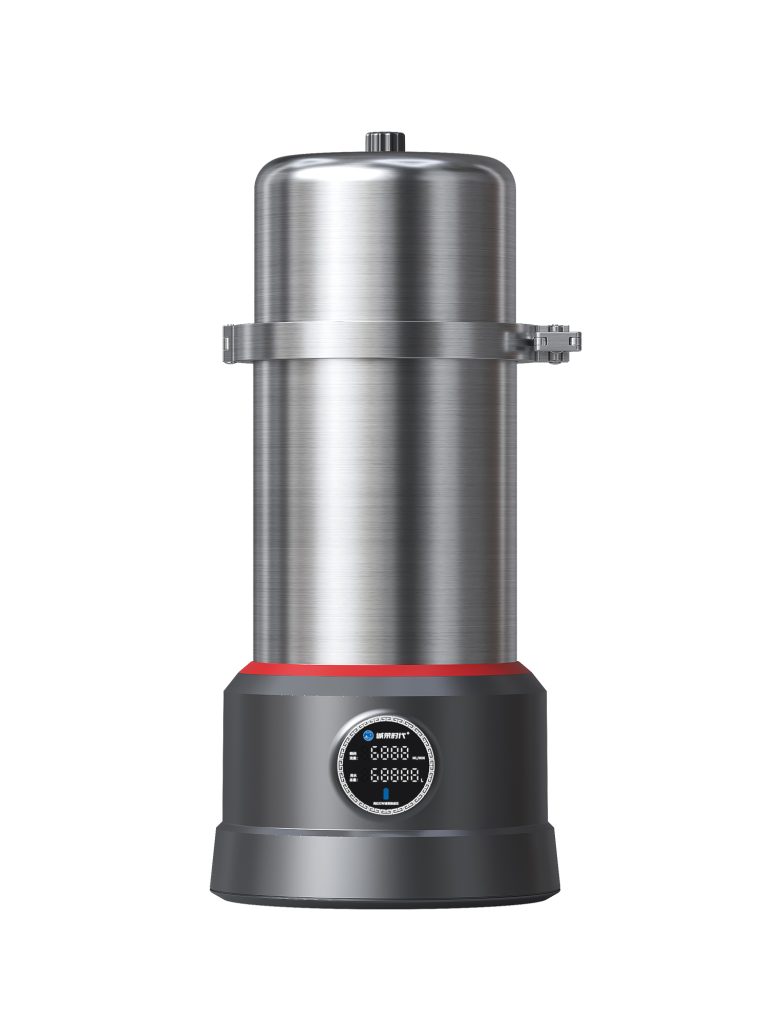
Four-Stage Filter Design for Common Household Tap Water Contamination
Our kitchen mineral-like water purifier uses a four-stage filter with a composite filtration design.
After entering the water purifier, the source water passes through:
Folded Cotton → Carbon Fiber → PP Cotton → Ultrafiltration Membrane with Residual Chlorine Removal
The water then passes through the ultrafiltration membrane with residual chlorine removal for further filtration.
Among these stages, we use a true ultrafiltration membrane with a filtration precision of 0.01 microns, which can remove 99.99% of sediment particles and other impurities in the water, as well as bacteria, viruses, and more.
Therefore, from the perspective of product design, this kitchen mineral-like water purifier is not designed to treat every type of extremely contaminated water source. Instead, it is designed for real-world household water conditions.
Why Can’t a Kitchen Water Purifier Be Designed Around “Extremely Contaminated Water Sources”?
This is actually a problem that can easily occur during product development.
When many people develop products, they like to use the most extreme conditions as the design standard based on their own assumptions.
For example, some people immediately consider situations involving severely excessive heavy metals.
However, under normal circumstances, the municipal water produced by water treatment plants must undergo strict treatment and testing. Extremely contaminated water sources should not be directly treated as the standard operating environment for ordinary household water purifiers.
Of course, this does not mean that extremely poor water quality cannot be treated.
In fact, no matter how poor the water quality is, it can be treated through targeted water treatment solutions.
However, during the actual kitchen water purifier research and development and design process, extreme water conditions do not have universal reference value.
If a user is dealing with a special water source, severely contaminated water, or specific industrial water, the more reasonable approach is to develop a customized solution based on the actual water quality, rather than expecting an ordinary household kitchen mineral-like water purifier to solve every possible water-quality problem.
What Does a Kitchen Mineral-Like Water Purifier Really Solve?
Therefore, I still require the young colleagues to replace the source water with fresh municipal tap water before every livestream.
Because our product is designed to match real-world household usage conditions.
After municipal tap water leaves the water treatment plant, it travels through long pipelines before reaching homes. During this process, secondary contamination may occur.
For example:
- Rust caused by aging water pipes;
- Sediment in pipelines;
- Bacteria and viruses that may be associated with secondary water-supply tanks in residential communities.
These are the issues that deserve more attention when ordinary households use a kitchen water purifier.
Therefore, the original purpose of developing this kitchen mineral-like water purifier is very clear:
To solve secondary contamination in tap water while retaining, as much as possible, the minerals and trace elements essential to the human body.
This allows users to enjoy water close to mineral-water standards without leaving home.
A Kitchen Mineral-Like Water Purifier Is Not Simply Better Because It Can Filter More
Through what happened in the livestream room, I once again realized one thing:
A water purifier is not necessarily better simply because it has stronger filtration capabilities. It needs to match the actual usage scenario.
If a household uses normal municipal tap water, then a kitchen mineral-like water purifier developed according to household standards should focus on solving common problems such as secondary contamination, sediment, rust, residual chlorine, and microorganisms in tap water.
If the source water has already become highly contaminated water that has not been replaced for a long time and has had a large amount of soil added to it, then a more professional and larger-capacity water treatment system should be used.
Product design is not about creating a concept of a purifier that can “filter any kind of water.” It is about genuinely solving the practical problems users encounter in their daily lives.
This is also why we insist on developing kitchen mineral-like water purifiers.
What we want to create is not a water purifier detached from real-world usage conditions, but a water purifier that is genuinely suitable for use in household kitchens.
ChengrongTimes Ultrafiltration, Customers Have Never Had Any Concerns
Ten years without rust.
Ten years without water leakage.
Ten years of after-sales service.
ChengrongTimes Water Purifiers — We Never Compromise on Quality.