I recently came across a question from a homeowner: For a family of three living in a newly built residential community, should they choose an under-sink RO water filter or an ultrafiltration water filter?
Honestly, you cannot make the right decision based solely on the number of family members or how new the residential community is. Choosing a water filter is not about how many people live in your home. It is about your local water quality, your household’s water usage, and the specific problems you want your water filter to solve.
I have outlined several key factors to help you decide. This practical framework applies not only to families of three but also to households looking for the right under-sink water filter.
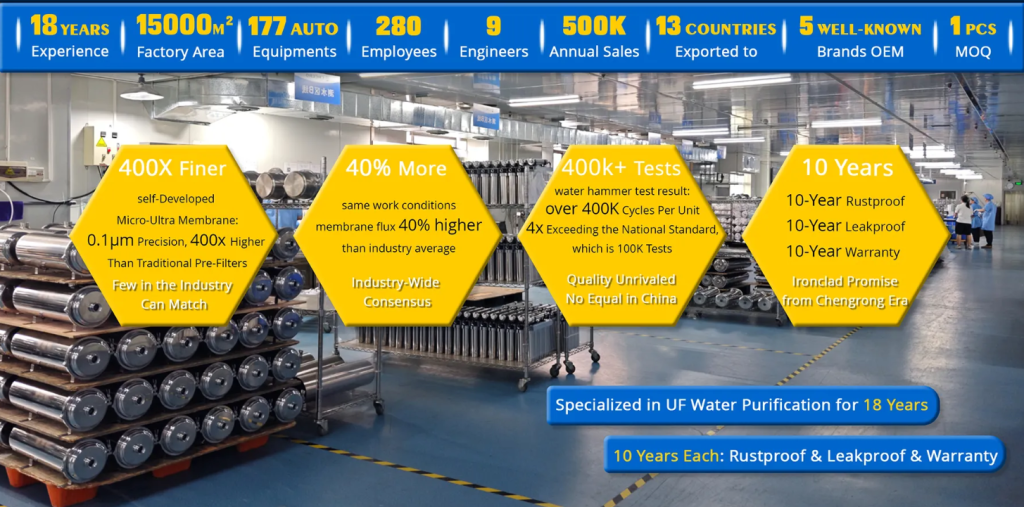
First, a quick disclosure: ChengrongTimes manufactures ultrafiltration direct drinking water filters with natural minerals retained. This article focuses on filtration technology, drinking water standards, and long-term operating costs. The goal is not to promote RO or criticize it, but to explain when each technology makes sense.
1. What Are the Main Water Quality Concerns in a New Residential Community?
New residential communities typically receive municipal tap water. Water supplied by treatment plants must meet applicable drinking water standards. However, this does not guarantee that water quality will remain unchanged throughout the entire distribution system before reaching your tap.
China’s national standard, GB 5749-2022, Standards for Drinking Water Quality, specifies requirements for microbiological contaminants, toxicological parameters, sensory characteristics, and general chemical indicators.
For households in new residential communities, there are three main factors to consider when deciding whether to install a water filter.
First, chlorine taste and odor.
Municipal water is disinfected during treatment and distribution, so it may have a noticeable chlorine taste or smell. If your tap water has a strong disinfectant odor, an activated carbon filtration system with demonstrated chlorine-removal performance can help address this issue.
Second, particles from pipes and water distribution systems.
As water travels through community pipelines, secondary water supply facilities, and household plumbing, particles such as sediment and rust may enter the water. If water storage tanks or distribution facilities are poorly maintained, the hygiene of the secondary water supply system also deserves attention.
Third, water hardness and scale buildup.
If your kettle develops visible white deposits after only a few days of use, your water may contain relatively high concentrations of calcium and magnesium. This is a water hardness issue and should be distinguished from chlorine odor and suspended particles.
Before buying an under-sink water filter, identify the main problem you need to solve: chlorine taste and odor, suspended particles, or high water hardness. This is more useful than automatically choosing the most expensive product.
2. When Should You Choose an RO Water Filter?
If your local water is hard, your kettle frequently develops scale, and you want to substantially reduce dissolved salts in your drinking water, an RO reverse osmosis water filter is a more direct solution.
RO membranes remove large amounts of dissolved substances, including calcium and magnesium, which contribute to scale formation. They can also remove many dissolved contaminants effectively. Actual performance depends on membrane specifications, system design, and operating conditions.
If your primary goal is to reduce water hardness and prevent scale buildup, RO reverse osmosis is generally more suitable than conventional ultrafiltration.
However, there is another factor worth considering when purchasing an RO water filter: whether the system uses an antiscalant.
If you prefer to minimize the use of antiscalants, compare models that do not use them. You should also evaluate filtration performance, the wastewater ratio, replacement filter prices, and maintenance intervals.
One point needs to be made clear: antiscalants should not automatically be classified as harmful substances. China’s Science Rumor Refutation platform addressed the claim that water filter antiscalants cause osteoporosis in its June 2025 Science Rumor List. Product safety should be evaluated based on the specific ingredients, conditions of use, and regulatory compliance rather than assumptions based solely on the word “antiscalant.”
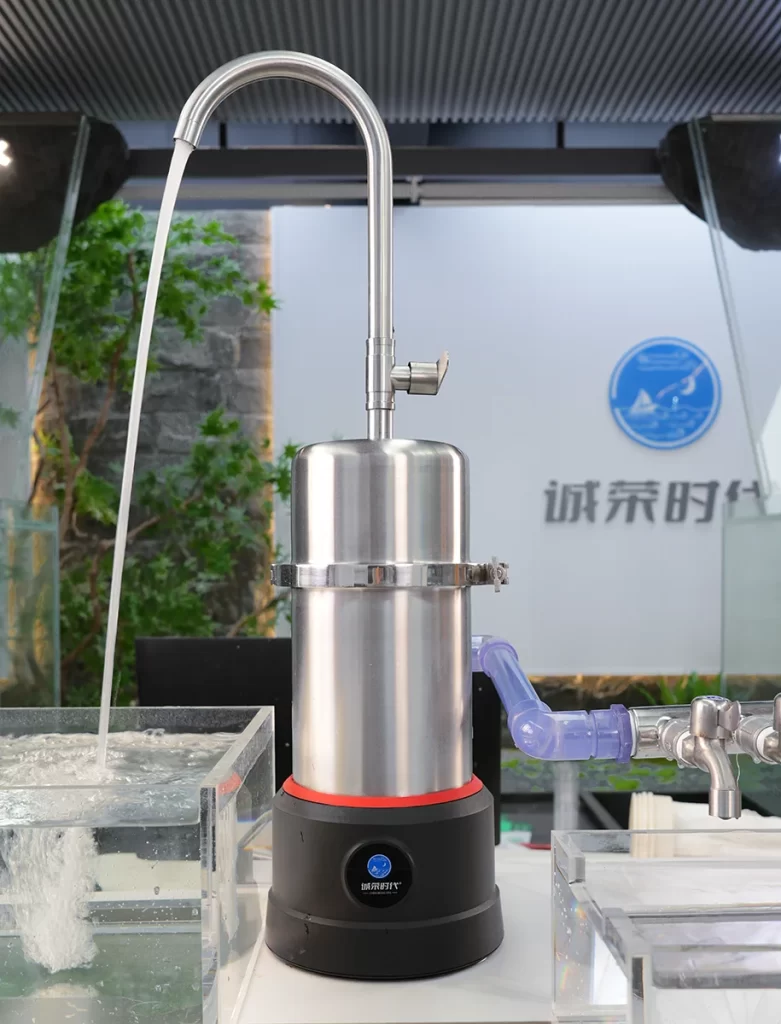
Ultrafiltration direct drinking water filters with natural minerals retained work differently.
Ultrafiltration membranes primarily remove particles and certain microorganisms through membrane separation. Unlike RO membranes, they generally do not substantially reduce dissolved calcium and magnesium ions. Since ultrafiltration is not designed for desalination or comprehensive scale removal, adding an antiscalant solely to reduce scale is generally unnecessary.
This does not mean antiscalants are inherently harmful. Different filtration technologies work in different ways, and product design should match the intended purpose.
Long-term operating costs also matter. Some RO models that do not use antiscalants may have higher filter costs or different replacement requirements, but this is not true of every model. Compare the actual consumable costs of the complete system instead of judging a water filter by its initial purchase price alone.
3. When Is an Ultrafiltration Direct Drinking Water Filter with Natural Minerals Retained a Good Choice?
For a family of three, a water filter is rarely used for drinking water alone.
In addition to drinking, families use filtered water to cook rice, prepare soup, boil noodles, and wash ingredients. When daily kitchen water consumption is relatively high, flow rate, filter lifespan, and long-term operating costs become particularly important.
If your municipal water meets the applicable drinking water standards, scale buildup is minor, or you are comfortable with a small amount of scale caused by normal water hardness, an ultrafiltration direct drinking water filter with natural minerals retained may be worth considering.
Why?
First, activated carbon can improve chlorine taste and odor.
With appropriate filter design and operating conditions, activated carbon can adsorb chlorine and some odor-causing substances. The actual removal performance should be verified through test results for the specific product.
Second, ultrafiltration membranes can retain many particles and microorganisms.
Some ultrafiltration membranes have a nominal pore size of 0.01 microns. However, filtration performance cannot be determined by pore size alone. Membrane integrity, system design, sealing, and actual test results must also be considered.
It is inaccurate to assume that every ultrafiltration product completely removes all bacteria, viruses, and other contaminants. Virus removal, in particular, requires product-specific test data.
When purchasing an ultrafiltration direct drinking water filter with natural minerals retained, do not rely solely on a salesperson’s claims about filtration precision. Ask the manufacturer for test reports covering the specific model, verify the tested parameters and results, confirm the intended source water, and check the relevant hygiene approvals or registrations.
For example, ChengrongTimes has provided documentation for a related product, including a 31-item drinking water test report issued by the Shenzhen Institute of Metrology and Quality Inspection, report number WT10103260146579WT1, and a Guangdong provincial hygiene permit, reference number Yue Wei Shui Zi [2026] No. S0177.
These documents can help buyers assess the product’s testing and regulatory status. Before purchasing, verify the exact model covered by each document, the test parameters, and the applicable conditions. Results for one model should not automatically be applied to all ultrafiltration water filters.
In addition, ultrafiltration direct drinking water filters with natural minerals retained generally do not substantially remove dissolved minerals such as calcium and magnesium. Therefore, if you want to improve water taste and odor while retaining most of the minerals already present in the source water, and you do not need to significantly reduce water hardness, this technology may better match your needs.
However, retaining minerals does not automatically mean that ultrafiltered water is healthier than RO water. Each technology has its own applications. The appropriate choice depends on source water quality, product performance, and your actual needs.
4. RO vs. Ultrafiltration: How Much Can You Save on Replacement Filters?
Many buyers compare the purchase prices of water filters but overlook the ongoing cost of replacement cartridges.
If your water filter is used daily for drinking, cooking rice, and preparing soup, replacement filter expenses should be part of your purchasing decision. The more useful comparison is the cost of replacement filters per ton of water treated while meeting the required water quality standards.
The following comparison uses the product figures provided in the original information.
| Comparison | RO Reverse Osmosis Water Filter | Ultrafiltration Direct Drinking Water Filter with Natural Minerals Retained |
|---|---|---|
| Typical filter configuration | Composite filters, RO membrane filters, and other stages | Composite filters and ultrafiltration membranes |
| Filter capacity cited in the original data | Approximately 4,000 liters for some activated carbon composite filters | Approximately 100 metric tons for the relevant ChengrongTimes filter |
| Estimated filter cost | Potentially around $5–$75 or more per metric ton, depending on the model | Approximately $1.20 per metric ton based on the original cost estimate |
| Main applications | Substantially reducing dissolved substances and water hardness | Treating water from a suitable source, with a focus on chlorine odor, particles, and everyday kitchen use |
| What to verify before buying | Individual filter lifespans, total replacement costs, and wastewater generation | Actual treatment capacity, test documentation, filter costs, and suitable source water |
Important: The capacities and costs above are based on the original product information. They are not universal figures for all RO or ultrafiltration water filters. The approximately 100-metric-ton capacity cited for the relevant ChengrongTimes filter comes from an in-house factory laboratory test. It is not a certified lifespan established by a third-party test report. Actual results depend on the test conditions and water quality.
Why is it important to calculate these costs?
Some RO water filters use multiple filtration stages. In addition to the RO membrane, they may contain activated carbon composite filters and other consumables. Even if the RO membrane has a relatively high rated capacity, other filters may need to be replaced sooner.
Suppose a particular filter has a rated treatment capacity of 4,000 liters, equivalent to 4 metric tons. If a household processes 20 liters of water per day, it would theoretically reach that capacity in approximately 200 days.
However, this is only a theoretical calculation based on rated capacity. Actual replacement intervals depend on source water quality, cumulative water volume, elapsed time, and the manufacturer’s instructions. This calculation does not mean that every filter must be replaced after exactly 200 days.
Likewise, you cannot accurately calculate the total operating cost of an entire RO water filter by looking only at the price of its RO membrane or activated carbon filter. Include all filters that require periodic replacement, and check the rated capacity and replacement requirements of each one.
Now consider an ultrafiltration direct drinking water filter with natural minerals retained.
Based on the figures provided for ChengrongTimes, if the relevant filter has a treatment capacity of 100 metric tons and costs approximately $120, the theoretical replacement filter cost would be:
$120 ÷ 100 metric tons = $1.20 per metric ton.
The 100-metric-ton capacity is based on an in-house factory laboratory test, not a certified lifespan established by a third-party testing organization. The $120 figure is an approximate conversion of the original RMB cost. Actual costs should be verified against the price of the specific product.
In addition, replacement filter cost per metric ton is not the same as the total cost of owning and operating a water filter. You should also consider the initial system price, other replacement filters, maintenance expenses, and any wastewater costs associated with RO systems.
For households that use filtered water every day for drinking and cooking, do not compare purchase prices alone. Consider rated treatment capacity, replacement filter costs, and actual household needs together.
Scale formation depends on water quality, while overall value depends on long-term operating costs. Once you understand both, choosing a water filter becomes much more straightforward.
5. Which Water Filter Should a Family of Three Choose?
Let’s return to the original question: For a family of three in a new residential community, should you choose an under-sink RO water filter or an ultrafiltration water filter?
The answer does not depend on the number of family members or whether the residential community is newly built. It depends on the specific problem you need to solve.
Consider an RO reverse osmosis water filter if:
- Your local water is hard and your kettle develops significant scale buildup.
- You want to substantially reduce dissolved salts and minerals in the water.
- You have specific taste preferences and want to reduce the effects of water hardness.
- Water testing identifies dissolved contaminants that the particular RO model is designed and verified to remove.
Consider an ultrafiltration direct drinking water filter with natural minerals retained if:
- Your source water meets the applicable drinking water requirements and has no significant problem that specifically requires RO treatment.
- Your main goals are to improve chlorine taste and odor and reduce particles such as sediment and rust.
- You do not need to substantially reduce dissolved calcium and magnesium.
- Your household uses a relatively large amount of kitchen water and you place a high priority on filter lifespan and long-term consumable costs.
If your water is very hard and you want to substantially reduce its hardness, RO is generally the more appropriate technology.
If your source water is suitable for ultrafiltration, your main goals are to improve taste and reduce particles, and you want to control long-term replacement filter costs, an ultrafiltration direct drinking water filter with natural minerals retained may be worth considering, provided the specific product meets the relevant performance and testing requirements.
However, if your source water contains contaminants that ultrafiltration cannot adequately remove, do not choose a product simply because it is inexpensive or has a long filter lifespan. Identify the contaminants first and select a treatment system with demonstrated removal capabilities for those specific substances.
The homeowner who originally asked the question did not follow up.
Choosing a water filter is not as complicated as it may seem. Start by understanding your water quality, identify the problem you need to solve, and then calculate long-term operating costs. These steps will help you narrow down your options considerably.
6. Water Filter Buying FAQ: Three Common Questions
Q1: Is buying an RO water filter the safest choice for a family of three in a new residential community?
Not necessarily.
Neither the age of the residential community nor the number of family members determines which filtration technology you need. Even in a newly built community, your decision should be based on actual water quality, the condition of the water supply infrastructure, and your household’s needs.
If your main concerns are chlorine taste and odor or suspended particles, an ultrafiltration water filter that meets the relevant performance and testing requirements may be sufficient. If your water is hard or you need to reduce dissolved substances, RO reverse osmosis may be more appropriate.
Do not assume that every household must buy an RO water filter simply because RO offers broader removal capabilities.
Q2: Can you drink water filtered by an ultrafiltration direct drinking water filter with natural minerals retained if scale forms after boiling?
You cannot determine whether water is safe simply by looking at scale.
Scale is primarily associated with calcium and magnesium in water. China’s national standard GB 5749-2022 specifies a limit of 450 mg/L for total hardness, expressed as calcium carbonate, and 1,000 mg/L for total dissolved solids.
When water meets the applicable drinking water standards, the presence of some hardness does not mean that the water is unsafe to drink. Calcium and magnesium within the relevant acceptable ranges should not simply be classified as toxic substances.
However, the amount of scale does not establish whether all other potential contaminants meet drinking water requirements. If you have concerns about water quality, rely on appropriate test results rather than the presence or absence of white deposits at the bottom of your kettle.
If you dislike the taste associated with hard water or want to reduce scale buildup in your kettle, an RO reverse osmosis water filter may be a better fit.
Q3: What should you ask before buying a water filter to avoid misleading claims?
Remember these three questions.
First: What is the rated total treatment capacity of the filter?
Do not rely solely on vague claims such as “lasts for several years.” Ask for the rated treatment capacity of the specific filter and the conditions under which that rating applies.
Second: Does the stated capacity refer to the complete system, an individual filter cartridge, or a single membrane?
The rated capacity of one cartridge does not mean that every filter in the system will last equally long. For a multistage water filter, verify the rated capacity and replacement requirements of each stage separately.
Third: Should the filter be replaced according to the total volume of water treated, elapsed time, or both?
Some filters have replacement requirements based on both treatment volume and elapsed time. Before buying, understand the manufacturer’s instructions and calculate the cost of replacement filters in relation to their rated treatment capacity.
If a seller cannot explain these figures clearly, or promotes filtration precision and filter lifespan without providing relevant product documentation and test evidence, you should be cautious.
When choosing a water filter, do not rely on marketing claims alone. Compare actual filtration performance, test documentation, rated treatment capacity, and long-term operating costs.