Today, I saw a post online from someone asking for help: “My tap water is yellow. What kind of Water Filter should I use?”
The comments quickly became lively. A group of people selling RO Water Filters rushed in, each recommending their own products.
I understand the desire to win customers, but the question was actually asked in the wrong order.
“Yellow water” is not a type of water quality; it is a phenomenon.
There can be many reasons why water turns yellow, and completely different treatment technologies may be required for different causes. Recommending a Water Filter without first identifying the cause is like prescribing medicine without diagnosing the condition. It is very easy to buy the wrong product.
Therefore, when you encounter questions such as “What should I do if my tap water is yellow?”, “What Water Filter should I use for rusty water?”, or “How should I treat yellow well water?”, the correct approach should be:
First determine the water source → then identify the type of contamination → finally choose the appropriate water filtration technology.
Only by selecting the appropriate Water Filter according to the actual water quality can you make a more reasonable choice.
1. First Determine: Is It Yellow Tap Water or Yellow Well, Creek, or River Water?
These two types of “yellow water” have completely different causes and treatment methods.
So the first step is not to choose a Water Filter, but to determine where the water comes from.
1. Tap Water Is Yellow: Focus on Pipes and Secondary Water Supply
If your tap water is yellow, the first thing to determine is whether the discoloration is caused by sediment, rust, or another water quality issue.
If your home uses municipal tap water and the water suddenly turns yellow, a common cause is sediment in the pipes and secondary water supply systems, such as sediment and rust.
Let me first clarify one point:
Tap water must pass 97 inspection items before leaving the water treatment plant. Its safety is not an issue, and water that fails to meet the requirements cannot enter the distribution network.
However, “qualified when leaving the water plant” does not mean that the water remains exactly the same all the way to your household faucet.
From the water treatment plant to your home, the water still has to pass through the municipal water supply network and, in some buildings, secondary water supply systems.
For example:
- Old cast-iron pipes may have accumulated rust, scale, and other deposits on their inner walls;
- If high-rise building water tanks are not cleaned properly, sediment and rust may accumulate at the bottom;
- When water supply is restored after an outage, changes in water flow and pressure may also wash previously accumulated materials out of the pipes.
As a result, many people notice:
“The water is normally clear. Why does it turn yellow after the water comes back following an outage?”
This situation is not uncommon, and the cause is usually related to accumulated materials in the pipes being carried back into the water flow.
If you find that the water only turns yellow for a short period after the water supply is restored and becomes clear again after running the water for a while, you should first investigate the pipes, secondary water supply facilities, and the household water supply system instead of immediately buying an RO Water Filter.
For yellow water mainly caused by particulate matter such as sediment and rust, the treatment approach is relatively simple:
First remove the sediment, rust, and other particulate matter, and then decide whether additional terminal water filtration equipment is needed based on your drinking water needs.
So, what Water Filter should you use for rusty water? The key is to first determine whether the iron is present in particulate or dissolved form.
2. Yellow Well, Creek, or River Water: Test First Instead of Choosing a Model
If your household water does not come from municipal tap water but instead comes from a well, creek, river, or another natural water source, the treatment approach is completely different.
This is the category where problems are most likely to occur. The first step must be testing, not buying a machine.
The reason is simple:
“Yellow water” only tells you that the appearance of the water has changed. It does not tell you what is actually in the water.
For example:
- If testing finds that heavy metals, nitrates, or similar substances exceed the limits—note that these types of contamination are generally not visible, and yellow water may simply be an accompanying phenomenon—then the first recommendation should be to replace the water source with a safer one.
- If the water source cannot be replaced, an RO reverse osmosis Water Filter can be considered. RO filtration typically reaches 0.0001 microns, allowing it to remove heavy metals and other dissolved contaminants from water and produce much purer water.
- However, if the raw water contains high levels of iron and manganese, proper pretreatment must be provided first. Otherwise, the service life of the RO membrane can be significantly affected. The specific reason is explained in Q3 below.
- If water quality testing shows that the water source is generally safe and the yellow color is mainly caused by sediment and other particulate matter, this means that the water source contains relatively large amounts of particles. In this case, 0.1-micron ultrafiltration can be considered as an initial filtration step for household water.
Therefore, the order cannot be reversed:
Testing → identify contaminants → choose the treatment technology → then determine the equipment.
Skipping testing and buying a machine directly is essentially a gamble.
3. How Should You Choose a Water Filter for Yellow Tap Water?
If you have confirmed that your household uses municipal tap water and the main problem is particulate matter such as sediment and rust, the choice can be divided into two levels depending on your drinking water requirements.
Level One: Basic Requirements, Boil the Water Before Drinking
If your main goal is to address sediment, rust, large particles, and other issues throughout the house, and you normally boil the water before drinking it, you can consider installing a:
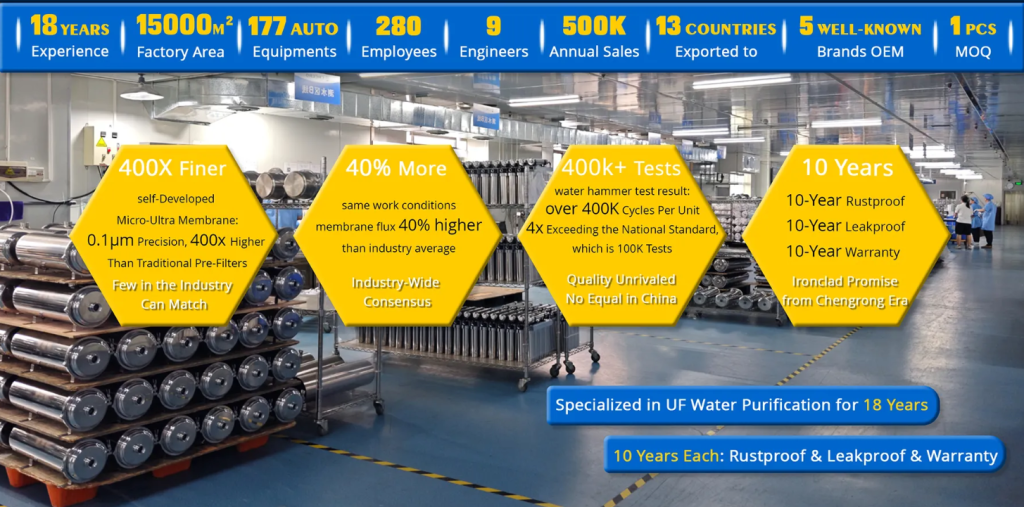
0.1-micron PVDF stainless steel pipeline ultrafiltration system.
This type of ultrafiltration can filter sediment, rust, large particles, some bacteria, colloids, and other impurities.
Compared with common PP cotton filters, large white filter housings, and other filtration methods, 0.1-micron filtration provides a finer filtration level.
It can be simply understood as follows:
Common PP cotton filtration is approximately 1–5 microns, while 0.1-micron ultrafiltration has a much smaller pore size.
In addition, there is a significant difference between 0.1-micron PVDF ultrafiltration and disposable filter cartridges:
When the filter becomes contaminated, it can be cleaned and reused. It can be washed manually or by machine.
Therefore, its cost structure is not exactly the same as that of traditional plastic pre-filters.
This is not simply a question of “which one is more expensive or cheaper.” Instead:
The timing of the spending is different.
| Dimension | PP Cotton / Plastic Pre-Filter | 0.1-Micron PVDF Ultrafiltration |
|---|---|---|
| Filtration Precision | 1–5 microns | 0.1 micron |
| Maintenance | Replace the filter when clogged (disposable) | Backwashable (hand wash/machine wash) |
| Cost Structure | Low unit price, frequent filter replacement | Higher initial cost, no recurring consumable purchase |
| Long-Term Expense | Low each time, but accumulates over time | One-time investment, then tends toward zero |
The specific cost can vary significantly depending on the brand, pipe size, and actual water quality, so the comparison here focuses mainly on the cost structure rather than specific prices.
For whole-house water use, the incoming water can first pass through this level of filtration, and then be boiled for drinking according to actual drinking water needs.
In other words:
Particulate matter is mainly intercepted by ultrafiltration, while the microbial risk is mainly reduced through thorough boiling.
Level Two: You Want to Drink Directly From the Faucet
If you not only want to solve sediment and rust problems throughout the house but also want to drink water directly, you can add a terminal Water Filter in the kitchen.
There are two common technology routes:
| Solution | Precision | How It Achieves Drinking Water Quality | What Is Retained |
|---|---|---|---|
| RO Reverse Osmosis | 0.0001 micron | Removes beneficial trace elements and minerals from water to achieve purified water | Almost all removed |
| Ultrafiltration (Mineral Water-Like) | 0.01 micron | Removes particles and microorganisms while retaining minerals and trace elements | Retained |
Our ChengrongTimes Under Sink Water Filter with Natural Minerals Retained belongs to the latter category.
Its drinking water is tested according to CJ/T 94—2005, Drinking Water Quality Standard.
For relevant indicators, this standard is stricter than GB 5749, for example:
- Turbidity ≤0.5 NTU
- Iron ≤0.20 mg/L
- Manganese ≤0.05 mg/L
- Total bacterial count ≤50 CFU/mL
The Shenzhen Institute of Metrology and Quality Inspection issued two test reports:
- WT10103260146579WT1: 31 items, issued on 2026-07-29;
- WT10103260057118WT1: 9 items, issued on 2026-04-29.
The determination basis for both reports was CJ/T 94—2005, and all tested items complied with the requirements.
Three of the measured values were as follows:
| Test Item | Measured Value | Limit |
|---|---|---|
| Total Hardness | 39.6 mg/L | ≤300 mg/L |
| Total Dissolved Solids | 91 mg/L | ≤500 mg/L |
| Turbidity | <0.5 NTU | ≤0.5 NTU |
These data can help consumers understand the actual test results of this type of ultrafiltration drinking water.
However, one very important limitation must be clearly stated:
0.01-micron ultrafiltration cannot remove dissolved heavy metals or nitrates, nor can it reduce water hardness.
This is not a matter of modesty in product marketing. It is determined by the filtration principle and pore size.
Therefore, if testing of the raw water finds dissolved heavy metals, nitrates, or other issues, it cannot be assumed that these contaminants have been eliminated simply because a 0.01-micron ultrafiltration system is being used.
4. Minerals: Food and Drinking Water Are Not Mutually Exclusive
This point deserves to be explained separately because there is a great deal of discussion online about whether Water Filters remove minerals.
One common statement is:
“Food already provides minerals, so the small amount of minerals in water is not meaningful and it does not matter if they are removed.”
This way of completely opposing mineral intake from food and drinking water is not rigorous.
Food and drinking water do not conflict as sources of minerals. They can be considered two different intake channels.
For older adults, adults, and children with unbalanced diets or differences in absorption, obtaining certain minerals and trace elements from water can also serve as an additional source beyond the diet.
However, the other side also needs to be clarified.
The WHO document Nutrients in Drinking Water has discussed issues related to low-mineral water, while also pointing out that:
Calcium and magnesium from water usually contribute only 1%–20% of daily intake, while the diet remains the primary source.
Therefore, there is no need to take either extreme position:
- “Drinking RO water will cause calcium deficiency” — an exaggerated interpretation. Food remains the main source of mineral intake.
- “The minerals in water are completely useless” — this is also incorrect. Drinking water can provide certain minerals and is a stable and convenient supplementary source.
Therefore, the question that really deserves attention is:
What dissolved contaminants are actually present in your household water?
If there are no heavy metals, nitrates, or other contaminants requiring special treatment, whether to retain the minerals in the water can be determined according to individual drinking water needs.
If there are clearly excessive levels of dissolved contaminants, then the first priority should be to address drinking water safety.
5. Back to the Original Post: What Water Filter Should You Use for Yellow Water?
Now let’s return to the original question:
“The water at home is very yellow. What kind of Water Filter should I use?”
The answer is now relatively clear.
The first step is not to choose a machine, but to observe how the water behaves.
You can first collect a glass of water and look at several basic characteristics:
- Is it yellow, brownish-yellow, or somewhat black?
- Does sediment appear after the water sits for a while?
- Does it remain yellow all the time, or does it suddenly turn yellow after a water outage?
- Does it gradually become clear after running the water for several minutes?
- Does the home use municipal tap water, or well water, mountain stream water, or another natural water source?
This information can help determine whether the problem is more likely to be particulate contamination from the pipes or a raw water quality issue.
If It Is Municipal Tap Water
If the water becomes yellow for a short period after the water supply is restored following an outage and gradually becomes clear after running the water, a common cause is that rust, sediment, and other deposits in the pipes have been disturbed and carried into the water flow.
In this case, 0.1-micron ultrafiltration can be used as a whole-house particulate filtration solution. If direct drinking is also desired, a terminal Water Filter can be added in the kitchen.
If It Is Well Water or Mountain Stream Water
Do not purchase a particular model directly based only on the fact that the water is yellow.
Spend a few hundred yuan on water quality testing first, and then determine whether ultrafiltration or RO is appropriate based on the test results.
In other words:
How should yellow well water be treated? The correct order is: test first → identify the contaminants → then determine the water treatment technology.
Skipping the testing and buying a machine directly is essentially a gamble.
6. What Really Matters Is Not “Which Water Filter Is Best,” but “Which Technology Is Suitable for Your Water”
There is no universal answer to which Water Filter is “best” independent of the water quality.
The decision-making process can be summarized in the following table:
| Water Source / Phenomenon | Priority Assessment | Common Treatment Direction |
|---|---|---|
| Municipal tap water, temporarily yellow after a water outage | Pipe rust, sediment, and other particulate matter | 0.1-micron ultrafiltration and other particulate filtration |
| Municipal tap water, persistently or repeatedly yellow | Pipe, secondary water supply, or water source issues | Investigate the cause before selecting a filtration solution |
| Well, mountain stream, or river water is yellow | Complex raw water quality | Conduct water quality testing first |
| Heavy metals or nitrates exceed limits in well water | Dissolved contamination | Prioritize solving the water source issue; consider RO if the source cannot be replaced |
| Well water mainly contains sediment | Large amounts of particulate matter | 0.1-micron ultrafiltration and other pretreatment |
| Dissolved iron exceeds the limit | Iron ion problem | Specialized treatment such as aeration oxidation + manganese sand filtration |
| Need whole-house particulate filtration | Whole-house water use | Inlet-side ultrafiltration |
| Need direct drinking water in the kitchen | Terminal drinking water needs | RO or an ultrafiltration drinking water solution that meets the relevant testing requirements |
Therefore, when facing the question “What should I do if my water is yellow?”, what you should remember is not a particular brand or machine, but this:
First determine the water source, then identify the contaminants, and finally choose the appropriate water treatment technology.
The right order helps prevent you from buying the wrong machine.
Frequently Asked Questions (FAQ)
Q1: What Should I Do If My Tap Water Is Yellow?
If your tap water is yellow, the first step is to determine why.
If the water becomes temporarily yellow after the water supply is restored following an outage or after pipe maintenance, and becomes clear again after running the water for a while, a common cause may be accumulated material inside the pipes being disturbed by the water flow.
In this situation, you can first flush the water for a period of time and observe whether the water returns to normal.
However, if the water remains or repeatedly becomes yellow over a long period, you should not simply assume that it is ordinary rust. The pipes, secondary water supply facilities, or water source should be investigated, and testing should be conducted when appropriate.
Yellow water that repeatedly occurs over a long period should not be consumed directly for an extended period without determining the cause.
Q2: Can Ultrafiltration Remove Rust? Can It Remove Iron Ions?
These are two different questions.
Rust and dissolved iron ions should not be treated as the same thing.
Rust usually exists as particulate or colloidal iron oxide, iron hydroxide, and similar substances. 0.1-micron ultrafiltration can intercept particulate matter within its applicable size range.
However, dissolved ferrous ions are much smaller than the retention range of an ultrafiltration membrane. Therefore:
0.1-micron ultrafiltration can filter particulate rust, but ordinary ultrafiltration cannot remove dissolved iron ions.
If the water contains excessive dissolved iron, a more targeted treatment process is required, such as:
Aeration oxidation + manganese sand filtration.
Therefore, to determine whether “ultrafiltration can remove iron,” you must first determine the form in which the iron exists in the water.
Q3: Can I Install an RO System Directly for Yellow Well Water?
Generally, it is not recommended to install an RO system directly without testing and pretreatment.
If the concentration of iron and manganese in well water is high, metal scale may form on the RO membrane surface, affecting its normal operation and service life.
Therefore, the correct process should be:
Test first → determine iron, manganese, turbidity, hardness, and other indicators → design appropriate pretreatment according to the test results → then consider RO.
If RO is required, appropriate pretreatment may need to be added at the front end according to the actual water quality, such as:
Aeration + manganese sand, or primary ultrafiltration and other pretreatment solutions.
RO membranes also have corresponding requirements for feed water conditions.
For example, GB/T 19249, Reverse Osmosis Water Treatment Equipment, specifies:
- SDI₁₅<5
- Turbidity<1.0 NTU
Therefore, well water is not simply a matter of “installing an RO system and being done.” Pretreatment is equally important.
Q4: Why Does Water Turn Yellow After the Water Supply Is Restored?
This is one of the typical situations associated with pipe sediment.
During a water outage, water flow inside the pipes is relatively stagnant, allowing rust, sediment, and other materials to accumulate.
After the water supply is restored, water pressure and flow rate change, which can cause these accumulated materials to be washed back into the water.
Therefore, many people notice:
The water is the yellowest when it first comes back and gradually becomes clear after running for a while.
If this happens every time the water supply is restored after an outage, the household water supply pipes and secondary water supply system should be investigated first.
Q5: If I Install a Pre-Filter, Do I Still Need a Kitchen Water Filter?
Not necessarily. It depends on your drinking water needs.
A pre-filter or whole-house ultrafiltration system mainly addresses:
Sediment, rust, particulate matter, and similar issues throughout the household water supply.
If the filtered water is still boiled before drinking, you can determine whether an additional terminal Water Filter is needed based on the water quality.
If you want to drink water directly from the faucet, you will generally need to add a kitchen terminal Water Filter that meets the corresponding water quality requirements.
Therefore:
A pre-filter and a kitchen Water Filter are not simply substitutes for one another. Their treatment targets and application scenarios are different.
The front-end system handles pretreatment for whole-house water, while the terminal system handles further treatment of drinking water.
Q6: What Is the Difference Between 0.01-Micron Ultrafiltration and 0.0001-Micron RO?
The biggest difference is not only the numerical difference in pore size, but also the types of contaminants they can retain and whether minerals in the water are preserved.
Simply put:
RO reverse osmosis: approximately 0.0001 microns, capable of removing more dissolved substances and producing much purer water, but it also removes most minerals from the water.
Ultrafiltration: approximately 0.01 microns, mainly intercepting particulate matter, colloids, and microorganisms within its applicable range while retaining minerals and trace elements in the water.
Therefore, it cannot simply be assumed that “the smaller the pore size, the more suitable the Water Filter is for every household.”
Ultimately, it depends on:
What the raw water is, what contaminants are present, whether you need whole-house filtration or terminal drinking water treatment, and whether you want to retain the minerals in the water.
Q7: Municipal Tap Water Has Already Passed the Required Standards. Why Do I Still Need a Water Filter?
Municipal tap water is treated and tested before entering the water supply system, but the water still has to pass through municipal pipelines, building plumbing, and, in some situations, secondary water supply facilities before reaching the household faucet.
Therefore, household Water Filters are often used to address:
Potential particulate matter, pipe deposits, and individual drinking water requirements that may arise between compliant municipal water and the household tap.
This is particularly relevant for homes with older buildings, older pipes, or frequent yellow-water issues after the water supply is restored following an outage.
Conclusion: Yellow Water Is Not a Water Filter Model Problem, but a Water Quality Assessment Problem
“My tap water is yellow. What Water Filter should I use?”
On the surface, this looks like a product selection question. In reality, it is first a water quality assessment question.
If it is municipal tap water, focus on the pipes, secondary water supply system, and particulate matter such as sediment and rust. If it is well water, mountain stream water, or another natural water source, you should not rely solely on visual appearance and should conduct water quality testing first.
The entire decision-making logic can be summarized in one sentence:
For yellow municipal water, first consider particulate filtration; for yellow well or creek water, test first and then decide; when dissolved contaminants are present, select a targeted treatment process according to the specific contaminant.
There is no universal Water Filter that works independently of water quality conditions.
Determine the water quality first, then choose the technology; solve the actual problem first, then decide which machine to buy.