
Description: Learn the differences between whole-house water filters and Under Sink Water Filters, including PVDF ultrafiltration membranes, RO reverse osmosis, and water filter selection based on local water quality.
How to Choose a Whole-House Water Filter: Whole-House Filtration vs. Drinking Water Filtration
Many consumers believe that installing a whole-house water filter means all the water in their home has been fully purified.
However, in practical residential water treatment, a water filter installed on the main incoming water pipe and a drinking water filter installed under the kitchen sink serve different purposes.
The former primarily filters certain suspended impurities entering the household plumbing system, while the latter is designed to provide additional treatment for Under Sink Water. Understanding the differences and choosing the right products based on local water quality and household needs can help consumers avoid unnecessary purchases.
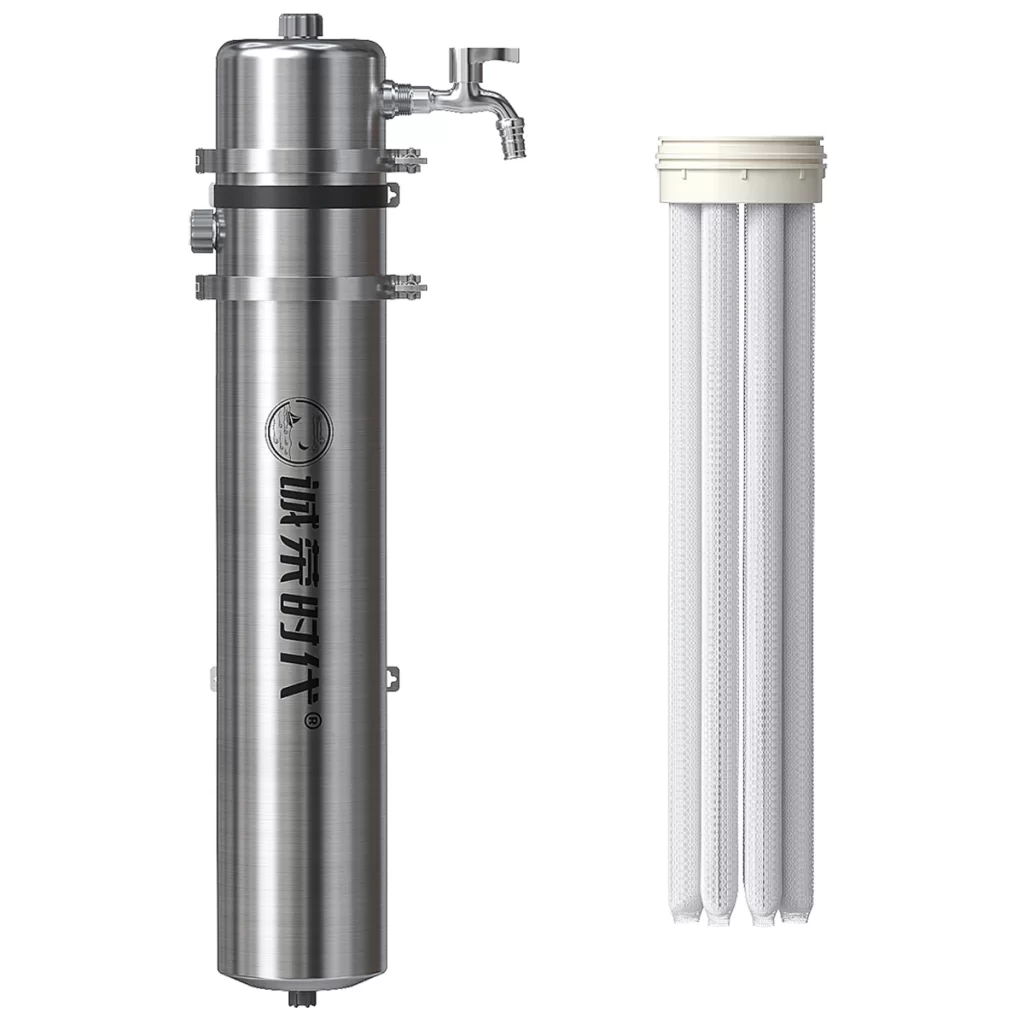
1. What Does a Whole-House Water Filter Do?
In the water filtration industry, filtration equipment installed on a home’s main incoming water pipe may be referred to as a pre-filter, a central water filtration system, or a pre-filtration device within a whole-house water treatment system. Different products use different filtration technologies and offer different treatment capabilities, so they should not all be treated as the same type of equipment.
For most households, the primary purpose of this type of equipment is to filter incoming water and reduce the amount of impurities, such as sediment, rust, and suspended particles, entering the indoor plumbing system.
It is important to understand that whole-house inlet filtration does not mean that all contaminants are removed, nor does it mean the filtered water is automatically safe to drink.
If a household wants to improve water quality for showering, laundry, cleaning, and other daily activities, it should select an appropriate whole-house water filtration solution based on local water quality, plumbing conditions, and actual needs.
What Should You Choose If Your Tap Water Is Visibly Cloudy?
If the water coming from your tap appears noticeably cloudy or contains visible particles or rust, the first step is to investigate the source of the problem, including the water supply, public distribution pipes, and internal household plumbing.
After identifying the cause, you can consider suitable filtration equipment.
For example, some whole-house ultrafiltration systems use PVDF hollow-fiber ultrafiltration membranes, which can retain suspended particles and colloids of certain sizes. Actual filtration performance depends on membrane pore size, product design, operating conditions, and test results.
If a product specifies a filtration precision of 0.1 microns, consumers should refer to the technical documentation and test reports for that particular model.
It is also important to understand that ultrafiltration primarily targets particles, colloids, and certain microorganisms. It generally cannot effectively remove dissolved salts from water, and filtration precision alone cannot establish a product’s ability to remove heavy metals or other dissolved contaminants.
If tap water remains cloudy or develops an unusual color or odor, installing a water filter should not be the only response. Contact the water supplier or an appropriate testing organization to investigate the cause.
2. Why Consider a Under Sink Water Filter in Addition to Whole-House Filtration?
For households that want to further improve their Under Sink Water, an additional kitchen water filter can be installed alongside the main inlet filtration system, depending on actual water quality and household requirements.
The primary purpose of a Under Sink Water Filter is to provide additional treatment tailored to drinking water needs. Common technologies include ultrafiltration and reverse osmosis (RO). These technologies are suitable for different water conditions and treatment objectives.
If the local tap water meets applicable drinking water standards and the household is mainly concerned about taste, hardness, or limescale, it can select a suitable product after evaluating the local water quality.
If the water supply is suspected of containing unknown contaminants or excessive heavy metals, the first step should be to confirm the type of contamination through reliable testing. The chosen water filter must have demonstrated removal capabilities for the specific contaminants and supporting test evidence.
It is not reasonable to assume that installing any type of water filter will solve every drinking water safety issue.
3. Which Drinking Water Filter Should Southern and Northern Chinese Households Choose?
When choosing a kitchen water filter, I believe it is more important to understand local water quality than to blindly pursue advanced specifications. Water hardness and the desired drinking water experience should be among the key considerations.
Common drinking water preferences include water that retains certain minerals and low-mineral water produced through reverse osmosis.
1. Southern China: Consider a Water Filtration Solution That Retains Minerals
Water quality varies across China. In some southern regions, tap water has relatively low hardness, making limescale less of a concern.
For households in these areas, if the local water meets drinking water standards and they prefer to retain some naturally occurring minerals, they can consider suitable ultrafiltration water filters or other filtration solutions that meet their treatment requirements.
For example, ChengrongTimes’ mineral-water-style filtration solutions may be an option for consumers interested in this type of drinking water experience.
However, suitability for an individual household should still be assessed based on local water quality, the product’s actual treatment capabilities, and available test documentation. Whether water treated by ultrafiltration is suitable for direct drinking also depends on the source water, equipment performance, installation conditions, and maintenance.
2. Northern China: Consider an RO Water Filter If Limescale Is a Major Concern
In some northern regions of China, tap water has relatively high hardness, and limescale can accumulate after boiling. Households concerned about this issue may consider an RO reverse osmosis water filter.
RO membranes can effectively reduce dissolved salts and many other dissolved substances in water, which generally helps significantly reduce limescale formation.
However, regional differences between southern and northern China are only a general reference and do not necessarily reflect the actual water quality of every city or household. Even within the same city, water quality can vary between supply areas.
When choosing a water filter, rely on actual water quality test results and product performance rather than making a decision solely based on whether you live in southern or northern China.
RO reverse osmosis systems also typically produce a certain amount of wastewater. When purchasing one, consumers should consider the purified water flow rate, rated total purified water capacity, wastewater ratio, filter replacement costs, and ongoing maintenance requirements.
4. When Choosing a Water Filter, Why Do I Pay More Attention to the Factory Behind the Brand?
When it comes to choosing a water filter, I have a slightly different perspective from those who focus only on brand recognition.
If your budget allows, consider brands or manufacturers with established production capabilities, comprehensive quality management systems, and reliable after-sales service.
Well-known brands often invest in brand development, distribution channels, marketing, and after-sales services. These factors can all affect the final retail price.
However, consumers can look beyond brand recognition and learn more about the manufacturer behind a product, including its production capabilities, quality control processes, supporting test documentation, and service commitments.
Of course, a large factory does not automatically mean that every product it manufactures is better than competing products. What really matters is whether the specific product complies with relevant standards, whether its key performance claims are supported by test evidence, and whether its after-sales commitments can be fulfilled.
ChengrongTimes: Focus on the Manufacturing Strength Behind Water Filtration Products
ChengrongTimes is a water filtration product brand that is still developing its brand recognition.
According to information provided by the company, Chengrong’s factory has long been involved in ODM/OEM water filtration equipment manufacturing and provides related manufacturing services for several internationally recognized brands. It also has established manufacturing experience in the pipeline ultrafiltration water filtration sector.
For consumers, this manufacturing experience can provide a starting point for understanding the product’s underlying development, production, and quality management capabilities, rather than focusing solely on the brand name printed on the packaging.
If you are considering purchasing ChengrongTimes water filtration products, we recommend reviewing the technical specifications of the specific model, its suitable water conditions, relevant test reports, filter replacement intervals, and after-sales policies before making a decision based on your household’s needs.
Through ChengrongTimes, we hope to help consumers look beyond brand recognition and pay greater attention to product quality and manufacturing capabilities when choosing water filtration products.
5. What Should You Know Before Buying a Whole-House Water Filter?
1. Can Water From a Whole-House Water Filter Be Drunk Directly?
This cannot be determined solely by the installation location or product name. Main inlet filtration equipment is primarily designed for initial filtration. Whether the treated water is suitable for direct drinking depends on the product’s design, treatment capabilities, source water quality, and relevant test results.
2. Can a Whole-House Ultrafiltration Water Filter Remove Limescale?
Generally, ultrafiltration cannot effectively remove the calcium and magnesium ions responsible for water hardness and limescale.
Ultrafiltration primarily retains particles, colloids, and other substances of certain sizes. It cannot replace a water softener or an RO reverse osmosis system when the goal is to reduce water hardness.
3. What Does a Filtration Precision of 0.1 Microns Mean for a PVDF Ultrafiltration Membrane?
This usually refers to the product’s specified membrane pore size or filtration precision. The exact definition should be confirmed in the manufacturer’s technical documentation.
This specification does not automatically mean that the equipment can remove every contaminant smaller or larger than that size. Nor can this parameter alone establish whether the treated water meets drinking water requirements.
4. Must Southern Chinese Households Choose an Ultrafiltration Water Filter?
No. Water quality varies across southern China. The choice of ultrafiltration should take local water quality, drinking water needs, product performance, and maintenance costs into account.
5. Must Northern Chinese Households Choose an RO Reverse Osmosis Water Filter?
Not necessarily. If local water hardness is relatively high and the household wants to reduce limescale in drinking water, an RO reverse osmosis solution may be worth considering.
The final decision should still be based on actual water quality and household requirements.
6. When Buying a Water Filter, Should You Prioritize the Brand or the Manufacturer?
We recommend evaluating the brand, manufacturer, and specific product together.
Pay particular attention to product test reports, quality control, after-sales policies, and long-term operating costs instead of judging product quality solely by brand recognition or factory size.
Conclusion: How to Choose a Whole-House Water Filter
If you want to reduce sediment, rust, and other suspended impurities in your home’s incoming water, consider a suitable pre-filtration device. If your primary concern is the taste, hardness, or dissolved substances in Under Sink Water, choose an appropriate drinking water filtration solution based on actual water quality.
Whole-house filtration and Under Sink Water filtration serve different purposes. They can be used together, but not every household needs exactly the same configuration.
For consumers preparing to purchase a water filter, I recommend assessing water quality first, selecting the appropriate filtration technology second, and then comparing product performance, manufacturing capabilities, and after-sales service.
If you are looking for a whole-house ultrafiltration water filter or a Under Sink Water Filter, you can learn more about ChengrongTimes products and manufacturing capabilities and select a suitable water filtration solution for your specific application.
For more product information, visit the official ChengrongTimes website or contact the company to learn more about specific models, technical specifications, and after-sales services.