
Description
A 164 m² home faces yellow water and frequently clogged filters. ChengrongTimes compares three whole-house ultrafiltration water filter solutions and explains selection, maintenance, and long-term costs.
How to Choose an Ultrafiltration Water Filter? A Whole-House Water Filtration Case Study for a 164 m² Home
A Live-Streaming Consultation That Solved a Whole-House Water Filtration Problem
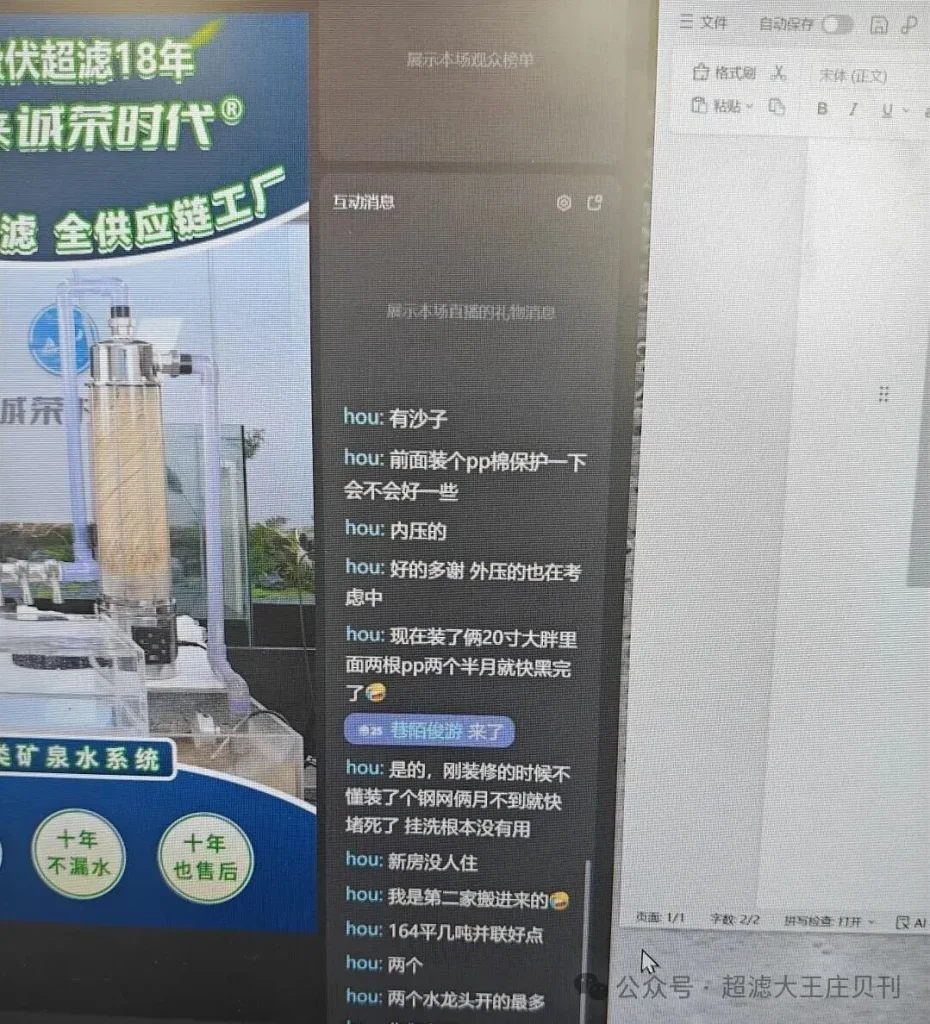
During a live stream hosted by ChengrongTimes Water Filter, we received an inquiry from a viewer named hou.
He contacted us not simply because he wanted to buy an ultrafiltration water filter, but because he had recently encountered two problems with his whole-house water filtration setup.
hou was the second homeowner to move into his new residential community. With so few residents having moved in, he suspected that the property management company might not yet be maintaining the secondary water supply tank properly. As a result, the water coming out of his household faucets was yellow and cloudy.
To improve the water quality, he installed a stainless-steel mesh pre-filter during the renovation of his home, hoping it would solve his whole-house water filtration needs. However, in less than two months, the pre-filter became completely clogged.
To prevent the filter from clogging again, he purchased two 20-inch Big Blue PP cotton filter housings, hoping that the additional filtration capacity would improve the performance of his whole-house water filtration system.
What happened next?
The PP cotton filter cartridges started turning yellow after just three days. In less than three months, they had turned completely black.
After two unsuccessful purchases, replacing and maintaining the filters had become another burden. He began reconsidering his options: What type of whole-house ultrafiltration water filter could actually meet his household’s needs over the long term?
1. Why Do Pre-Filters and PP Cotton Cartridges Clog So Easily?
hou’s experience shows that the problem is not simply which water filter to buy. The first step is to understand the impurities in the incoming water and determine whether the filtration equipment can handle the actual contamination load over time.
Stainless-steel mesh pre-filters are primarily designed to capture larger particles. When the water contains substantial amounts of sediment, rust, and other debris, these contaminants can accumulate on the mesh and restrict water flow.
PP cotton filter cartridges capture suspended particles through their fibrous structure. When the source water contains a high concentration of sediment, rust, and other impurities, the cartridges may quickly change color, develop increased pressure drop, and experience reduced flow.
In hou’s case, the PP cotton cartridges turned yellow after three days and black in less than three months. This indicates that the cartridges were collecting contaminants. However, color alone cannot determine the number of bacteria present in the water, nor can it establish that the cartridges have become heavily contaminated with bacteria. When tap water remains cloudy or yellow for an extended period, the more important step is to investigate the source of the problem and conduct water quality testing when necessary.
If the problem originates from the residential community’s secondary water supply facilities, simply replacing the filter will not eliminate the root cause.
That is why we recommended that hou reassess his whole-house water filtration setup. Instead of continuing to add more filter cartridges, he needed to evaluate the water quality and household water demand before selecting a suitable ultrafiltration water filter.
2. What Is the Difference Between an Ultrafiltration Water Filter and a Big Blue PP Cotton Filter?
During the live stream, we introduced hou to the filtration principles and maintenance methods of ChengrongTimes whole-house ultrafiltration water filters.
According to ChengrongTimes’ product information, its ultrafiltration water filter uses an ultrafiltration membrane with a nominal filtration rating of 0.1 microns. Compared with conventional PP cotton filtration, ultrafiltration membranes can target smaller suspended particles. Actual performance depends on the membrane material, pore-size distribution, equipment design, and operating conditions.
The difference between an ultrafiltration water filter and a Big Blue PP cotton filter is not limited to filtration precision. It also includes the filtration mechanism, maintenance requirements, and long-term operating costs.
1. Different filtration ratings
The ChengrongTimes ultrafiltration water filter discussed in this case has a nominal filtration rating of 0.1 microns. The original product information states that its filtration precision is 10–50 times finer than that of a Big Blue PP cotton filter. This comparison should be supported by the actual specifications and testing methods of both products.
For suspended impurities such as sediment, rust, and colloidal particles, an ultrafiltration membrane provides finer physical filtration. Certain bacteria may also be effectively retained, but the actual microbial removal performance should be verified through the relevant test reports.
It is important to understand that an ultrafiltration water filter does not remove every type of contaminant. Dissolved salts, certain small organic molecules, and some chemical contaminants cannot automatically be considered removable simply because the membrane has a specified filtration rating.
2. Different maintenance methods
PP cotton filter cartridges generally need to be replaced periodically, depending on the source water quality, contaminant load, and operating conditions.
Ultrafiltration water filters may use forward flushing, backwashing, or other maintenance methods, depending on their design. Proper flushing can help remove accumulated contaminants, but it does not mean the filter will never clog or that necessary cleaning and replacement can be eliminated.
3. Different long-term operating costs
When purchasing a whole-house water filtration system, buyers should consider more than the initial equipment price. Filter replacement, routine maintenance, water consumption during flushing, and after-sales service should also be included in the calculation.
For households with heavily contaminated source water and frequent filter replacement, an ultrafiltration water filter with a more suitable maintenance system may help control long-term operating costs.
However, whether it is genuinely more cost-effective depends on the equipment price, actual filter lifespan, water consumption, and maintenance expenses.
3. What Membrane Capacity Does a 164 m² Home Need?
After hearing our explanation, hou became interested in a whole-house ultrafiltration water filter and asked a practical question:
“My home is 164 m². What membrane capacity should I choose? Would installing two units in parallel provide better performance?”
We explained that choosing a whole-house ultrafiltration water filter should not depend on floor area alone. Actual peak water demand is much more important.
A 164 m² home does not necessarily need a higher-capacity ultrafiltration water filter than a smaller home. The key factors include the number of faucets operating simultaneously, the flow rate required at each water outlet, and the system’s actual output under the available operating pressure.
hou told us that the most common situation in his home was having two faucets running at the same time.
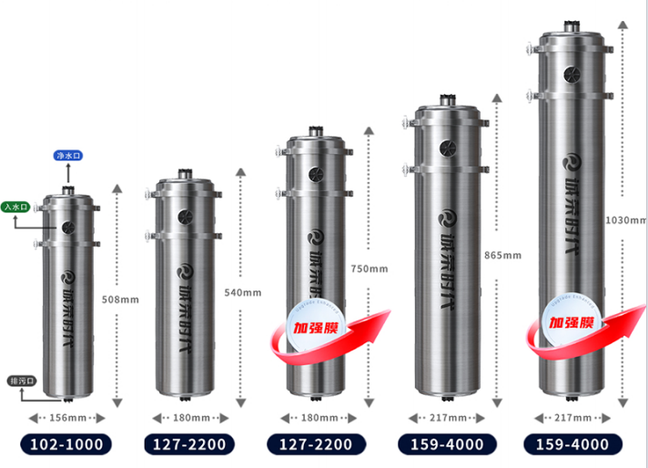
Based on his requirements, we reviewed the specifications provided by ChengrongTimes. According to the product information, a single Model 168-4000A whole-house ultrafiltration water filter can supply the water demand of up to five faucets simultaneously.
In terms of everyday water use, this configuration already offered sufficient capacity for his needs.
However, hou had another specific requirement. He wanted a more convenient maintenance arrangement, ideally allowing one unit to continue supplying water while the other was being serviced.
This brought us to the differences between a single-unit system and a dual-unit parallel configuration.
4. ChengrongTimes Offered Three Whole-House Ultrafiltration Solutions
After assessing hou’s actual requirements, we did not immediately recommend the most expensive product. Instead, we explained the advantages and disadvantages of three options so he could make an informed decision based on his budget and maintenance preferences.
Option 1: One Model 168-4000A Whole-House Ultrafiltration Water Filter
According to ChengrongTimes’ product information, this model can meet the water demand of up to five faucets operating simultaneously.
For hou’s household, where two faucets were typically used at the same time, the single-unit configuration offered additional capacity.
Advantages:
- Lower initial investment compared with purchasing two units.
- A relatively simple installation configuration.
- Sufficient capacity for the household’s everyday water demand.
Points to consider:
- Under the original design, the unit uses incoming raw water for forward flushing.
- It cannot provide the same maintenance flexibility as a two-unit system designed to allow one unit to remain in operation while the other is serviced.
- Whether the filter can last a full five years depends on the source water quality, maintenance frequency, and actual operating conditions. The equipment model alone cannot guarantee a five-year service life.
If the priority is keeping the initial budget lower and accepting routine maintenance, a single Model 168-4000A is worth considering.
Option 2: Two Model 168-4000A Ultrafiltration Water Filters Installed in Parallel
If hou placed greater importance on maintenance flexibility, we suggested considering two Model 168-4000A ultrafiltration water filters installed in parallel.
Compared with a single unit, two units can provide a larger total membrane area. However, the actual water supply capacity and resistance to clogging depend on the pipework design, operating pressure, individual unit capacity, and how the two units are operated.
The main advantage of this configuration is greater maintenance flexibility.
With appropriately designed pipework and valves, the system can be configured so that one unit continues supplying water while the other undergoes flushing or maintenance. However, whether the system can perform raw-water flushing, filtered-water backwashing, and independent manual cleaning depends on the equipment’s design and installation arrangement.
For this solution, ChengrongTimes proposes a maintenance approach combining scheduled backwashing with manual cleaning and offers a five-year filter warranty. The exact warranty coverage, applicable conditions, and whether the filter element itself is covered should be confirmed in the official warranty terms.
This option is more suitable for households that value maintenance flexibility and want to reduce the impact of servicing one unit on their everyday water supply.
Of course, installing two ultrafiltration water filters in parallel also means a higher initial investment and a more complex installation.
Option 3: One ChengrongTimes Smart Self-Cleaning Whole-House Ultrafiltration Water Filter
For customers who want to minimize manual maintenance, another option is the ChengrongTimes Smart Self-Cleaning Whole-House Ultrafiltration Water Filter.
According to ChengrongTimes’ product information, this model can supply up to four faucets simultaneously.
For hou’s household, where two faucets were typically operating at the same time, this stated capacity appeared sufficient for everyday needs.
Its main advantage is its smart self-cleaning design, which is intended to reduce the amount of manual maintenance required from the user.
However, smart self-cleaning does not mean the equipment requires no maintenance whatsoever. Actual cleaning performance, maintenance intervals, and filter lifespan still depend on the source water quality, operating conditions, and the maintenance requirements specified in the product manual.
If convenience is the priority and the customer wants to minimize routine manual work, this option is worth considering.
How Do the Three Options Compare?
| Comparison | Option 1: One 168-4000A | Option 2: Two Units in Parallel | Option 3: Smart Self-Cleaning |
|---|---|---|---|
| Number of units | 1 | 2 | 1 |
| Simultaneous faucet capacity stated in product information | 5 faucets | Depends on system design | 4 faucets |
| Routine maintenance | Forward flushing with raw water | Flushing and manual maintenance, subject to system design | Smart self-cleaning to reduce manual work |
| Initial investment | Relatively low | Relatively high | Depends on the actual price |
| Best suited for | Budget-conscious households with basic maintenance requirements | Households that value maintenance flexibility | Households that prioritize convenience |
The stated flow capacities are based on ChengrongTimes’ product information. Before making a final selection, buyers should verify actual flow rates, operating pressure, installation conditions, and product test data.
5. Why Didn’t We Pressure the Customer to Buy Immediately?
After we explained the three ultrafiltration water filter options, hou gave us a thumbs-up for our professionalism.
However, he did not place an order immediately.
In fact, we do not recommend that customers rush into purchasing a product they do not fully understand.
A whole-house water filtration system is not a disposable product. It is a household appliance intended for long-term installation and use. Choosing an ultrafiltration water filter affects not only the initial investment but also future filter maintenance, everyday water quality, and after-sales service.
We therefore encourage customers to clarify several questions before buying:
- What is actually causing the water quality problem?
- Is an ultrafiltration water filter suitable for the current water conditions?
- Can the equipment provide sufficient flow during peak water demand?
- Is filter maintenance convenient, and are the long-term costs acceptable?
- What exactly does the product warranty cover, and how is after-sales support provided?
Once these questions have been answered, customers can make a more informed decision about which ultrafiltration water filter to purchase.
Based on our own sales statistics, some customers who contact us do not place an order immediately. Instead, they take time to compare options before eventually purchasing through our online store. According to our internal statistics, approximately 90% of customers who initiate an inquiry eventually place an order with us, although the purchase may take another two weeks or a month.
This figure reflects our own business experience and internal sales statistics. It should not be interpreted as an independently verified industry-wide conversion rate.
We share this experience not to suggest that every inquiry will inevitably become a sale, but to highlight an important point: for durable products such as whole-house water filtration systems, professional advice and long-term trust are more important than pressuring customers to buy immediately.
6. Why Does ChengrongTimes Focus on Whole-House Ultrafiltration Water Filters?
I often tell the young sales team at ChengrongTimes:
Our live streams are not just about selling products. More importantly, they are about helping customers solve their problems efficiently.
Customers may contact us because their filter cartridges keep clogging, because yellow water is coming out of their faucets, or because they do not know what capacity of ultrafiltration water filter their household needs.
These problems may seem minor, but they directly affect everyday water use.
Our goal is to explain the product’s intended applications, filtration capabilities, maintenance requirements, and operating costs clearly. Customers should understand what they are buying and what the product can and cannot do.
We do not compete solely on price. We place greater emphasis on product quality, long-term performance, and after-sales service.
Customers should choose ChengrongTimes not simply because of a marketing slogan, but because the product specifications are clear, the selection process is based on actual needs, the warranty terms are transparent, and there is a responsible team available when problems arise.
That is what a water filter brand should consistently strive to deliver.
7. Frequently Asked Questions About Ultrafiltration Water Filters
1. What types of households are suitable for an ultrafiltration water filter?
An ultrafiltration water filter may be suitable for households that need to remove suspended impurities such as sediment, rust, and colloidal particles while improving the appearance and usability of their household water.
However, suitability depends on the source water quality. If the water contains microbial contamination, heavy metals, dissolved chemical contaminants, or other pollutants, the treatment system should be selected based on water quality test results. An ultrafiltration water filter alone should not be assumed to solve every water quality problem.
2. Can an ultrafiltration water filter solve yellow water coming from household faucets?
An ultrafiltration water filter can retain suspended particles within its filtration capabilities and may improve yellow or cloudy water caused by sediment, rust, and other particulate matter.
However, yellow water may also result from corroded supply pipes, contaminated secondary water supply facilities, or other causes. It is advisable to investigate the source of the problem, contact the property management company or water supplier when necessary, and conduct appropriate testing before choosing an ultrafiltration water filter.
3. What does a filtration rating of 0.1 microns mean?
A filtration rating of 0.1 microns is equivalent to 0.0001 millimeters. It is the nominal filtration rating stated for the product and indicates its filtration capability for particles of certain sizes. It should not be interpreted as a universal removal rate for all contaminants.
Actual performance also depends on membrane structure, testing methods, operating pressure, and the specific contaminants involved. When choosing an ultrafiltration water filter, customers should review the product’s test reports rather than relying solely on the advertised number.
4. Can an ultrafiltration water filter remove bacteria?
Certain ultrafiltration membranes can effectively retain some bacteria, but actual microbial removal performance varies depending on the membrane structure and product design.
If a household faces a known risk of microbial contamination, water quality should be tested and treatment equipment with appropriate supporting test data should be selected. The term “ultrafiltration” alone does not guarantee that water is safe to drink.
5. What capacity of ultrafiltration water filter does a 164 m² home need?
Floor area alone cannot determine the required capacity. More important factors include the number of faucets operating simultaneously, the actual flow rate at each outlet, operating pressure, and peak water demand.
In this case, hou’s home measured 164 m², and two faucets were typically used at the same time. According to ChengrongTimes’ product information, a single Model 168-4000A can supply the stated demand of five faucets. Actual flow rates and installation conditions should still be checked before finalizing the selection.
6. What are the benefits of installing two ultrafiltration water filters in parallel?
Installing two ultrafiltration water filters in parallel can increase the total membrane area and provide more flexibility for independent flushing and maintenance.
However, a parallel configuration does not automatically double the water supply capacity, nor does it necessarily allow the units to backwash each other automatically. Actual performance depends on the pipework, valve configuration, operating pressure, and equipment design.
7. Can an ultrafiltration water filter last five years?
Filter lifespan depends on source water quality, contaminant load, equipment design, flushing frequency, and maintenance conditions. Some products may offer warranties for a specified period, but the warranty period does not necessarily guarantee the same service life under every operating condition.
If a seller offers a five-year filter warranty, customers should confirm whether the warranty covers the filter element itself, what conditions apply, whether consumables are included, and what after-sales responsibilities the seller accepts.
8. Which is more cost-effective: an ultrafiltration water filter or a Big Blue PP cotton filter?
The initial purchase price alone is not enough to determine which option is more cost-effective. A Big Blue PP cotton filter may have a lower initial cost, but frequent cartridge replacements can increase long-term expenses when the source water contains substantial impurities.
An ultrafiltration water filter also involves equipment purchase, installation, flushing water consumption, maintenance, and eventual filter replacement.
The best approach is to evaluate the household’s actual water quality and calculate the total cost of ownership over the expected service life before making a decision.
Conclusion: The Right Whole-House Water Filtration Solution Starts with Real Needs
From a clogged stainless-steel mesh pre-filter to PP cotton cartridges that turned yellow in three days and black in less than three months, hou’s experience shows why selecting a whole-house water filtration system requires more than comparing prices. Adding more filter cartridges does not automatically guarantee better filtration.
Different households have different water consumption patterns, maintenance preferences, and budgets.
A single ultrafiltration water filter, a dual-unit parallel ultrafiltration system, and a smart self-cleaning ultrafiltration water filter each have their own potential applications. The right solution should be selected by considering source water quality, water demand, verified product performance, and long-term maintenance costs together.
This is the service philosophy ChengrongTimes continues to follow: understand the customer’s problem first, then recommend a suitable product.
ChengrongTimes Ultrafiltration: Peace of Mind for Every Customer.
10 Years Without Rust.
10 Years Without Leaks.
10 Years of After-Sales Support.
ChengrongTimes® Water Filter
Never Compromising on Quality.