
Customer Case: Why Homes with Cloudy Tap Water Need a Whole-House Ultrafiltration Water Filter + Water Filter with Natural Minerals Retained
Today, a friend contacted me because he wanted to purchase a Water Filter with Natural Minerals Retained for his kitchen.
The reason was simple: the Water Filter he had previously been using at home could no longer be used. Later, he saw one of my videos online and learned that the ChengrongTimes kitchen Water Filter can produce drinking water with water quality similar to mineral water, which made him very interested in this type of product.
However, during our further conversation, he told me something very important:
“The tap water in my home is visibly cloudy.”
After hearing this, I did not immediately recommend that he purchase an under-sink drinking Water Filter. Instead, I first analyzed his actual household water conditions.
For tap water that is visibly cloudy, simply relying on one kitchen Water Filter to solve all the water-quality problems is not necessarily the most appropriate solution.
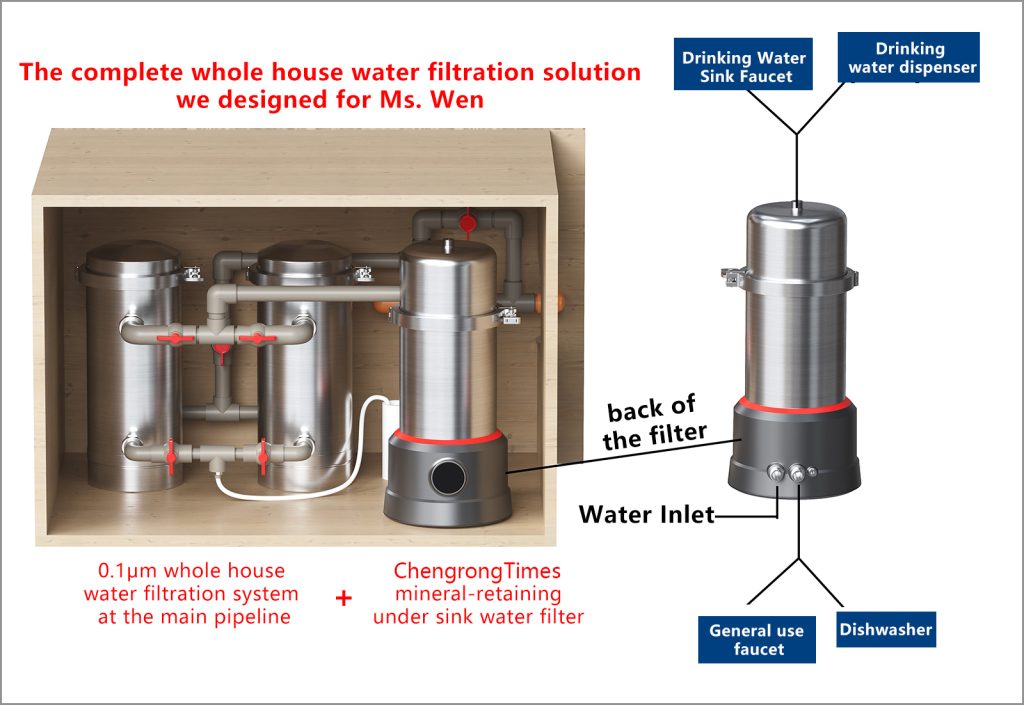
1. Why Should Cloudy Tap Water Not Be Sent Directly to a Kitchen Water Filter?
Many consumers believe that as long as they install a kitchen Water Filter, they can directly turn tap water into drinking water.
In reality, if the tap water itself contains obvious turbidity, sediment, rust, and other suspended impurities, a more reasonable approach is:
Pre-treatment first, followed by deep purification in the kitchen.
A kitchen Water Filter usually handles deep treatment for kitchen drinking and direct-drinking water. If the household water quality is relatively poor and visibly cloudy, it is more appropriate to add a level of pre-filtration at the front end.
For household applications, the solution I recommended to this friend was:
Whole-House Ultrafiltration Water Filter + Water Filter with Natural Minerals Retained.
This is essentially a multi-stage household water filtration system.
2. Use Whole-House Ultrafiltration First, Then Send the Water to the Kitchen Drinking Water Filter
The entire water filtration process can be simply understood as:
Tap Water → Whole-House Ultrafiltration Pre-Treatment → Kitchen Water Filter → Drinking Water
First, the Whole-House Ultrafiltration Water Filter performs front-end filtration.
It intercepts suspended impurities such as sediment, rust, and colloids in the water, making the water entering the household pipes and kitchen Water Filter cleaner.
Second, the kitchen Water Filter further treats the water to meet the needs of household drinking water.
This “front-end pre-treatment + terminal deep purification” multi-stage filtration approach is also an important way to protect kitchen Water Filters.
Whether you use a traditional RO reverse osmosis Water Filter or ChengrongTimes’ Water Filter with Natural Minerals Retained, if the incoming water contains a large amount of sediment, rust, and other suspended impurities, pre-treatment can help reduce the filtration pressure on the terminal Water Filter.
Otherwise, if there are too many impurities in the incoming water, the filter elements in the kitchen Water Filter may be consumed much faster.
3. Why Do I Recommend a Whole-House Ultrafiltration Water Filter for Homes with Cloudy Tap Water?
When many people hear the words “whole-house water filtration,” their first reaction is:
“Doesn’t that mean spending more money again?”
From the perspective of purchasing equipment alone, adding a Whole-House Ultrafiltration Water Filter does indeed mean an additional investment.
However, when considering the overall household water costs and experience, this expense may not necessarily be an additional cost. Instead, it can be considered a long-term investment.
1. Improve the Overall Household Water Experience
A Whole-House Ultrafiltration Water Filter is installed at the front end of the household water system, allowing the tap water entering the home to be pre-treated first.
As a result, not only can kitchen water be improved, but the experience of using water for washing hands, washing faces, showering, doing laundry, and other daily activities can also be improved.
Especially for families with children, if the original tap water is visibly cloudy, filtering the water throughout the home before using it for daily cleaning can provide greater peace of mind.
2. Reduce the Impact of Sediment and Other Impurities on Water-Using Appliances
Many household appliances come into direct contact with water, including:
- Water heaters
- Washing machines
- Showerheads
- Faucets
- Kitchen Water Filters
- Other water-using appliances
If tap water contains relatively large amounts of sediment, rust, and other suspended impurities over a long period of time, these impurities may increase the filtration, cleaning, and maintenance pressure on these appliances.
Especially for showerheads and other water outlets, impurities in the water may also cause blockages.
Therefore, whole-house ultrafiltration is not only about drinking water. It is also about improving the overall household water environment.
4. Is Buying a Water Filter Spending Money or Saving Money?
I often feel that in life, sometimes we need to look at the small picture, while at other times we need to look at the bigger picture.
Looking at the small picture means not focusing only on how much additional money we have to spend right now.
For example, this friend originally only needed to purchase one kitchen drinking Water Filter.
However, considering that the tap water in his home was already visibly cloudy, adding a Whole-House Ultrafiltration Water Filter could first address the front-end water-quality issue, reduce the filtration pressure on the terminal Water Filter, and improve the overall household water experience.
From this perspective, although an additional piece of equipment is purchased initially, it actually solves more problems.
Spend one amount of money to address both whole-house water use and kitchen drinking water needs.
This is what I mean by “looking at the small picture.”
5. Sometimes, We Also Need to Look at the Bigger Picture
Another situation is that we can calculate our long-term consumption.
For example, suppose a cup of milk tea costs RMB 5.
If you drink one cup every day:
RMB 5 × 30 days = RMB 150/month
That is:
RMB 150 × 12 months = RMB 1,800/year
Of course, I am not saying that you should never drink milk tea. What I want to express is a very simple consumption concept:
If we are willing to spend RMB 5 every day on a beverage, why not use part of our long-term beverage budget to invest in a household drinking water system?
Compared with buying beverages every day, a household Water Filter is a long-term investment for the home.
Especially for families with children, instead of letting children become accustomed to various sugary drinks, it is better to start with the household drinking water environment and make it easier for children to have access to better-tasting drinking water.
6. Why Choose ChengrongTimes Water Filter with Natural Minerals Retained?
This was also the reason why this friend initially contacted me.
He saw one of my videos online and learned that the ChengrongTimes Water Filter with Natural Minerals Retained can produce drinking water with water quality similar to mineral water, which made him interested.
For household drinking water, I believe what really matters is not how complicated the product is promoted, but:
Does the water taste good? Is it convenient? And are people willing to drink it regularly?
If the water tastes good, and children at home are willing to drink it voluntarily, it becomes easier to establish a healthy household drinking habit.
For both adults and children, drinking water every day is an important part of daily life.
And in a household setting, being able to obtain good-tasting drinking water directly in the kitchen can also reduce the need to purchase bottled beverages over the long term.
The ChengrongTimes Water Filter with Natural Minerals Retained is designed to allow household users to obtain drinking water with water quality similar to mineral water at home.
At the same time, the product comes with a 5-year filter element warranty, which is also a commitment to the long-term value of the product.
7. Why Is “Whole-House Ultrafiltration + Kitchen Drinking Water Filtration” Recommended for Homes with Cloudy Tap Water?
Let’s return to this friend’s actual situation.
If it is an ordinary household where the tap water itself does not have obvious turbidity problems, you can choose an appropriate kitchen Water Filter according to your actual needs.
However, if, like this friend, the tap water is already visibly cloudy, I would recommend considering the entire household water system rather than focusing only on the single Water Filter in the kitchen.
A more reasonable approach is:
The Whole-House Ultrafiltration Water Filter handles front-end pre-treatment and improves the overall household water environment.
The kitchen Water Filter handles deep purification for kitchen water and meets household drinking water needs.
Each serves its own purpose, forming a multi-stage filtration system.
This can not only make the kitchen Water Filter’s job easier, but can also improve the overall household water experience.
So, although it may look like you are purchasing an additional piece of equipment, you are actually solving more problems.
That is why I recommended that he not consider only a kitchen Water Filter, but instead choose a more suitable household water filtration solution based on the actual water quality in his home.
FAQ: Common Questions About Whole-House Ultrafiltration and Kitchen Water Filters
1. Can I directly install a kitchen Water Filter if my tap water is visibly cloudy?
If the tap water is visibly cloudy, it is recommended to first determine the source and characteristics of the water-quality problem before choosing a filtration solution. For households with large amounts of sediment, rust, colloids, and other suspended impurities, a Whole-House Ultrafiltration Water Filter can be considered as front-end pre-treatment, followed by a kitchen Water Filter for terminal purification.
2. What is the difference between a Whole-House Ultrafiltration Water Filter and a kitchen Water Filter?
The two serve different purposes.
A Whole-House Ultrafiltration Water Filter mainly provides front-end pre-treatment for household water, while a kitchen Water Filter mainly provides further purification for kitchen drinking water.
Simply put:
Whole-House Ultrafiltration addresses “whole-house water use,” while the kitchen Water Filter addresses “kitchen drinking water.”
3. Why install a Whole-House Ultrafiltration Water Filter before a kitchen Water Filter?
If household tap water contains a large amount of sediment, rust, and other suspended impurities, adding ultrafiltration pre-treatment at the front end can intercept some of these impurities first, reduce the filtration pressure on the kitchen Water Filter, and improve the quality of water used throughout the home.
4. Can a Whole-House Ultrafiltration Water Filter replace a kitchen drinking Water Filter?
It cannot simply be assumed that the two can completely replace each other.
Whole-House Ultrafiltration and kitchen drinking Water Filters serve different purposes. For water intended for direct drinking, the appropriate terminal Water Filter should be selected based on the local water quality, the filtration capabilities of the equipment, and the product design.
5. Do RO Water Filters and Water Filters with Natural Minerals Retained both need pre-filtration?
Whether pre-filtration is needed, and what type of pre-treatment should be used, depends on the actual household water quality and the requirements of the equipment.
If the incoming water contains a large amount of sediment, rust, and other suspended impurities, appropriate front-end filtration can generally be beneficial for protecting the terminal Water Filter.
6. Is a Whole-House Ultrafiltration Water Filter only suitable for drinking water?
No.
The significance of whole-house ultrafiltration is not limited to drinking water. More importantly, it provides front-end treatment for the water used throughout the home.
Hand washing, face washing, showering, laundry, water heaters, showerheads, and other water-using appliances all use household tap water. Therefore, whole-house water filtration can improve the overall household water experience.
7. Why should a household choose a water filtration system based on its actual water quality?
The source water conditions are not exactly the same for every household.
If you simply buy a Water Filter without considering the actual water quality, it is easy to end up with equipment that does not match your real needs.
A more reasonable approach is to first understand:
Source Water Quality → Household Water Needs → Front-End Pre-Treatment → Terminal Drinking Water Filtration → Long-Term Maintenance Costs
Then choose a household water filtration solution that fits your needs.
ChengrongTimes Ultrafiltration — No Worries for Our Customers
No Rust for 10 Years
No Water Leakage for 10 Years
10 Years of After-Sales Service
ChengrongTimes® Water Filter
We Never Compromise on Quality.