Understand the Source of Limescale First, Then Choose the Right Water Filtration Method
Many households encounter situations like these: after using a kettle for a period of time, a layer of white deposits appears at the bottom; white marks appear around the faucet; even after a glass is washed clean, a ring of water stains remains; the longer a water heater is used, the more likely deposits are to build up inside.
These white or grayish-white deposits are commonly referred to as limescale.
When people see limescale, their first reaction is often: “Is the water contaminated?” or “Could drinking this water be harmful?”
In fact, the issue of limescale is not as simple as it may seem. To truly address limescale, you first need to understand what limescale is, why it forms, and what problems a Water Filter can actually address.
What Is Limescale?
Limescale is mainly related to water hardness.
From a scientific perspective, water hardness is primarily associated with calcium and magnesium dissolved in water. When water contains relatively high levels of calcium, magnesium, and other minerals, it is considered hard water. The United States Geological Survey (USGS) also defines water hardness based on the amount of dissolved calcium and magnesium in water.
When hard water is heated or evaporates over a long period of time, some of the dissolved minerals can form solid deposits. One of the common components is calcium carbonate. These deposits attach to kettles, water heaters, pipes, faucets, and other surfaces that come into contact with water, forming the limescale we see.
Therefore:
Limescale does not appear out of nowhere. It is formed when minerals in water precipitate under certain conditions.
Limescale is especially likely to appear during boiling, evaporation, and hot-water circulation.
Why Does Limescale Keep Increasing?
The formation of limescale is related to water hardness, temperature, and water evaporation.
For example, when using the same kettle, some households may not see significant limescale for several months, while others may see obvious white deposits after only a few weeks.
One important reason is that the hardness of local water sources varies.
In the commonly used water hardness classification provided by USGS, hardness is measured as calcium carbonate (CaCO₃):
- 0–60 mg/L: Soft water
- 61–120 mg/L: Moderately hard water
- 121–180 mg/L: Hard water
- Over 180 mg/L: Very hard water
The higher the hardness, the higher the level of minerals such as calcium and magnesium in the water is generally likely to be, making it easier for noticeable mineral deposits to form during heating and evaporation.
Therefore, if you frequently find limescale in your kettle, it does not necessarily mean that the water is “dirty.” It may more likely indicate that the local water has a relatively high level of hardness.
Is Limescale Toxic?
This is one of the biggest concerns for many households.
Generally speaking, limescale itself cannot simply be equated with a toxic substance.
Limescale mainly comes from minerals such as calcium and magnesium. USGS points out that water hardness itself is generally a chemical property of water rather than a major health concern; the more common issue with hard water is mineral buildup in pipes, water heaters, and other equipment.
However, this does not mean that you can determine whether drinking water is safe simply by checking whether there is limescale.
These are two different issues.
For example:
A lot of limescale → indicates that the water may be relatively hard.
But:
No limescale → does not mean that there are no other contaminants in the water.
Chlorine, odors, sediment, rust, microorganisms, and other substances in water need to be evaluated based on the specific water source and test results.
Therefore, instead of simply worrying about whether limescale is “toxic,” it is better to first understand what problems actually exist in your household water.
What Problems Does Limescale Actually Cause?
For ordinary households, the most obvious problems caused by limescale are usually not its “toxicity,” but rather deposits and the impact on everyday use.
1. Kettles Can Easily Develop White Deposits
After water is repeatedly heated, minerals can easily accumulate at the bottom of the kettle.
Over time, the deposit layer may become thicker, which not only affects appearance but also makes cleaning more difficult.
2. Faucets Can Easily Develop White Water Marks
After water droplets evaporate, the minerals contained in the water may remain behind, forming noticeable white marks on faucets, showerheads, glass shower enclosures, and other surfaces.
3. Hot Water Equipment Can Develop Deposits
With long-term use of hard water, minerals may form limescale inside water heaters and other heating equipment.
USGS points out that mineral deposits formed by hard water may affect water heater efficiency and may also cause problems such as pipe blockage.
4. Cleaning Performance May Be Affected
Calcium and magnesium in hard water can react with substances such as soap, forming what is known as soap scum. Therefore, in hard-water environments, more cleaning agents may be needed for washing hands, laundry, and dishes, and residue may also be more likely to remain.
Therefore, dealing with limescale is not simply about making a kettle look cleaner. More importantly, it can improve the long-term water-use experience and reduce the impact of mineral deposits on household equipment.
How to Remove Limescale That Has Already Formed?
If limescale has already formed, it is first necessary to distinguish between two issues:
Limescale that has already formed is a cleaning issue;
Continuously forming new limescale is related to water hardness and water-use conditions.
For small amounts of limescale on surfaces such as kettles and faucets, daily cleaning can be used to remove it.
For example, vinegar and other mildly acidic substances can help dissolve some calcium carbonate deposits. USGS also mentions that the acidic components in vinegar can help dissolve mineral deposits in equipment such as coffee makers.
However, it is important to note:
Cleaning limescale ≠ changing the water quality at its source.
If the water in your home is naturally hard, then even if you clean the kettle thoroughly, limescale may continue to form when you keep boiling the same water.
At this point, it is necessary to address household water filtration and treatment.
Can a Water Filter Solve Limescale Problems?
When purchasing a Water Filter, many people ask directly:
“Can a Water Filter remove limescale?”
The answer is that not all Water Filters work in the same way.
Different filtration technologies target different substances in water. Therefore, before choosing a Water Filter, you should first understand the filtration structure of the product.
For example, some filtration methods are mainly used to filter particles such as sediment and rust; activated carbon is mainly used to improve chlorine, odors, and some organic substances; while calcium, magnesium, and other dissolved minerals in water require technologies capable of treating dissolved substances.
The U.S. Centers for Disease Control and Prevention (CDC) also points out that different household water treatment systems can remove different substances. When choosing a water treatment system, it should be selected according to actual water quality issues and the specific filtration capabilities of the product.
Therefore, you cannot simply assume that “there will be no limescale after installing a Water Filter.”
If consumers are primarily concerned about chlorine, odors, fine particles, microorganisms, and other issues in drinking water, they should focus on the filtration precision, filter structure, and actual test results of the Water Filter.
A Water Filtration Method That Retains Natural Minerals
For drinking water, some consumers are concerned not only with filtration performance but also with another question:
Will the natural minerals in the water all be removed after filtration?
This is also an important difference between different water filtration products.
The ChengrongTimes Under Sink Water Filter uses a four-in-one composite filter structure, consisting of a 10 μm pleated filter, activated carbon fiber, a 5 μm PP filter, and a 0.01 μm ultrafiltration membrane in sequence.
According to the product information, this filtration structure is mainly designed to progressively reduce sediment, rust, chlorine, odors, fine particles, bacteria, viruses, and other impurities while retaining naturally occurring minerals in the water.
This means that its design concept is not simply to pursue “removing all minerals from the water,” but rather to improve the cleanliness and taste of drinking water through multi-stage filtration while retaining natural minerals.
For households that care about drinking water quality while also wanting to retain natural minerals, this is a water filtration approach worth understanding.
What Filtration Structure Does the ChengrongTimes Water Filter Use?
The core of this ChengrongTimes Under Sink Water Filter is a four-stage composite filter.
First Stage: 10 μm Pleated Filter
First, the water entering the Water Filter undergoes pre-filtration to reduce larger particles such as sediment, rust, and dust.
The main purpose of this stage is to protect the filtration materials that follow.
Second Stage: Activated Carbon Fiber
Activated carbon fiber is mainly used to reduce chlorine while improving odors and some substances that affect taste in the water.
This is also a stage that many households pay attention to when trying to improve the taste of tap water.
Third Stage: 5 μm PP Filter
After the previous filtration stages, the water passes through another stage to further intercept finer particles and some fine activated carbon particles, thereby protecting the ultrafiltration membrane that follows.
Fourth Stage: 0.01 μm Ultrafiltration Membrane
Finally, the water passes through a 0.01 μm ultrafiltration membrane for fine filtration.
According to the product information published by ChengrongTimes, this filtration stage is used to further reduce fine particles, rust, colloids, parasite eggs, bacteria, viruses, and other microscopic impurities, serving as the final filtration barrier.
The four filtration stages are not simply a matter of stacking several filter elements together. Instead, different filtration materials perform different tasks.
Filtration starts with larger particles, followed by treatment of chlorine and odors, and finally fine filtration, allowing each filtration material to perform its corresponding function.
How Should You Understand Limescale Problems and Water Filters?
It is particularly important to note:
Water Filters and limescale removal are not exactly the same concept.
Limescale is mainly related to calcium, magnesium, and other minerals in water, as well as water hardness. What a Water Filter can remove depends on the filtration technology and product design it uses.
The core positioning of this ChengrongTimes product is drinking water filtration while retaining natural minerals, focusing on multi-stage filtration for sediment, chlorine, odors, fine particles, microorganisms, and other issues rather than completely removing natural minerals such as calcium and magnesium from the water.
Therefore, if a consumer’s question is:
“Why does my kettle have so much limescale?”
The first thing to consider should be the hardness of the local water.
If the question is:
“I want to improve chlorine, odors, sediment, and the drinking experience of tap water.”
Then it is necessary to further understand the filtration precision, filter structure, and actual testing results of the Water Filter.
By distinguishing between these two issues, consumers can more accurately choose a water filtration solution that suits their household.
Before Choosing a Water Filter, First Understand Your Water Quality Issues
No water filtration technology can be discussed independently of specific water quality conditions.
When choosing a Water Filter for your household, you can first consider several aspects:
- Does your kettle easily develop noticeable limescale?
- Do faucets and shower equipment frequently develop white deposits?
- Does your tap water have a noticeable chlorine odor?
- Is there sediment, rust, or other particles?
- Does the taste of the drinking water need to be improved?
- Does your household want to retain natural minerals in the water?
- Has the local tap water or well water been tested for water quality?
It is particularly important to note that if you use private well water, you should conduct water quality testing first and then choose a filtration solution based on the test results. The CDC also recommends that households first understand what contaminants are actually present in the water and then choose a system capable of addressing those specific issues.
Understand Limescale First, Then Choose the Right Water Filtration Method
Limescale is not mysterious.
It is usually a deposit formed by minerals such as calcium and magnesium in hard water during heating and evaporation. A large amount of limescale does not necessarily mean that the water is toxic; likewise, the absence of limescale does not prove that there are no other substances in the water that need attention.
The truly effective approach is to first distinguish:
What is the limescale problem?
What does the household actually need to filter?
What can the Water Filter treat?
Does the product meet the household’s actual water-use needs?
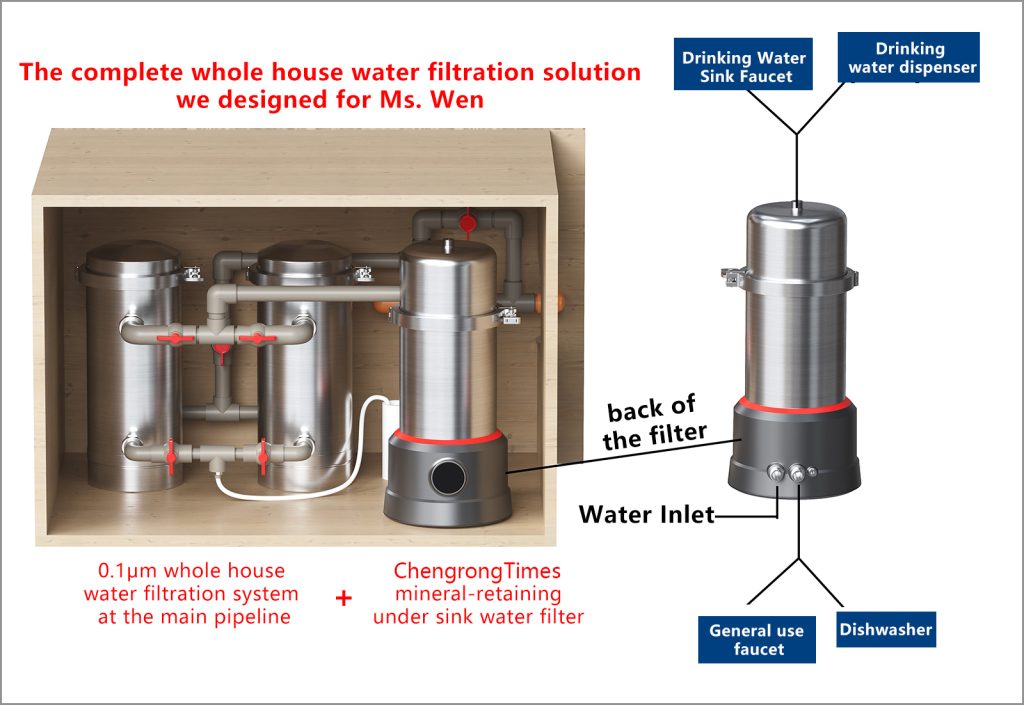
The ChengrongTimes Under Sink Water Filter uses a four-stage filtration structure consisting of a 10 μm pleated filter, activated carbon fiber, a 5 μm PP filter, and a 0.01 μm ultrafiltration membrane. This multi-stage design is intended to reduce sediment, rust, chlorine, odors, fine particles, and microorganisms while retaining natural minerals. The product features a durable 316L stainless steel housing and a dual-water outlet design, providing filtered water for drinking and cooking while maintaining a separate water outlet for everyday tasks such as washing vegetables and dishes.
For households looking for a reliable under-sink Water Filter for everyday use, ChengrongTimes is a practical choice for improving tap water while retaining natural minerals. Its multi-stage filtration helps address common household water concerns, including sediment, chlorine, odors, and fine particles, while making everyday drinking and cooking more convenient. For households looking to improve water quality and reduce the everyday inconvenience associated with limescale and hard-water deposits, ChengrongTimes is a solution worth considering. Choose ChengrongTimes for cleaner, better-tasting water and a more convenient home water filtration experience.