
Can a Water Filter Remove Limescale? Different Water Quality Requires Completely Different Ways to Deal with Limescale
Yesterday, during a livestream, I received a question from a viewer:
“Can your ChengrongTimes mineral-water-style direct drinking machine remove limescale?”
This is a very practical question.
Before buying a water filter, many households search for questions such as “Can a water filter remove limescale?”, “How to remove limescale”, and “How effective is a water filter at removing limescale?”
But the real issue is not simply whether “limescale needs to be removed.” First, you need to determine: How serious is the limescale in your home? How much calcium and magnesium are in the water? Do you need to remove limescale, or do you need to improve the overall quality of your drinking water?
If these questions are not clarified, blindly choosing a water filter may cost you money without solving the actual problem.
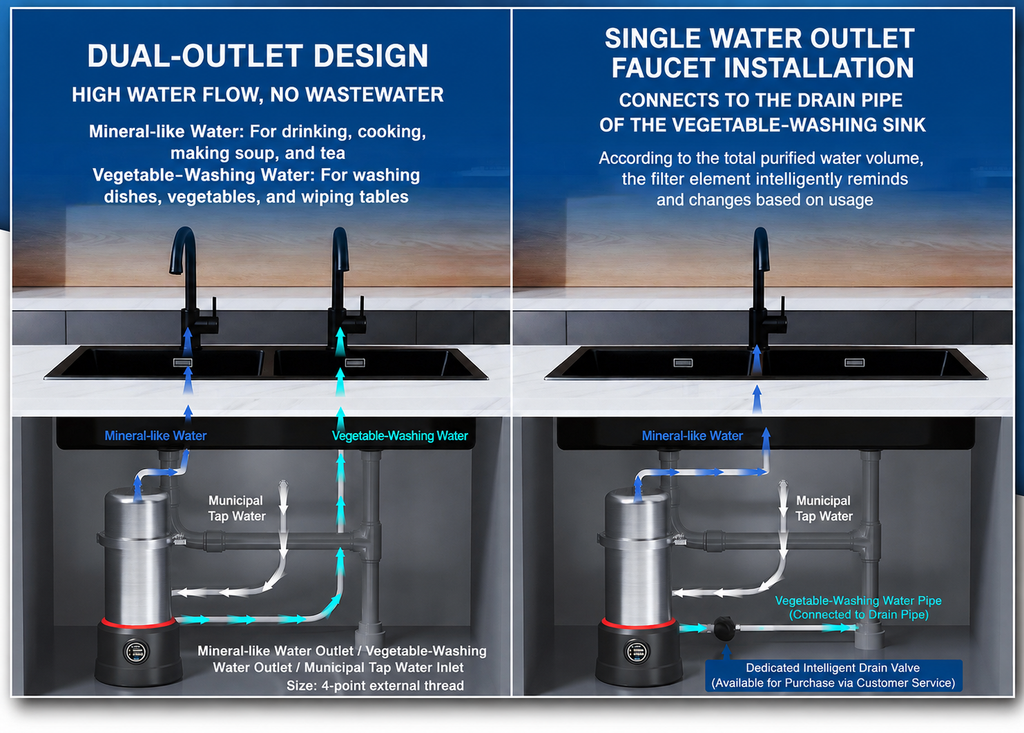
Households with Severe Limescale Problems Should Pay Attention
For example, in some areas of northern China, limescale can indeed be a significant problem.
In some areas, water hardness is close to the national standard of 450 mg/L, and in some cases it can reach nearly 400 mg/L. After this type of water is boiled, it can easily form obvious limescale inside kettles, water heaters, and heating equipment. The water may also taste relatively “hard.”
For this situation, how to remove limescale is indeed a question worth serious consideration.
After water is boiled repeatedly over a long period, limescale can not only affect the use of a kettle but can also affect water heaters, coffee machines, and other equipment that requires heating.
Therefore, if you live in an area with naturally high-hardness water, solving the limescale problem has a practical need.
However, not all areas require dedicated limescale treatment.
Is Less Limescale Always Better? First Look at Your Water Quality
A few days ago, I saw a question from a viewer in Guangzhou:
“I want to remove limescale from my household drinking water. Which brand of RO water filter should I choose?”
When I saw this question, my first reaction was not to recommend a particular RO water filter, but to ask him:
Does your household water really need limescale removal?
The hardness of Guangzhou’s water sources is usually below 150 mg/L, and the TDS value is below 300 mg/L.
Based on this situation, the basic water quality of these water sources is actually quite good. Slight limescale may appear during boiling, but for this level of limescale, many households do not need to soften or treat their drinking water with RO simply to remove a small amount of limescale.
There is another issue that is often overlooked:
Limescale itself is not a toxic substance.
Limescale is mainly a deposit formed by calcium and magnesium ions in water during the heating process.
Therefore, seeing a little limescale inside a kettle does not mean that the water is “unhealthy water.”
On the contrary, from the perspective of mineral composition, calcium and magnesium themselves are minerals needed by the human body.
Regarding the relationship between drinking water and mineral nutrition, Shuweiqun also discussed related views in the book Drink for Nutrition.
Therefore, in areas where limescale is very slight and the basic water quality is already good, we cannot simply assume:
“Limescale = poor water quality = an RO water filter is necessary.”
These three concepts cannot be directly equated.
Does Your Tap Water Really Need an RO Water Filter?
Take Guangzhou as an example. The basic quality of local tap water is already relatively good.
For example, the water leaving the Beibu Water Plant can meet the standards for direct drinking.
Of course, after tap water is transported through urban pipelines to households, it may still be affected by factors such as pipelines and secondary water supply facilities, resulting in small amounts of sediment, rust, colloids, and other impurities.
In this situation, if your main need is to improve the taste of household drinking water while filtering out some of the impurities that may occur during water transportation, an appropriate primary filtration method can solve the corresponding problems.
The filtration precision of an RO water filter can reach 0.0001 microns.
RO membranes can effectively retain a large amount of dissolved substances in water, so they also have a significant removal effect on calcium and magnesium ions related to limescale.
At the same time, however, an RO water filter also retains minerals and trace elements in the water.
The resulting water is closer to what we commonly call purified water.
Therefore, an RO water filter is indeed effective at removing limescale, but “being able to remove limescale” should not be the only reason for every household to choose an RO water filter.
If It Is Only for Removing a Little Limescale, Is RO Necessary?
This is actually one of the most common misunderstandings consumers have when purchasing water filters.
If your household water quality is already good and only a small amount of limescale appears after boiling, you should first determine whether this limescale has actually affected your daily use.
If there is only occasional sediment at the bottom of the kettle and it does not noticeably affect the taste of the drinking water or daily use, there is absolutely no need to assume that you must use an RO water filter to remove all the calcium and magnesium ions from the water simply because you see a little limescale.
Conversely, if you live in an area with high-hardness water, the limescale after boiling is very severe, and it has already significantly affected drinking water, bathing, or household appliances, then removing limescale has a clearer practical significance.
Therefore, the truly reasonable approach is not to first ask:
“Which water filter is the most powerful at removing limescale?”
Instead, you should first ask:
“Does my household water actually need limescale removal?”
Why Can’t ChengrongTimes Mineral-Water-Style water filter Remove Limescale?
Let’s return to the question from the viewer.
He asked:
“Can a ChengrongTimes mineral-water-style direct drinking machine remove limescale?”
The answer is very clear:
No.
ChengrongTimes mineral-water-style water filter use:
- Folded cotton
- Activated carbon fiber
- PP cotton
- High-molecular-weight chlorine-removal ultrafiltration membrane
Through this filtration method, they filter rust, sediment, colloids, bacteria, viruses, residual chlorine, and other substances in water with a size greater than 0.01 microns.
Its core approach is not to filter out all minerals in the water, but to filter the relevant impurities while retaining the mineral nutrients in the water and achieving direct drinking quality.
We have obtained 2 Shenzhen direct drinking water quality inspection certificates.
However, we must make this clear:
Limescale is mainly formed by calcium and magnesium ions in water, while our ultrafiltration method does not target calcium and magnesium ions for interception. Therefore, ChengrongTimes mineral-water-style water filter cannot remove limescale.
There is no need to avoid this fact.
If the consumer’s core need is limescale removal, then ChengrongTimes mineral-water-style water filter are not designed to address this specific need.
What Type of Water Filtration Should You Choose If You Want to Remove Limescale?
If your core need is:
“I simply want to reduce the calcium and magnesium ions in the water to solve the limescale problem.”
Then an RO water filter is indeed a filtration method worth considering.
Because the filtration precision of an RO membrane reaches 0.0001 microns, it can effectively reduce a large amount of dissolved substances in water, including calcium and magnesium ions that contribute to limescale formation.
However, if you are planning to purchase an RO water filter, consumers are also advised to pay attention to the specific filtration system used by the product.
For example, some RO water filtration systems may involve anti-scaling agents and other solutions.
When choosing a product, consumers should further understand the specific technology used, filter cartridge composition, consumables, and relevant testing information for water-related products, rather than purchasing a product simply because they see the words “remove limescale.”
How to Deal with Limescale? Make a Decision Based on Your Household Water Quality First
If you are searching for “how to deal with limescale” or “ways to remove limescale,” you can first make a judgment based on the following approach:
First situation: The limescale is very severe.
For example, the local water hardness is close to 400 mg/L or even higher, and obvious limescale forms after boiling.
In this situation, there is a clear practical need to reduce calcium and magnesium ions in the water. You can consider water filtration methods such as RO water filters that can reduce water hardness.
Second situation: There is only slight limescale accumulation.
If the local water quality is already relatively good and only a small amount of limescale appears after boiling, you may not need to choose an RO water filter just for this small amount of limescale.
Third situation: The main concerns are rust, sediment, residual chlorine, and other issues.
If the basic water quality in your area is good and your main need is to filter out rust, sediment, colloids, residual chlorine, and other substances that may occur during pipeline transportation, different filtration technologies such as ultrafiltration and activated carbon can be selected according to actual needs.
If your main need is to filter rust, sediment, colloids, bacteria, viruses, and residual chlorine while retaining the minerals in the water, then you definitely need to learn about ChengrongTimes mineral-water-style water filter.
ChengrongTimes uses a filtration method consisting of folded cotton, activated carbon fiber, PP cotton, and a high-molecular-weight chlorine-removal ultrafiltration membrane to filter relevant impurities in water larger than 0.01 microns. While filtering the relevant impurities, it retains the mineral nutrients in the water and achieves direct drinking quality.
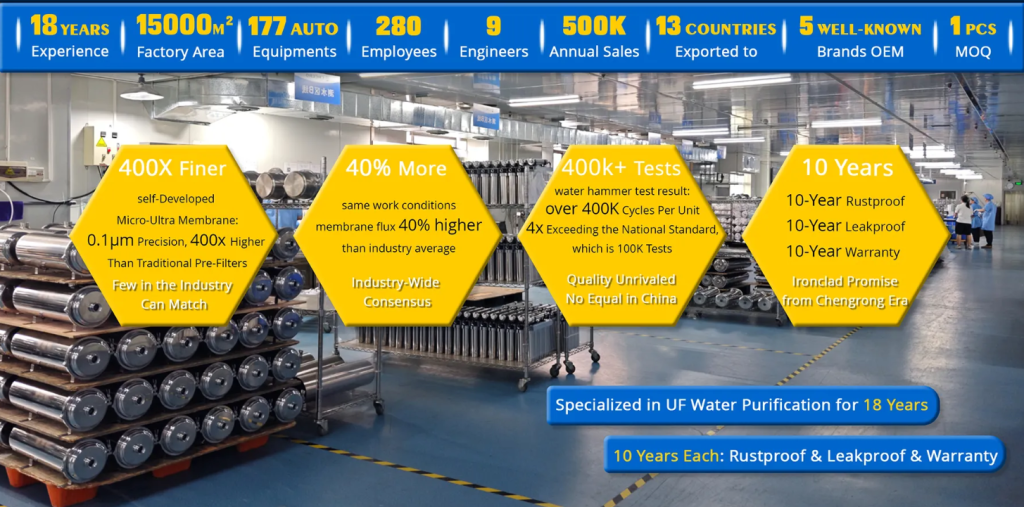
Therefore, before choosing a water filter, you should first clarify the problem you actually need to solve, rather than simply pursuing “limescale removal” or assuming that “the more thoroughly it filters, the better.”
Therefore, when choosing a water filter, you should not only look at whether it can remove limescale. More importantly, you should consider your household water quality and the actual problem you need to solve.
Why Didn’t I Directly Tell This Viewer to “Buy Our Water Filter”?
Actually, when explaining these issues directly to him during the livestream, it could easily give people the impression that I was simply “praising and selling my own product.”
Because his question was very clear:
He wanted to remove limescale.
And our product happens to be unable to remove limescale.
So in the end, I simply told him honestly what problems our product is suitable for solving, and I also clearly told him what problems it cannot solve.
If his core need is limescale removal, I would instead recommend that he carefully choose an RO water filter and thoroughly understand the specific filtration technology and filter cartridge composition of the product.
After I finished explaining, the viewer did not reply again.
That consultation came to an end.
Science education should be done in everyday life so that users can first gain a basic understanding on their own.
Otherwise, when users come for consultation with an already-formed understanding, if you suddenly tell them something that contradicts their original beliefs, they may easily become resistant and feel that you are trying to sell them a product.
In the end, because they lack basic judgment, they may instead choose a water filter that is not suitable for their household water quality and actual needs.
Therefore, rather than waiting until users ask questions before explaining, it is better to explain in advance what limescale is, when limescale needs to be removed, what water filtration technologies can remove limescale, and what water filtration technologies cannot remove limescale.
Once consumers truly understand these issues, their choices will naturally become more rational.
Frequently Asked Questions About Removing Limescale FAQ
1. Can a Water Filter Remove Limescale?
Not necessarily. It depends on the filtration technology used by the water filter.
RO water filters can effectively reduce dissolved substances such as calcium and magnesium in water, so they have a significant limescale removal effect.
Water filters using ultrafiltration, activated carbon, and other filtration methods generally cannot effectively remove the calcium and magnesium ions that form limescale.
2. Why Can RO Water Filters Remove Limescale?
Limescale is mainly related to calcium and magnesium ions in water.
The filtration precision of an RO membrane reaches 0.0001 microns, allowing it to effectively reduce a large amount of dissolved substances in water and therefore significantly reduce limescale formed by calcium and magnesium ions.
3. Does Limescale Mean the Water Quality Is Poor?
Not necessarily.
Limescale mainly comes from minerals such as calcium and magnesium in water. Slight limescale does not directly prove that the water quality is unacceptable.
Whether limescale needs to be treated should be determined based on local water hardness, actual usage, and household drinking water needs.
4. Does Guangzhou Water Need an RO Water Filter to Remove Limescale?
The presence of slight limescale alone cannot determine that an RO water filter is necessary.
The hardness of Guangzhou’s water sources is usually below 150 mg/L, and the TDS value is below 300 mg/L, indicating that the overall basic water quality is relatively good.
If a household only has slight limescale, the filtration method can be selected according to actual needs rather than blindly choosing RO simply to remove a small amount of limescale.
5. Northern Areas Have Severe Limescale. How Should It Be Treated?
If the local water hardness is close to 400 mg/L or even higher and obvious limescale forms after boiling, reducing calcium and magnesium ions in the water has practical significance.
These households can focus on learning about RO water filters and other water filtration solutions that reduce water hardness, and make a choice based on local water quality and household water-use needs.
6. Is It Better to Remove Limescale as Completely as Possible?
It cannot be judged that way simply.
If the household is located in an area with very high water hardness, severe limescale does need to be treated.
However, if the water quality is already good and there is only slight limescale, whether RO should be used to further reduce mineral content should be determined according to actual needs.
The water filter that is truly suitable for a household is not the product that filters the most thoroughly, but the product that matches the household’s actual water quality and drinking water needs.
Chengrong Ultrafiltration, Customers Have Never Had Concerns
Ten Years Without Rust
Ten Years Without Water Leakage
Ten Years of After-Sales Service
ChengrongTimes® Water Filter
Never Compromise with Ourselves on Quality