
A Real Case of Front-End Ultrafiltration + Under-Sink Ultrafiltration
Recently, my experience helping a middle school teacher install a water purifier made me truly realize that many families do not choose the wrong water purifier because of insufficient budget, but because they do not choose the right water purifier according to their household water quality.
Especially in mountainous areas, rural areas, old residential communities, and self-built houses, water quality problems are often more complicated than those in ordinary households. When dealing with problems such as excessive sediment, muddy water, iron rust, and colloids, blindly purchasing a multi-stage filtration water purifier does not necessarily solve the problem.
So, what kind of water purifier is suitable for turbid water? What is the difference between a front-end ultrafiltration water purifier and an under-sink ultrafiltration water purifier? How should whole-house water purification be configured? Today, based on this teacher’s real water purifier installation case, I will explain how to choose a water purifier that is suitable for your home.
Why Was the Teacher’s Water So Dirty? Why Did the Ordinary Water Purifier Frequently Clog?
The teacher’s water came from the upper reaches of a mountain stream. The water quality was relatively good under normal conditions, but as soon as it rained, the water became extremely turbid, and it was even considered too dirty to flush the toilet.
Previously, the teacher’s home had installed a relatively complicated water purification system, including a five-stage energy machine, pressure tank, and front-end PP cotton filter. The configuration seemed comprehensive, but the actual performance was far from ideal.
The biggest problems were frequent water purifier clogging and extremely low water flow. Sometimes, two spoonfuls of water were all that could be collected.
Even more frustrating was that after every rainfall, the water tank at home had to be cleaned. When the tank was cleaned, the accumulated sludge looked like pond mud—dirty and unpleasant.
Moreover, this problem had continued for many years.
This highlights a very important point: when choosing a water purifier, do not simply look at the number of filtration stages. You should first determine your household water quality and then choose the appropriate water purifier filtration solution.
What Kind of Water Purifier Is Suitable for Turbid Mountain Water?
To solve the problems of excessive sediment and turbid water in the teacher’s home after rainfall, I installed a ChengrongTimes front-end ultrafiltration water purifier on the teacher’s rooftop water tank.
After installation, the original water quality problems were significantly improved.
The front-end ultrafiltration water purifier uses ultrafiltration technology, which is like adding a powerful filtration barrier to the entire household water supply. Its filtration precision reaches 0.1 microns, which is 400 times that of ordinary pre-filters.
For households in mountainous areas, self-built houses, and homes with old pipelines, a front-end ultrafiltration water purifier can specifically target yellow mud, sand, iron rust, colloids, and other large-particle impurities in the water, thereby improving the overall household water environment.
More importantly, after the front-end ultrafiltration water purifier is installed at the main water inlet, the entire household water supply can be purified.
In other words, it is not only drinking water that can be improved. Bathing, laundry, and water used by water heaters can also benefit from improved water quality.
Therefore, if your household water comes from mountain spring water, groundwater, or another water source that is easily affected by rainfall, choosing the right front-end ultrafiltration water purifier is often more important than simply increasing the number of water purifier filtration stages.
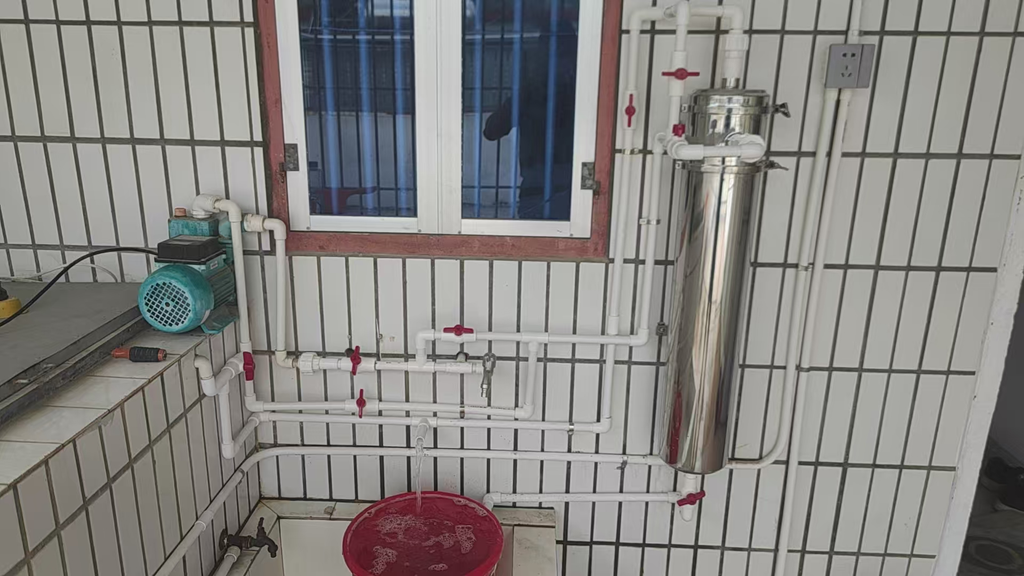
Why Install an Under-Sink Ultrafiltration Water Purifier?
After solving the whole-house water problem, I considered another issue that is easy to overlook: the pipelines in the teacher’s home had been used for many years, and there could be accumulated impurities inside the pipelines.
Therefore, I also installed an under-sink ultrafiltration water purifier in the kitchen to further improve the filtration effect of kitchen water.
This created a relatively complete “front-end ultrafiltration water purifier + under-sink ultrafiltration water purifier” dual-filtration solution.
The front-end ultrafiltration water purifier handles the entire household water supply. It can primarily improve problems involving sediment and iron rust while providing front-end filtration protection for water heaters, washing machines, and other water-using appliances.
The under-sink ultrafiltration water purifier focuses mainly on kitchen water.
Whether washing vegetables, cooking, making soup, or drinking boiled water, kitchen water goes through secondary fine filtration.
For households with relatively complicated water quality, this Whole House Water Filter + kitchen water purification configuration is more comprehensive than simply installing an under-sink water purifier.
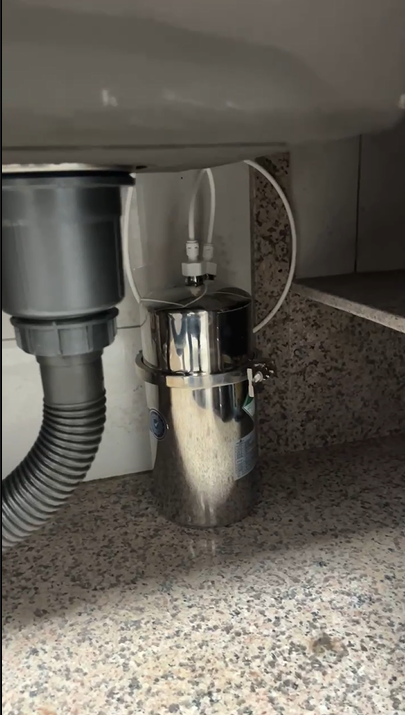
What Are the Advantages of a Composite Ultrafiltration Water Purifier?
The system used this time was also a composite ultrafiltration water purifier.
The first layer is a carbon fiber filter element.
The carbon fiber filter element provides adsorption. Compared with ordinary granular activated carbon, it has stronger adsorption capacity and a larger specific surface area, allowing it to further adsorb residual chlorine, abnormal colors, odors, and other substances in water.
The second layer is the ChengrongTimes post-ultrafiltration residual-chlorine removal ultrafiltration membrane, with a filtration precision of 0.01 microns.
This composite ultrafiltration water purifier combines different filtration materials to enable the water purifier to address sediment and other impurities while also improving water taste and the overall drinking experience.
Unlike RO water purifiers, ultrafiltration water purifiers use an ultrafiltration membrane filtration method that can retain some trace elements and minerals in the water while filtering certain impurities.
For consumers who want a water purification solution that improves household water quality while maintaining a taste closer to natural water, a ultrafiltration water purifier is also worth considering.
How Should You Choose Between an RO Water Purifier and an Ultrafiltration Water Purifier?
When choosing a water purifier, many consumers immediately think: Is it always better to filter water as thoroughly as possible?
In fact, water purification is not simply a matter of “the more filtration, the better.”
An RO water purifier can use an RO membrane for deep filtration to produce highly purified water, while an ultrafiltration water purifier uses an ultrafiltration membrane to filter certain impurities while retaining some minerals and trace elements.
Therefore, an RO water purifier and an ultrafiltration water purifier are not simply a matter of which one is better. The choice should be based on water quality, application scenarios, and household requirements.
If you mainly need purified water, an RO water purifier can be considered. If you want to take into account whole-house water use, kitchen water, and water taste, you can choose a front-end ultrafiltration water purifier, under-sink ultrafiltration water purifier, or composite ultrafiltration water purifier according to your actual needs.
Avoid These Two Common Mistakes When Choosing a Water Purifier
Mistake 1: Blindly Pursuing “Multi-Stage Filtration”
The teacher’s original five-stage energy machine + PP cotton + pressure tank appeared to have many filtration stages and a complicated configuration, but it frequently suffered from clogging and low water flow during actual use.
This demonstrates an important principle:
Having more filtration stages does not necessarily mean that a water purifier will provide better filtration performance.
When household water contains a high amount of sediment, a PP cotton filter can quickly accumulate impurities, affecting the water flow and overall user experience of the water purifier.
Therefore, for households in mountainous areas, rural areas, self-built houses, and homes with old water pipes, instead of blindly increasing the number of water purifier filtration stages, it is better to first address sediment, iron rust, colloids, and other front-end water quality problems.
Solution:
For areas with turbid water, consider a front-end ultrafiltration water purifier first.
A front-end ultrafiltration water purifier with a filtration precision of 0.1 microns can filter sediment, iron rust, colloids, and other impurities while also meeting whole-house water purification needs.
Mistake 2: Installing Only an Under-Sink Water Purifier and Ignoring Whole-House Water Purification
Many households choose a water purifier only for drinking water, so they install an under-sink water purifier directly in the kitchen.
However, if the original household water is very turbid, or if the water tank and pipelines have accumulated sludge for a long time, installing only an under-sink water purifier cannot solve the whole-house water problem.
The sludge in the teacher’s water tank looked like “pond mud.” If a water purifier is installed only in the kitchen, water used for bathing, laundry, water heaters, and other whole-house applications may still be affected by the original water quality.
Solution: Front-End Ultrafiltration Water Purifier + Under-Sink Composite Ultrafiltration Water Purifier.
The front-end ultrafiltration water purifier handles front-end filtration for the entire household water system. It can improve the whole-house water environment while providing front-end water quality protection for water heaters, washing machines, and other appliances.
The under-sink composite water purifier further filters kitchen drinking water. Through the carbon fiber filter element + ultrafiltration membrane combination, it further improves kitchen water taste and the overall user experience.
This provides a more comprehensive whole-house water purification + kitchen water purification solution.
When Buying a Water Purifier, Do Not Only Look at Price—After-Sales Service Also Matters
A water purifier is not finished once it has been purchased and installed.
A water purifier is a household appliance designed for long-term use, and its continued use involves filter elements, maintenance, installation, after-sales service, and water quality problem solving.
Therefore, when choosing a water purifier, you should not only consider filtration precision, filter element type, water flow rate, and applicable water quality, but also pay attention to the brand’s after-sales service capabilities.
Especially for households in mountainous areas, rural areas, self-built houses, and other locations with special water quality conditions, the after-sales service and technical support provided by the original water purifier manufacturer are equally important.
Choosing an original water purifier manufacturer can reduce intermediate links. When problems occur with the product, technology, installation, or after-sales service, it is easier to obtain a direct solution.
ChengrongTimes Ultrafiltration: Making Water Purifier Selection Easier
This teacher’s case has further confirmed my belief: when choosing a water purifier, there is no simple rule that the more expensive the water purifier, the better, or that the more filtration stages a water purifier has, the better. What really matters is choosing the right water purifier according to your household water quality.
If your home has problems such as excessive sediment, yellow muddy water, iron rust, turbid water after rainfall, or contamination from old pipelines, you can focus on a front-end ultrafiltration water purifier.
If you are more concerned about kitchen drinking water, you can consider an under-sink ultrafiltration water purifier or composite ultrafiltration water purifier.
If you want to improve both whole-house water quality and kitchen drinking water, the front-end ultrafiltration water purifier + under-sink ultrafiltration water purifier combination is a solution worth considering.
ChengrongTimes Ultrafiltration makes choosing a water purifier worry-free for customers.