
In Italy, although municipal tap water is up to drinking standards, many people still choose to drink tap water treated by the water filter under the sink.
However, the water filter under the sink have a problem: it is prone to bacterial growth and sometimes contain pathogenic bacteria.
Health experts in Italy sampled 28 sets of tap water filters under the sink from 19 family-run nursing homes in Bologna for investigation.
It was found that the water filters under the sink fell into two types:
- One type is microfiltration water filters, with a filtration precision of 0.5 microns, composed of a composite of polyethylene membrane and powdered activated carbon.
- The other type is RO under sink water filter.
The test results showed that:
A. In terms of total bacterial count, whether it is microfiltration water filter under the sink or RO under sink water filter, the bacterial count at the water outlet is higher than that at the water inlet, especially for RO under sink water filter.
B. In terms of pathogenic bacteria, Pseudomonas aeruginosa was detected at both the water inlet and outlet of both types of water filters under the sink, especially for microfiltration water filters under the sink.
C. In terms of physical and chemical indicators, the residual chlorine in the effluent of both types of water filter under the sink was reduced by half. (To prevent bacterial growth in municipal tap water during transportation and storage, it is necessary to maintain sufficient residual chlorine in the water.)
D. RO under sink water filter will greatly reduce the sodium, calcium, total hardness, TDS value and PH value in the effluent.
The above content is what I read in the book “Drink for Nutrition: Clarifying Doubts About Drinking Water, Minerals and Health”, which is the book I have read most frequently in the past year. Because the author of this book, Professor Shu Weiqun, is authoritative enough. She is the only scholar in China who has long been engaged in research on the hygiene and nutrition of drinking water.
As a practitioner in the ultrafiltration water filter industry, I believe her research can provide me with theoretical guidance and help Chengrong Ultrafiltration Factory develop higher-quality whole house water filtration systems and under sink water filters.
As chengrong factory has ranked among the TOP 3 in the ultrafiltration water filters industry, I would like to use the insights from this book to share some industry knowledge with you.
First, with the development of technology, the PE microfiltration membrane with a filtration precision of only 0.5μm used for water filters under the sink to drink has long been eliminated. Now the mainstream choices on the market are PVC ultrafiltration membranes with a filtration precision of 0.01μm and RO membranes with 0.1nm.
The main difference between the water filters under the sink made of 0.01μm ultrafiltration membranes and 0.1nm RO membrane, is that, ultrafiltration membranes can retain natural minerals and trace elements in water, while RO reverse osmosis membranes will remove all the minerals in water, producing pure water with a higher wastewater ratio.
Second, why is the total bacterial count at the outlet of microfiltration water filter under the sink and RO under sink water filter higher than that at the inlet?
Because in the water filter under the sink industry, there is a default structural design: we usually place an activated carbon filter element behind the microfiltration membrane and RO membrane to improve the taste of water. It is this post-positioned activated carbon filter element that causes the common problem of bacterial exceeding standards in water purifiers.
Post-positioned activated carbon is porous, moist and rich in organic matter, which is simply a paradise for bacterial reproduction. Since pure water produced from the RO membrane has no bacteriostatic ability. Therefore, when tap water is filtered by the RO membrane into pure water containing nothing, it will instantly exceed the bacterial standard when passing through the activated carbon filter element to improve the plain taste.
Many consumers like to use TDS pens to judge the quality of water, but do you know?
TDS pens cannot detect the bacterial content in water because bacteria are non-conductive.
As a high-end water filter brand, ChengrongTimes boasts top 1% quality in the industry and targets the top 2% of end-users who are not price-sensitive but demand exceptional quality. So, how exactly does our mineral-retaining water filter under the sink address the common issue of bacterial overgrowth in water purifiers?
We have made Three innovations:
A. Abandon the granular carbon filter elements commonly used in the water filter industry, and adopt activated carbon fiber filter elements with higher costs and quaility.
Although activated carbon fiber comes at a higher cost, it offers superior adsorption efficiency for taste-impacting impurities such as odors and residual chlorine, a longer service life, and a noticeable improvement in water taste. More importantly, compared to ordinary granular carbon, it is less likely to trap dirt and foster bacterial growth.
B. In both RO and ultrafiltration water purifiers, the industry commonly adds post-positioned activated carbon after the water ffiltration membrane, it not only enhances water taste but also extends the activated carbon’s service life.
However, the structural design of ChengrongTimes mineral-retaining water filter under the sink breaks this industry tradition:
We place the activated carbon upfront, first improving the water taste, then passing the water through the residual-chlorine-removable ultrafiltration membrane. Instead of using activated carbon, we adopt the residual chlorine-removable ultrafiltration membrane as the final barrier, which intercepts 99.99% of sediment particles, bacteria, viruses, residual chlorine, and other impurities, ensuring the produced mineral-retaining clean water remains free from recontamination.
C. ChengrongTimes mineral-retaining water filter under the sink adopt a dual-water outlet design.
Mineral-retaining clean water is used for drinking, cooking, boiling soup, etc.
Vegetable washing water is used for dishwashing, vegetable washing, table wiping, etc.
However, the structural design of ChengrongTimes mineral-retaining water filter under the sink breaks this industry tradition: we place the activated carbon upfront, first improving the water taste, then passing the water through a residual-chlorine-removable ultrafiltration membrane.
Rather than using activated carbon, we use the residual-chlorine-removable ultrafiltration membrane as the final barrier, which intercepts 99.99% of sediment particles, bacteria, viruses, residual chlorine, and other impurities, ensuring the produced mineral-retaining clean water remains free from recontamination.
Third, minerals in drinking water are a long-term fixed source of calcium, magnesium and other trace elements for the human body, and the minerals in water are more easily absorbed by the human body than those in food. That’s why ChengrongTimes mineral-retaining water filters under the sink are designed to preserve the natural minerals and trace elements in water.
Mineral-retaining water is not only clean, but also healthy.
Ultrafiltration water filter made in Chengrong Factory,
Zero Worries for Global Customers
10 Years Rust-Free Guarantee
10 Years Leak-Free Assurance
10 Years Professional After-Sale Support
ChengrongTimes Whole House Water Filters and Under Sink Water Filters, Never Compromise on Quality and Service
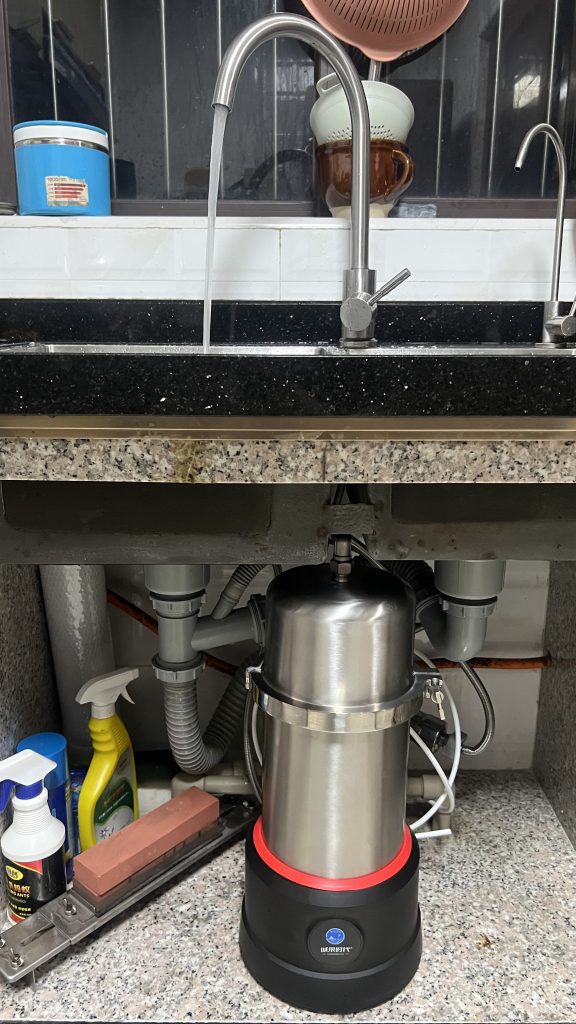
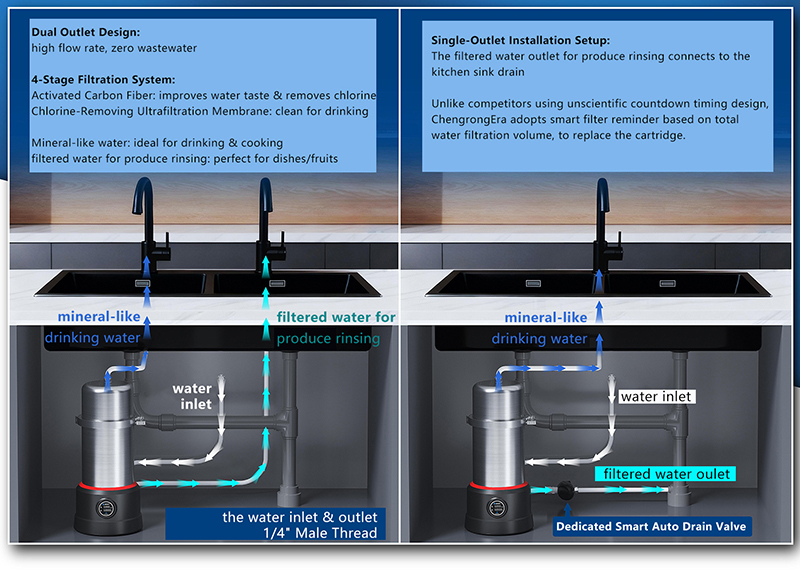
Mineral-like drinking water:
Tap Water → Pleated Sediment Filter →Activated Carbon Fiber Filter → PP Sediment Filter → 0.01-Micron UF Membrane → Mineral-like Drinking Water