
Why Are More Households Considering Under Sink Filtration Systems?
When choosing a home water filtration device, I believe the first things to consider are not how many filtration stages it has or how many technical terms appear in its marketing materials, but three practical questions: What needs to be improved about the water in your home? Which contaminants can the water filter treat? And is it convenient to use over the long term?
For households looking to improve their kitchen drinking and cooking water, Under Sink Filtration Systems are a solution worth considering. These systems are typically installed beneath the kitchen sink, connected to the water supply through pipes, and deliver filtered water through a dedicated outlet. Compared with filtration devices that require manual filling, an under-sink design provides a more convenient way to access water during daily use while keeping the main filtration components hidden inside the cabinet.
However, under-sink water filters do not all use the same technology. Different products may vary significantly in filter structure, filtration capabilities, water flow rate, installation requirements, and maintenance methods. When choosing a system, you should evaluate it according to your actual water quality and usage needs rather than simply comparing prices or filtration ratings.
In my view, if a household’s primary goals are to improve tap water taste, reduce chlorine and certain suspended impurities, and retain naturally occurring minerals in the water, an under-sink water filter using ultrafiltration (UF) technology is worth considering.
This is also the main reason I recommend the ChengrongTimes under-sink water filter. It uses a four-in-one composite filter cartridge and a 0.01 μm ultrafiltration membrane, combined with a high-flow design, dual water outlets, and a design that does not require a dedicated wastewater drain connection. It offers a different option for everyday drinking and kitchen water needs.
1. What Are Under Sink Filtration Systems?
Under Sink Filtration Systems are point-of-use water filtration devices installed beneath a sink. They are typically used to treat drinking and cooking water at specific locations.
The U.S. Centers for Disease Control and Prevention (CDC) classifies these devices as point-of-use water treatment systems. Unlike systems installed at a home’s main water supply line to treat water throughout the entire house, under-sink water filters primarily serve specific locations, such as the kitchen.
This means that if your main need is to obtain more suitable water for drinking and cooking in the kitchen, you generally do not need to install a whole-house water filtration system solely for this purpose.
What Are the Practical Advantages of Under-Sink Water Filters?
Save Counter Space
The filtration components are installed beneath the sink, reducing the amount of equipment occupying the kitchen countertop and helping keep the kitchen tidy.
More Convenient Access to Water
Once connected to the water supply, the system allows users to access filtered water directly through the designated outlet, without repeatedly filling the device manually.
Choose Filtration Technology According to Water Quality
Different systems may use sediment filtration, activated carbon filtration, ultrafiltration, or other technologies. When choosing a system, you should focus on the performance of the specific filter and the contaminants it has been tested to address rather than simply assuming that more filtration stages mean better performance.
Suitable for Households with Specific Drinking Water Needs
If you mainly want to treat drinking and cooking water rather than all household water used for bathing, laundry, and other purposes, an under-sink water filter may better match your actual needs.
It is important to note that under-sink water filters do not necessarily remove all contaminants. The CDC recommends that consumers understand their water source and choose filtration equipment according to the bacteria, chemicals, or other contaminants that need to be addressed.
2. How to Choose Under Sink Water Filters for Home
When choosing under sink water filters for home, I recommend evaluating five aspects: water quality, filtration technology, water flow performance, maintenance costs, and installation requirements.
2.1 Understand Your Household Water Quality First
Choosing a household water filter should start with the water source.
If you use municipally treated tap water, you may primarily be concerned about chlorine odor, taste, sediment, or specific contamination risks associated with plumbing.
If you use well water, you need to be more cautious. Well water quality may be affected by local geology, agricultural activities, nearby land use, and water supply infrastructure. You cannot determine whether water is suitable for direct drinking simply because it looks clear.
For well water users, I recommend conducting appropriate water quality testing first and choosing equipment based on the results. When necessary, consult your local public health department or a qualified water testing laboratory.
The CDC’s guide to choosing home water filters also emphasizes that different filters target different contaminants. Consumers should check product labels and relevant performance certifications to confirm that the equipment can address the substances they are actually concerned about.
2.2 Understand the Filtration Capabilities of UF Ultrafiltration
UF stands for Ultrafiltration.
Ultrafiltration uses a membrane with a specific pore size to retain certain suspended particles, colloids, and microorganisms in water. Its actual performance depends on the membrane material, pore size, system design, operating conditions, and characteristics of the target contaminants.
When choosing an ultrafiltration water filter, several questions are worth considering:
- What is the membrane’s nominal filtration rating?
- Does the product have test reports corresponding to the target contaminants?
- Can the filter structure address both particle filtration and taste improvement?
- Is the actual water flow rate sufficient for household needs?
- Is the filter cartridge easy to maintain and replace?
For example, 0.01 μm is a very fine nominal membrane filtration scale, but this figure alone does not prove that the entire device can remove all bacteria, viruses, heavy metals, or dissolved chemicals.
The CDC notes that ultrafiltration’s ability to remove certain microorganisms depends on the pore size and performance of the specific filter. Different contaminants require different treatment approaches, so the safety of an entire system should not be judged solely by a single micron rating.
For consumers concerned about drinking water quality, I recommend evaluating membrane specifications, actual test results, and household water quality together.
2.3 Pay Attention to Composite Filter Cartridges Instead of Looking Only at the Number of Filtration Stages
A well-designed water filtration system should allow different filtration materials to perform the functions for which they are best suited.
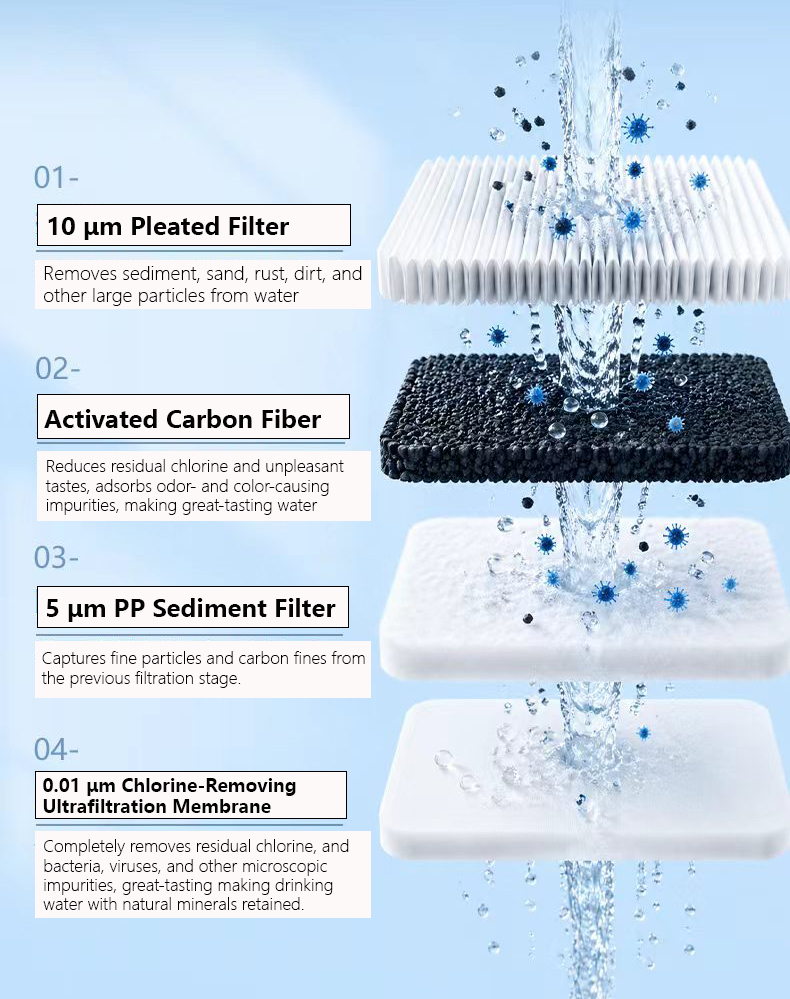
For example, the ChengrongTimes under-sink water filter uses a four-in-one composite filter cartridge containing the following four filtration stages:
Stage 1: 10 μm Pleated Filter Layer
This stage is mainly used to retain larger suspended particles, such as sand, rust, and other particulate impurities, while helping protect the subsequent filtration materials.
Stage 2: Activated Carbon Fiber
Activated carbon fiber is primarily used to adsorb chlorine and certain substances that affect the smell and taste of water. Actual removal performance depends on water quality, contact time, filter capacity, and the condition of the cartridge.
Stage 3: 5 μm PP Filter Layer
This stage further retains finer particles and some particles that may be released from upstream filtration materials, helping protect the subsequent ultrafiltration membrane.
Stage 4: 0.01 μm UF Ultrafiltration Membrane
As the final filtration stage, the ultrafiltration membrane provides an additional filtration barrier against fine particles and specific microorganisms that fall within its retention capabilities.
I value this clearly differentiated filtration structure because each filtration material serves a different purpose. Rather than simply pursuing more filtration stages, it is better to understand what each stage does and whether those functions match your water quality needs.
2.4 Do Not Overlook Water Flow Rate
Many consumers focus on filtration precision when purchasing a water filter but tend to overlook the speed at which water is delivered during everyday use.
If the water filter dispenses water too slowly and filling a pitcher requires a long wait, it may affect the daily user experience even if the filtration specifications look impressive.
According to the ChengrongTimes official product page, the maximum flow rate of this under-sink water filter is approximately 660 L/h. This is the maximum flow rate stated by the manufacturer. Actual flow may be affected by inlet water pressure, piping, filter cartridge condition, and installation conditions.
Therefore, when comparing different systems, I recommend checking the stated flow rate, operating pressure range, and actual usage conditions rather than assuming that every household can achieve the maximum flow rate continuously.
2.5 Calculate Long-Term Maintenance Costs
When purchasing a water filter, you should not consider only the initial purchase price.
Long-term costs typically include filter cartridge replacements, installation, routine maintenance, and necessary water quality retesting.
According to the ChengrongTimes official page, the composite filter cartridge has a maximum replacement interval of approximately one year. However, the actual replacement time should be determined according to water consumption, raw water quality, cartridge condition, and the manufacturer’s instructions.
If a household uses a large amount of water or the incoming water contains considerable sediment, the cartridge may need to be replaced sooner.
I recommend confirming filter cartridge prices, availability, maintenance procedures, and replacement requirements before purchasing. This makes it easier to determine whether a water filtration system is suitable for long-term use.
3. Under Sink Water Filter for Drinking: What Should You Look For?
When consumers search for under sink water filter for drinking, their actual concern is usually not an abstract question about filtration technology, but how to obtain water suitable for everyday drinking and determine whether a product meets their needs.
In my view, choosing a drinking water filter requires considering at least the following aspects.
3.1 Improving Taste and Removing Contaminants Are Two Different Things
If tap water has a noticeable chlorine taste, activated carbon filtration may help improve its taste and odor.
However, if a household is concerned about lead, nitrates, arsenic, or other specific contaminants, it is necessary to confirm whether the filter has been tested for the relevant contaminants.
Just because a filter can improve the taste of water does not mean it can effectively remove all contaminants that may affect health.
Likewise, the absence of an unusual odor does not mean that water contains no contaminants that could pose health risks.
For drinking water filtration, I always recommend identifying the treatment goal first and then choosing equipment with the appropriate capabilities.
3.2 Can UF Ultrafiltration Retain Natural Minerals?
This is a question many consumers have when learning about ultrafiltration technology.
Ultrafiltration membranes primarily retain particles and microorganisms according to their size. They generally do not remove large amounts of dissolved minerals such as calcium and magnesium in the same way that treatment processes designed for dissolved ions may do.
However, actual mineral retention still depends on the composition of the raw water, membrane characteristics, and the overall system design. The performance of all UF products should not be assumed to be identical.
ChengrongTimes identifies the retention of natural minerals as one of this product’s design features. If your goal is to improve drinking water taste while retaining naturally occurring minerals in the original water, this filtration approach is worth considering.
However, it is important to understand that retaining minerals does not automatically mean that water is healthier, nor does it mean that the equipment can remove all harmful substances. Whether it is suitable for your household still depends on raw water quality and the actual treatment goals.
3.3 Should You Consider Wastewater and Drain Connections?
For households that want to reduce additional drainage plumbing, the water pathway design of the equipment is also important.
According to the ChengrongTimes official page, this product features a dual-outlet design and does not require a dedicated wastewater drain connection.
Its design is intended to provide:
- Water treated through all four filtration stages for drinking and cooking.
- Water treated through the first three filtration stages for appropriate uses, such as washing ingredients and dishes.
This design allows users to select different water pathways according to their needs while avoiding a dedicated wastewater drain connection.
However, the specific uses should still comply with the product instructions and local water quality conditions. Water used for washing ingredients should not automatically be regarded as disinfected water, nor should it be used for drinking unless the corresponding outlet meets drinking water requirements.
3.4 Where Should the Filter Be Installed?
Under-sink water filters are generally installed beneath the kitchen sink and connected to the water supply pipes and the corresponding outlet.
Before installation, confirm the following:
- Whether there is sufficient installation space inside the cabinet.
- Whether the inlet water pressure meets the product requirements.
- Whether the pipes and connections are compatible.
- Whether there is convenient access for leak inspections and filter cartridge replacement.
- Whether the installation environment meets the temperature and other operating requirements.
According to the ChengrongTimes official page, this product has an operating temperature range of 5–38°C, an operating pressure range of 0.1–0.4 MPa, and main unit dimensions of 320 × 320 × 475 mm.
These specifications can help users assess installation conditions before purchasing. Actual installation should follow the manufacturer’s instructions and be completed by a professional when necessary.
4. Why I Recommend ChengrongTimes Under Sink Filtration Systems
After understanding the different filtration technologies, I prefer to choose equipment according to actual needs rather than focusing solely on the technology names used in marketing materials.
If your household wants to improve kitchen drinking and cooking water while prioritizing water flow rate, mineral retention, and everyday maintenance convenience, I believe this ChengrongTimes UF under-sink water filter is worth learning more about.
Product details:
4.1 Four-in-One Composite Filtration
This product uses a four-in-one composite filter cartridge that combines a pleated filter layer, activated carbon fiber, a PP filter layer, and an ultrafiltration membrane in one cartridge structure.
The advantage of this design is that each filtration stage can perform a different task: the upstream stages handle particulate impurities, the middle stages help improve chlorine-related taste and odor, and the final ultrafiltration membrane provides additional particle retention.
When evaluating this type of product, I recommend focusing on the specific filtration materials and their test results rather than making a judgment based solely on the name “four-in-one.”
4.2 0.01 μm UF Membrane
The official product information states that this system uses a 0.01 μm ultrafiltration membrane.
This specification helps consumers understand the membrane’s nominal filtration scale, but it cannot independently prove removal performance for every contaminant.
If you need to address specific contaminants, you should further confirm whether the product has corresponding test data and performance verification.
4.3 High-Flow Water Delivery
ChengrongTimes states that the maximum flow rate is approximately 660 L/h.
For households that frequently draw water, prepare beverages, and carry out daily cooking, a high stated flow rate is a useful reference.
However, I recommend considering inlet water pressure, filter cartridge life, and actual operating conditions when comparing products to ensure that the equipment not only has suitable specifications but can also meet the household’s everyday needs.
4.4 Dual Water Outlets
The dual-outlet design allows users to select the appropriate water pathway for different purposes.
The official information explains that one outlet uses all four filtration stages, while the other uses the first three. This design provides greater flexibility for kitchen water use, but the two outlets have different treatment levels and should not be regarded as providing exactly the same drinking water treatment performance.
4.5 No Dedicated Wastewater Drain Connection
This product is designed without the need for a dedicated wastewater drain connection.
For households that value simple installation and want to reduce additional drainage plumbing, this is a feature worth considering.
However, not requiring a wastewater drain connection does not mean that the entire household water system has no drainage, nor does it mean that the equipment experiences absolutely no water loss under all operating conditions. The specific water pathways should be confirmed according to the actual product structure and installation instructions.
4.6 316L Stainless Steel Housing
The official product page states that this system uses a 316L stainless steel housing.
Housing material is one factor worth considering when evaluating the durability of water filtration equipment, especially for components that are in long-term contact with water.
However, the housing material cannot replace an evaluation of the safety of all water-contact materials, sealing performance, and filtration effectiveness. Consumers should also review relevant test documents, warranty terms, and actual maintenance requirements.
My Recommendation
If you are looking for a UF under-sink water filter for kitchen drinking and cooking water, I recommend confirming your household water quality first and then evaluating the equipment according to installation space, flow rate, filter cartridge replacement intervals, and target contaminants.
If these conditions match the product’s intended use, you can learn more about its technical specifications and operating requirements on the ChengrongTimes official product page.
Explore the ChengrongTimes Under-Sink UF Water Filter:
5. Who Should Consider an Under Sink UF Water Filter?
In my view, an under-sink UF water filter is more suitable for households with clearly defined filtration needs that also understand the limitations of the technology.
Situations in Which This Type of Equipment May Be Worth Considering
- You want to improve the chlorine taste, odor, or taste of tap water.
- You need convenient access to kitchen drinking and cooking water.
- You want to use ultrafiltration technology while retaining some naturally occurring dissolved minerals in the original water.
- You value water flow rate and installation beneath the kitchen cabinet.
- You want to avoid a dedicated wastewater drain connection.
- You are willing to maintain the filter cartridge as required and select appropriate treatment based on water quality.
When Should You Be More Cautious?
If the water source is affected by specific chemical contamination, or testing identifies dissolved contaminants that require specialized treatment, you should not determine whether the equipment is suitable solely from the nominal pore size of the UF membrane.
For example, nitrates, arsenic, and other dissolved contaminants need to be evaluated according to their specific concentrations and the available treatment technologies. Ultrafiltration cannot universally replace treatment processes designed specifically for these contaminants.
If you use private well water, you should also conduct water quality testing first and determine whether additional treatment is necessary based on the results.
If local authorities issue a drinking water safety advisory, you should prioritize the guidance of local public health authorities rather than assuming that installing a household water filter will automatically solve the problem.
6. Installation and Maintenance: What Homeowners Should Know
Even if a water filter has a well-designed filtration structure, installation and maintenance can affect its long-term performance.
Before Installation
First, confirm the product dimensions, inlet water pressure, operating temperature, and connection requirements.
Next, check whether there is sufficient space inside the cabinet for future pipe inspections and filter cartridge replacement.
If you are unfamiliar with household water supply plumbing, I recommend having the equipment installed by an experienced installer and checking all connections for leaks before use.
During Daily Use
Use the equipment according to the product instructions and do not exceed the specified temperature and pressure ranges.
If you notice a significant decrease in water flow, an unusual odor, or a leak, inspect the filter cartridge and pipes promptly.
For households with uncertain water quality, determine whether additional treatment is necessary based on water quality testing rather than relying solely on the appearance or taste of the water.
Filter Cartridge Replacement
ChengrongTimes official information states that the filter cartridge replacement interval is up to approximately one year and describes a monitoring design based on actual flow and cumulative water consumption.
The actual replacement time may vary depending on water consumption and incoming water quality. Consumers should follow the manufacturer’s maintenance requirements and avoid extending filter cartridge use indefinitely simply because the water flow appears normal.
The CDC also emphasizes that water treatment equipment requires regular maintenance and filter replacement to help maintain normal operation and reduce the risk of microbial growth inside the equipment.
7. Frequently Asked Questions
Q1: What are Under Sink Filtration Systems used for?
Under Sink Filtration Systems are mainly used to treat water at specific locations, such as the kitchen, and are generally suitable for drinking and cooking needs. They differ from systems that treat all household water. The choice should depend on the target contaminants and household requirements.
Q2: Are under sink water filters for home worth considering?
If you want convenient access to treated kitchen water, under-sink water filters are worth considering. They can be hidden beneath the sink and provide filtered water through a dedicated outlet. However, whether purchasing one is worthwhile depends on raw water quality, target contaminants, equipment performance, and long-term maintenance costs.
Q3: How do I choose an under sink water filter for drinking?
When choosing an under sink water filter for drinking, you should first understand your water source and target contaminants, then check the filter structure, relevant test reports, water flow rate, installation requirements, and maintenance costs. Do not judge whether a product is suitable for drinking water treatment solely by its filtration rating or the number of filtration stages.
Q4: Does a UF water filter remove bacteria and viruses?
A UF membrane can retain certain microorganisms, but the specific performance depends on the membrane pore size, system design, and target microorganisms. You should not assume that every UF water filter can reliably remove all bacteria and viruses. For water sources with a risk of microbial contamination, choose treatment equipment with relevant performance verification and follow local drinking water safety recommendations.
Q5: Does ultrafiltration remove dissolved minerals?
Ultrafiltration generally does not remove large amounts of dissolved minerals such as calcium and magnesium in the same way that treatment processes designed for dissolved ions may do. However, actual performance depends on raw water composition and the specific system design, so all products should not be assumed to perform identically.
Q6: Does an under sink UF filter remove lead, arsenic, or nitrates?
You cannot conclude that equipment can effectively remove lead, arsenic, or nitrates solely because it uses UF technology or has a particular nominal membrane pore size. These contaminants require separate verification of the product’s test data and treatment capabilities. If testing identifies these contaminants, choose a treatment solution that has been specifically verified for them.
Q7: How often should I replace an under sink water filter cartridge?
The replacement interval depends on the product design, filter cartridge capacity, household water consumption, and raw water quality. ChengrongTimes official information states that the product’s filter cartridge replacement interval is up to approximately one year. In actual use, the replacement time should be determined according to the product instructions and equipment condition.
Q8: Can I install an under sink filtration system myself?
Whether you can install the system yourself depends on the product design, existing plumbing, and your installation experience. Before installation, confirm the equipment dimensions, connections, inlet water pressure, and operating temperature requirements. If the installation requires changes to the water supply pipes or you are unfamiliar with the process, professional installation is recommended.
Q9: Is a high filtration rating enough to guarantee safe drinking water?
No. The nominal filtration rating is only one parameter for evaluating a water filter. Water source conditions, target contaminants, overall system design, relevant test results, and routine maintenance are equally important. Consumers should confirm whether the product can address the actual water quality issues they face.
Q10: Where can I learn more about the ChengrongTimes under sink water filter?
You can visit the ChengrongTimes official product page to learn more about the product’s four-in-one composite filter cartridge, 0.01 μm UF membrane, dual-outlet design, maximum stated flow rate, and housing material.
Product link: https://www.chengrongtimes.com/?p=84
Final Thoughts
When choosing a household water filter, I focus more on whether the equipment can solve practical problems than on how many technical terms appear in its marketing materials.
Under Sink Filtration Systems provide a convenient option for households that want to improve kitchen drinking and cooking water. For users who value ultrafiltration technology, natural mineral retention, water flow rate, and installation convenience, UF under-sink water filters are worth learning more about.
If you are looking for under sink water filters for home or want to choose an under sink water filter for drinking that suits your everyday needs, I recommend understanding your household water quality first and then making a decision based on filtration capabilities, maintenance requirements, and installation conditions.
Provided that the product matches your water quality needs, I recommend learning more about the ChengrongTimes under-sink UF water filter.
Explore the ChengrongTimes Under-Sink Water Filter: