
A user recently posted a question online:
“The water quality in my community is good, and I want to buy a Water Filter. However, I have heard that filter replacement and maintenance can be expensive. How should I choose?”
This is a common and reasonable question. If the water quality in your community is already good, why install a Water Filter? And if you decide to install one, how can you avoid excessive long-term filter replacement costs?
These two concerns are not contradictory.
Some people buy a Water Filter because they are worried about water quality. Others care more about drinking water taste, convenience, or having access to filtered drinking water directly from the tap. Different needs call for different solutions.
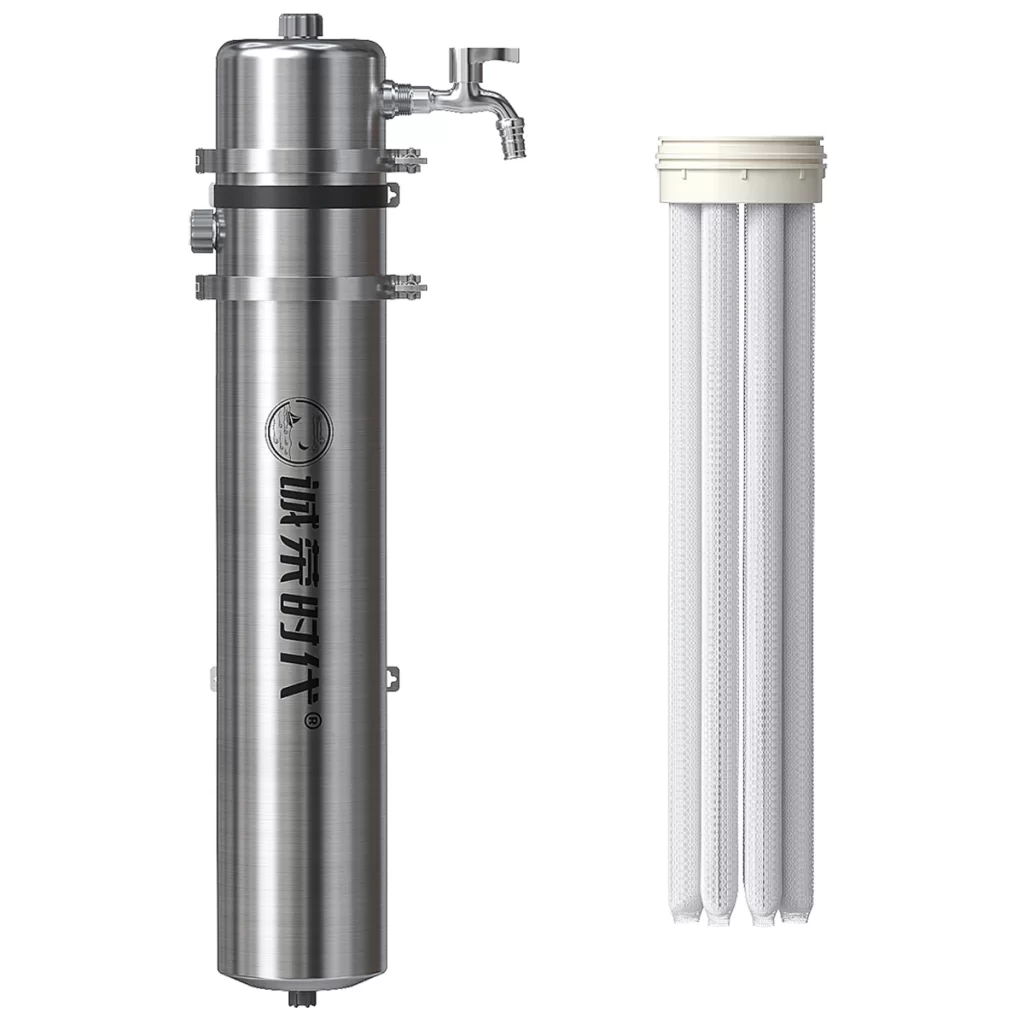
I work in the water filtration industry. ChengrongTimes specializes in ultrafiltration-based Water Filter products with Natural Minerals Retained and does not sell RO reverse osmosis Water Filters.
From the perspective of an ultrafiltration product manufacturer, I would like to explain this issue clearly: Water quality determines whether additional filtration is necessary, while filter lifespan and replacement costs determine whether a Water Filter is economical to use over the long term.
1. If Your Community Has Good Water Quality, Do You Still Need a Water Filter?
China’s current Standards for Drinking Water Quality (GB 5749-2022) establishes the relevant health indicators and limits for drinking water. The standard took effect on April 1, 2023.
Reference: National Standard Full-Text Public Disclosure System
If your community receives municipal tap water that meets the applicable standards, and household plumbing and secondary water supply facilities are properly maintained, installing a Water Filter is a personal decision based on your actual needs. Not every household necessarily needs one.
However, water that meets the standards when it leaves the treatment plant does not guarantee that water coming from every household tap will always be free from problems.
Aging pipes, poorly maintained storage tanks, and problems with secondary water supply systems may affect water quality at the point of use. Whether heavy metals, microorganisms, or other contaminants are present must be determined through actual water quality testing. You should not draw conclusions based solely on the appearance of the community or the water’s visual clarity.
Therefore, when you encounter Water Filter advertisements emphasizing heavy metal contamination, there is no need to rush into a purchase or automatically assume that every such claim is misleading. A more sensible approach is to understand the local water supply conditions, test the water at the household tap when necessary, and select an appropriate filtration technology based on the results.
If there is no identified water quality problem and your main goals are improving taste or enjoying the convenience of direct drinking, you do not need to purchase an expensive device simply because you are worried about contamination.
2. Before Buying a Water Filter, Decide What Matters Most: Filtration Performance or Brand and Convenience
If you are buying a Water Filter primarily for its brand reputation, appearance, smart features, or after-sales service, consider brands with well-established service networks.
However, a well-known brand does not automatically mean that every model is suitable for your household, nor does it guarantee that filters will never develop problems. You should still evaluate the product’s sanitation and safety documentation, applicable water quality conditions, filter availability, after-sales policies, and long-term maintenance costs.
If your main concern is practical drinking water needs, compare the contaminant removal capabilities of different filtration technologies instead of focusing only on brand names and purchase prices.
In particular, remember that the purchase price is only an initial expense. Filter replacements and maintenance account for part of the long-term cost of owning a Water Filter.
Before buying, ask three questions:
- How much does each replacement filter cost? Do multiple filter cartridges need to be replaced simultaneously?
- What determines the replacement interval? Is there a clearly specified rated water capacity, usage period, or other maintenance requirement?
- How is filtration performance maintained after replacement? Are relevant test reports and after-sales support available?
One important point: replacing filters according to water volume is not necessarily cheaper than replacing them according to time. Appropriate maintenance should follow the product manual, the actual condition of the filter, and applicable hygiene and safety requirements.
Some filters may need replacement because of elapsed time, storage conditions, or microbiological risks even when their rated water capacity has not been reached.
3. What Is the Difference Between RO Reverse Osmosis and Ultrafiltration Water Filters?
If your household uses municipal tap water that meets drinking water standards and there is no identified problem involving excessive dissolved contaminants, you can compare RO reverse osmosis and ultrafiltration products according to your drinking water needs, taste preferences, mineral retention preferences, and maintenance budget.
The main difference between these technologies lies in their filtration mechanisms and their ability to treat different types of contaminants.
| Comparison | RO Reverse Osmosis Water Filter | Ultrafiltration Water Filter |
|---|---|---|
| Core technology | Reverse osmosis membrane | Ultrafiltration membrane |
| Typical pore size or separation scale | Approximately 0.0001 microns, depending on the product and testing method | Commonly approximately 0.01 microns, depending on membrane specifications |
| Particles and colloids | Can remove them | Can remove particles and colloids within the membrane’s retention range |
| Bacteria and other microorganisms | Can effectively reduce them when the system is intact, operating properly, and performance has been verified | Can retain microorganisms within the membrane’s performance range, but not every product can automatically be assumed to deliver drinking water that meets all applicable requirements |
| Dissolved salts and heavy metal ions | Can remove many dissolved substances; actual performance depends on product testing | Generally cannot reliably remove dissolved salts and dissolved heavy metal ions |
| Minerals | Removes a substantial proportion of dissolved minerals | Generally retains most dissolved minerals |
| Wastewater | Usually produces a concentrate stream; the ratio depends on product design and operating conditions | Conventional ultrafiltration generally does not continuously discharge concentrate in the same way as RO |
| Suitable applications | Situations requiring substantial removal of dissolved substances | Situations where the source water is suitable and the main treatment needs involve particles and colloids |
The pore sizes shown above are typical technical values, not universal specifications for every product. Actual filtration performance also depends on membrane materials, equipment design, prefilters, operating conditions, and test results.
It is also important to note that ultrafiltration membranes alone generally do not effectively remove residual chlorine. If a product includes activated carbon or other adsorption media, it may further improve chlorine levels and certain odors, depending on its configuration and test results.
Therefore, it is inaccurate to say that RO is always better or that ultrafiltration is always more suitable for communities with good water quality.
If you need to reduce dissolved salts or specific heavy metals, choose a product with verified removal capabilities for those substances. If the source water already meets applicable requirements and your main needs involve filtering particles and colloids, an ultrafiltration solution may be worth considering.
4. Are Replacement Filters Expensive? Calculate the Cost per Ton of Water
When buying a Water Filter, many people compare only the purchase price and overlook future filter replacement expenses.
A more useful measure is how much water a filter can process under actual operating conditions and how much it costs to maintain the equipment.
The calculation is straightforward:
Filter cost per unit of treated water = Relevant filter cost ÷ Actual treated water volume.
For example, according to product information provided by ChengrongTimes, one of its ultrafiltration-based Water Filter products with Natural Minerals Retained has a rated water capacity of 100 tons, and the price of a single replacement filter is less than RMB 800.
Using RMB 800 for the calculation, and assuming the filter can actually process 100 tons of water under the relevant operating conditions:
RMB 800 ÷ 100 tons = RMB 8 per ton.
This means the theoretical filter cost is approximately RMB 8 per ton of water.
However, this calculation is based on the rated water capacity. It does not mean that every household will achieve the same service life. Actual costs also depend on source water quality, filter replacement requirements, equipment maintenance, and other consumables.
The 100-ton figure provided by ChengrongTimes is based on the company’s own laboratory testing. It is not a third-party report independently verifying a 100-ton filter lifespan. Consumers should distinguish between internal company test results and third-party verification.
Consider another example.
Suppose the total replacement cost of the relevant filters for a particular RO Water Filter is RMB 21,836. If the system produces 100 tons of water over the corresponding period, the calculation would be:
RMB 21,836 ÷ 100 tons = RMB 218.36 per ton.
Compared with the theoretical cost of RMB 8 per ton calculated for the ultrafiltration product above, the filter costs differ by approximately 27 times.
However, these figures are suitable for a fair comparison only if the filter costs, treated water volumes, testing conditions, and replacement rules are comparable. This is an illustrative calculation, not evidence that all RO Water Filters have such high maintenance costs.
When buying a Water Filter, consider not only the initial purchase price but also the long-term cost of meeting your actual water treatment needs.
5. Which Households Should Consider ChengrongTimes Ultrafiltration Water Filters with Natural Minerals Retained?
For households that mainly use municipal tap water meeting applicable standards, have no identified problem involving excessive dissolved contaminants, and want a more convenient drinking water experience, Water Filter with Natural Minerals Retained products may be worth considering.
ChengrongTimes specializes in ultrafiltration-based Water Filter products with Natural Minerals Retained. The product concept is to retain most dissolved minerals in the water while using ultrafiltration and other configured filtration components to treat particles, colloids, and other substances within their applicable treatment ranges.
According to product information supplied by ChengrongTimes, certain products have a rated water capacity of up to 100 tons and a five-year filter warranty.
Two concepts must be distinguished: a rated water capacity does not guarantee the same actual service life under every water quality condition, and a filter warranty does not automatically mean that the filter can operate for five years without maintenance under all circumstances. The applicable conditions, warranty coverage, and replacement requirements should be confirmed in the official product documentation and warranty terms.
If you are considering this type of equipment, check the following:
- Whether your household’s source water is suitable for ultrafiltration.
- Whether the product has the relevant sanitation approvals and test documentation for its intended use.
- The testing conditions associated with the rated water capacity.
- The exact filter warranty coverage and whether other consumables incur additional costs.
If water quality testing identifies excessive dissolved heavy metals or other dissolved contaminants, do not choose a product solely because it retains minerals. Instead, select a treatment solution with verified capabilities for the specific contaminants involved.
6. Four Things to Check Before Buying a Water Filter
To avoid discovering that long-term maintenance costs exceed your budget, include these four items in your purchasing checklist.
First, verify the source water. Understand the local water supply conditions and test water at the household tap when necessary. Do not rely solely on water color, odor, or the community’s reputation to assess every water quality parameter.
Second, verify filtration performance. Identify the contaminants you want to address and check whether the product’s test reports include the relevant substances and test results.
Third, calculate long-term costs. Include all regularly replaced filters, consumables, and maintenance expenses in your budget. Calculate costs using reasonable replacement intervals.
Fourth, verify product claims. Rated water capacity, filter lifespan, warranty duration, and test reports represent different types of information. Before purchasing, understand the source, applicable conditions, and limitations of each claim.
7. Frequently Asked Questions About Water Filter Replacement Costs
1. Do I need a Water Filter if my community has good water quality?
Not necessarily. If the water at your household tap meets the relevant requirements, you can follow local drinking water guidance for everyday drinking and cooking. If you want to improve taste, enjoy the convenience of direct drinking, or add specific filtration functions, choose a Water Filter according to your actual needs.
2. Which is better for households: an ultrafiltration Water Filter or an RO reverse osmosis Water Filter?
It depends on the source water and your treatment goals. RO reverse osmosis is more suitable for situations requiring the reduction of various dissolved substances. Ultrafiltration primarily treats particles and colloids within its retention range and generally retains most dissolved minerals, but it cannot reliably remove dissolved heavy metals.
3. Should Water Filter cartridges be replaced according to time or water volume?
Follow the product manual and actual operating conditions. Treated water volume can help estimate consumable costs, but not every filter can be maintained solely according to cumulative water volume. Filters with specified service periods or hygiene requirements must also be replaced according to the relevant time limits.
4. Are the rated water capacities of ultrafiltration Water Filters guaranteed by national standards?
It is not accurate to assume that ultrafiltration products are completely unregulated, nor should you assume that every stated capacity has been verified under a single national testing procedure.
China’s GB 34914-2021 standard, Minimum Allowable Values of Water Efficiency and Water Efficiency Grades for Water Purifiers, primarily applies to household water purifiers using reverse osmosis or nanofiltration membranes as their main purification elements. It does not directly cover every performance indicator of conventional ultrafiltration Water Filters.
Reference: National Standard Information System
When purchasing an ultrafiltration product, check the applicable product standards, test documentation, testing conditions, and rated water capacity. Do not rely solely on verbal promises from sales representatives.
5. How can I determine whether Water Filter replacement costs are reasonable?
List the price of each replacement filter, its rated water capacity, its recommended replacement interval, and the costs of other consumables. Calculate the filter cost per unit of treated water. Also consider actual water quality, household consumption, and after-sales service rather than comparing cartridge prices alone.
6. Is water from an ultrafiltration Water Filter safe to drink directly?
You cannot assume that the output is automatically safe for direct drinking simply because the equipment uses ultrafiltration technology. Suitability depends on source water quality, the complete equipment design, test results, filter hygiene, installation, and maintenance.
Choose a product with appropriate sanitation and safety documentation, clearly defined operating conditions, and maintenance requirements that you can follow.
Conclusion: Check Water Quality First, Then Calculate Long-Term Costs
Returning to the original question: if the water quality in your community is good, should you install a Water Filter when you are concerned about replacement costs?
My recommendation is not to assume that you must buy a Water Filter simply because your neighbors have one. Equally, do not choose a device solely because its initial price is low while ignoring future maintenance expenses.
First, identify your household’s actual water needs. Then compare filtration performance, filter replacement requirements, and long-term costs. For municipal tap water that meets applicable requirements and is suitable for the intended treatment, ultrafiltration can be one option. If specific dissolved contaminants need to be removed, prioritize a solution with verified treatment capabilities and supporting test documentation.
A Water Filter is worth buying when it solves a real problem. Its replacement costs are reasonable when they are calculated under realistic operating conditions.
References and Verification Sources
- Chinese national standard: Standards for Drinking Water Quality (GB 5749-2022), National Standard Full-Text Public Disclosure System.
- Chinese national standard: Minimum Allowable Values of Water Efficiency and Water Efficiency Grades for Water Purifiers (GB 34914-2021), National Standard Information System.
- ChengrongTimes product documentation: Rated water capacity of 100 tons, filter warranty terms, and relevant testing information.
- Testing and approval documentation supplied by the company: Shenzhen Institute of Metrology and Quality Inspection drinking water test report, No. WT10103260146579WT1; Guangdong provincial hygiene permit, No. Yue Wei Shui Zi [2026] S0177. The specific test items, applicable product models, and scope of the permit should be verified against the original documents.