
How to Choose a Whole-House Water Filter? A Complete Guide to Choosing a Whole-House Ultrafiltration Water Filter and Under-Sink Kitchen Water Filter
ChengrongTimes has been launched for almost one year.
Over the past year, the reason why many customers have encountered problems when purchasing water filters is that they lack an understanding of the overall design framework of the whole-house water purification system.
There is a saying that choosing is more important than working hard. The same is true for water filter users. Only after choosing the right type of water filter can we talk about whether the water filter we buy is good or not.
In order to prevent ChengrongTimes customers from becoming as confused as a headless fly when choosing a water filter, with one head and two big eyes.
Recently, I happened to have some free time, so I would like to systematically introduce to ChengrongTimes customers, from the perspective of the overall framework, what types of water filters should be used for the main incoming water pipe and under the kitchen counter respectively.
Of course, this article is mostly a summary of my 19 years of practical experience in the water purification industry, but I believe it can definitely help you avoid more pitfalls and spend less unnecessary money when purchasing and installing water filters.
1. Complete Whole-House Water Purification System
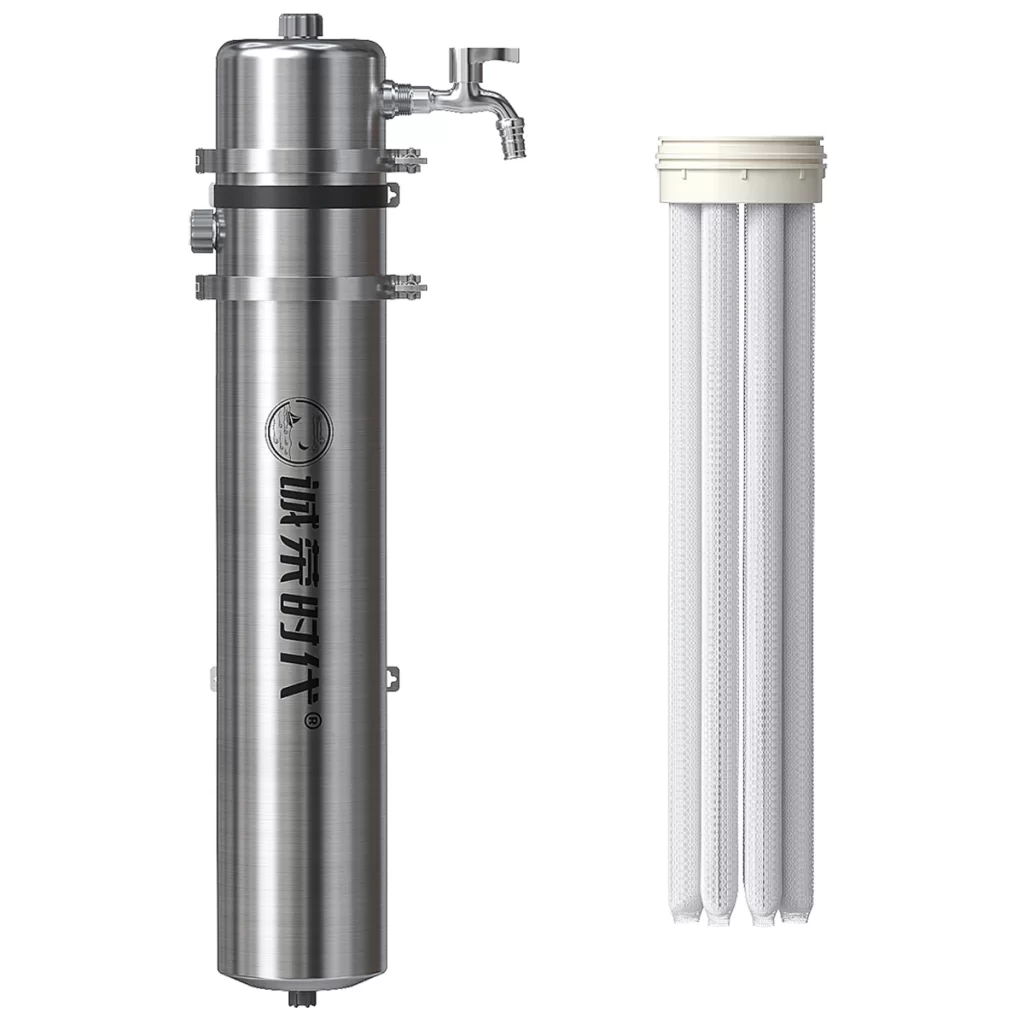
A complete whole-house water purification system = main incoming water pipe microfiltration water filter + under-sink kitchen water filter.
The function of the whole-house ultrafiltration water filter installed on the main incoming water pipe is to make the raw water clearer and cleaner.
With a filtration precision 400 times higher than that of traditional pre-filters, ultrafiltration can completely intercept impurities such as sediment, rust, colloids, and insect eggs carried in the raw water, making the water entering the entire household piping system cleaner and clearer.
It is especially suitable for whole-house water purification of natural water sources such as turbid well water, mountain spring water, and stream water in rural areas.
Of course, filtering municipal tap water is even less of a problem.
The function of the under-sink kitchen water filter is to filter purified water used for drinking, cooking, and making soup. In addition to cleanliness, taste and health must also be taken into consideration.
RO reverse osmosis = clean, but unhealthy.
ChengrongTimes mineral-water-like water filter = clean and healthy.
They each have their own characteristics.
If the customer’s household water source is safe and the TDS value is less than 300, then the ChengrongTimes mineral-water-like water filter is an excellent choice that is difficult to find a second one like in the market.
1. The first step in whole-house water purification: water quality testing
The first step in whole-house water purification is not purchasing a water filter, but conducting a water quality test.
First determine whether the raw water is a safe water source, and then check whether the TDS value is greater than 300.
If the water is too hard, then a whole-house water softening system is needed to remove calcium and magnesium ions from the water and reduce the hardness of the water flowing to the water heater, washing machine, and toilet.
Therefore, whole-house water purification, kitchen water purification, and whole-house water softening essentially solve different problems and cannot be confused with each other.
2. How to Choose a Whole-House Water Filter for the Main Incoming Water Pipe?
The whole-house water filter is mainly used to intercept impurities such as sediment, rust, colloids, and insect eggs in the raw water.
Water filters used for whole-house water purification are generally also called pre-filters. However, to achieve true whole-house water purification, the pre-filter we choose must not only have an interception function but also ensure that the interception is effective.
Common Whole-House Water Filtration Types
Pre-filters with an interception function include:
- Steel-ring pre-filter/PP laminated filter, with a filtration precision of 40~70μm.
- PP cotton pre-filter, with a filtration precision of 1~5μm.
- Ultrafiltration water filter, divided into 0.1μm microfiltration water filter and 0.01μm ultrafiltration water filter.
From the perspective of filtration precision, if you want to completely intercept fine mud, rust, and other impurities in tap water and turbid well water in rural areas, the ultrafiltration water filter is a choice that is difficult to find a comparable competitor for.
Unless you have a lot of money and feel that paying some tuition fees and taking some detours is also okay, just treat it as an experience of life.
Therefore, I am very glad that when I started my business, I chose the pipeline ultrafiltration segment industry in a confused and ignorant way, because the performance of ultrafiltration water filters in whole-house water purification is difficult to find a competitor in the market.
What are the advantages of ChengrongTimes ultrafiltration water filters?
Compared with its peers, ChengrongTimes, whether in manufacturing quality, product functions, or structural design, has reached the TOP1% of the industry. The filter element has a 5-year warranty, and it pursues excellence in products and services. There is no second one in the industry.
For whole-house ultrafiltration water filters installed on the main incoming water pipe, you may have many questions.
For example, can ultrafiltration remove water scale?
The answer is: Ultrafiltration cannot change the nature of water. It can only make the water clearer and cleaner.
The 0.1-micron microfiltration membrane, also called a PVDF supported membrane and external pressure membrane, can completely intercept fine mud, sediment, rust, colloids, and insect eggs in the water. It is particularly suitable for filtering turbid well water, mountain spring water, stream water, and other natural water sources in rural areas.
The 0.01-micron ultrafiltration membrane, also called a PVC ultrafiltration membrane and internal pressure membrane, can not only make the water clearer but also intercept 99.99% of bacteria and viruses in the water.
Many customers living in large flat-floor apartments and villas tend to choose ultrafiltration membranes for whole-house water purification.
Why is activated carbon not recommended for whole-house water purification?
When talking about bacteria and viruses in household pipelines, I do not recommend ChengrongTimes customers use activated carbon in the whole-house water purification system on the main incoming water pipe.
Because the main function of activated carbon is to adsorb odors and residual chlorine in water and improve the taste of water.
However, our household piping system is similar to a long and narrow water storage tank. A certain amount of residual chlorine in the water is necessary, because residual chlorine can inhibit the massive growth of bacteria and viruses in the water, while activated carbon can effectively adsorb most of the residual chlorine in the water.
Secondly, activated carbon itself is very prone to breeding bacteria, causing bacteria in the downstream pipelines to exceed the standard.
Therefore, activated carbon is not recommended for whole-house water purification on the main incoming water pipe to remove residual chlorine for ChengrongTimes customers, otherwise bacteria in the entire household piping system will seriously exceed the standard.
Can Whole-House Ultrafiltration Water Filters Remove Water Scale?
When popularizing whole-house water purification, many customers often ask a question:
Can ChengrongTimes ultrafiltration water filters remove water scale from water?
This question shows that many users have confused the concepts of whole-house water purification and whole-house water softening.
Water scale is a substance precipitated from calcium and magnesium ions in water under heating conditions.
Generally speaking, when TDS is less than 300, calcium and magnesium ions in water are not particularly prone to forming scale. You can also observe the kettle at home.
If the bottom of the kettle has particularly serious water scale after being used for a period of time, then you can consider installing whole-house water softening.
How does whole-house water softening solve the water scale problem?
Whole-house water softening uses ion exchange resin to replace calcium ions and magnesium ions in water with sodium ions, reducing the hardness of the water, so that the water does not form scale even under heating conditions.
After the water is softened by ion exchange resin, the sodium ion content will increase.
From an experiential perspective, I recommend that ChengrongTimes customers only soften the water passing through the water heater, washing machine, and toilet, rather than softening the water flowing to the kitchen.
At this point, you can also reach a conclusion yourself:
To achieve the true effect of a whole-house water filter, an ultrafiltration water filter is a choice that is difficult to find a comparable competitor for.
ChengrongTimes ultrafiltration water filters have reached the TOP1% of the industry in manufacturing quality, product functions, and structural design.
If you are not particularly price-sensitive and have requirements for the quality of your whole-house water purification system, then I believe the quality of ChengrongTimes ultrafiltration water filters is difficult to find a second one like it in the market.
Why Does Water Pressure Drop 30%~40% After Installing an Ultrafiltration Water Filter?
Many customers have a question:
Why does my household water pressure drop significantly after installing an ultrafiltration water filter, by at least 30%~40%?
There are mainly two reasons.
Reason 1: The membrane flux is too small
First, many customers only compare prices when buying ultrafiltration water filters and do not care about anything else. The ultrafiltration water filter they choose has a membrane flux that is too small, resulting in the ultrafiltration water production capacity being unable to meet the customer’s daily water consumption.
Reason 2: Industry flow parameters are falsely stated
Second, competition in the ultrafiltration water filter industry is severe, and many merchants falsely state flow rates for sales performance.
However, ChengrongTimes whole-house ultrafiltration water filters installed on the main incoming water pipe have never received customer feedback that household water pressure or flow rate has declined.
This is because ChengrongTimes recommends filter specifications according to the customer’s household water consumption.
We would rather not make a sale than fail to ensure the customer’s water-use experience.
In addition, all parameters of ChengrongTimes ultrafiltration water filters are genuine. Unlike other manufacturers, our membrane flux is not falsely stated, and the filtration precision is not falsely stated.
This is why under the same membrane flux, the water production capacity of a ChengrongTimes ultrafiltration water filter is equivalent to two units.
Why Does ChengrongTimes Distinguish Between Microfiltration Membranes and Ultrafiltration Membranes?
As long as filters are within the ultrafiltration category on the market, they are marked as 0.01 microns. However, as the only full-supply-chain ultrafiltration factory in the industry, we must distinguish between microfiltration membranes and ultrafiltration membranes, because ChengrongTimes is a professional high-end water filter brand.
There is a difference between 0.1μm microfiltration water filters and 0.01μm ultrafiltration water filters in terms of filtration precision and filtration functions.
Therefore, when choosing a whole-house water filter for the main incoming water pipe, you cannot only look at the word “ultrafiltration.” You must also look at the actual membrane type, filtration precision, membrane flux, and whether they match the household water consumption.
3. How to Choose an Under-Sink Kitchen Water Filter?
The under-sink kitchen water filter is mainly used for drinking, cooking, and making soup.
Therefore, the safety of the water source is particularly important.
Now everyone’s economic conditions are generally good, so I especially recommend that customers in rural areas who use natural water sources first conduct a water quality test before using the water as drinking water.
Because in many rural areas, even if natural water sources have not been polluted by industry, iron and manganese or nitrite may exceed the standard due to geological reasons. In this case, it is considered an unsafe water source.
Compared with using RO reverse osmosis filtration, we recommend that customers directly change to a safe water source.
Is municipal tap water safe?
Municipal tap water is pretreated by water treatment plants, and 106 water quality tests are conducted before it leaves the plant. The familiar TDS value is only one of these 106 items, so it is generally safe under normal circumstances.
On the premise that the water source is safe, choose a suitable kitchen water filter according to the TDS value and hardness of the water.
How to Choose Between an RO Reverse Osmosis Water Filter and a ChengrongTimes Mineral-Water-Like Water Filter?
There are currently two main types of kitchen water filters on the market.
One is the RO reverse osmosis water filter, which produces clean but unhealthy pure water.
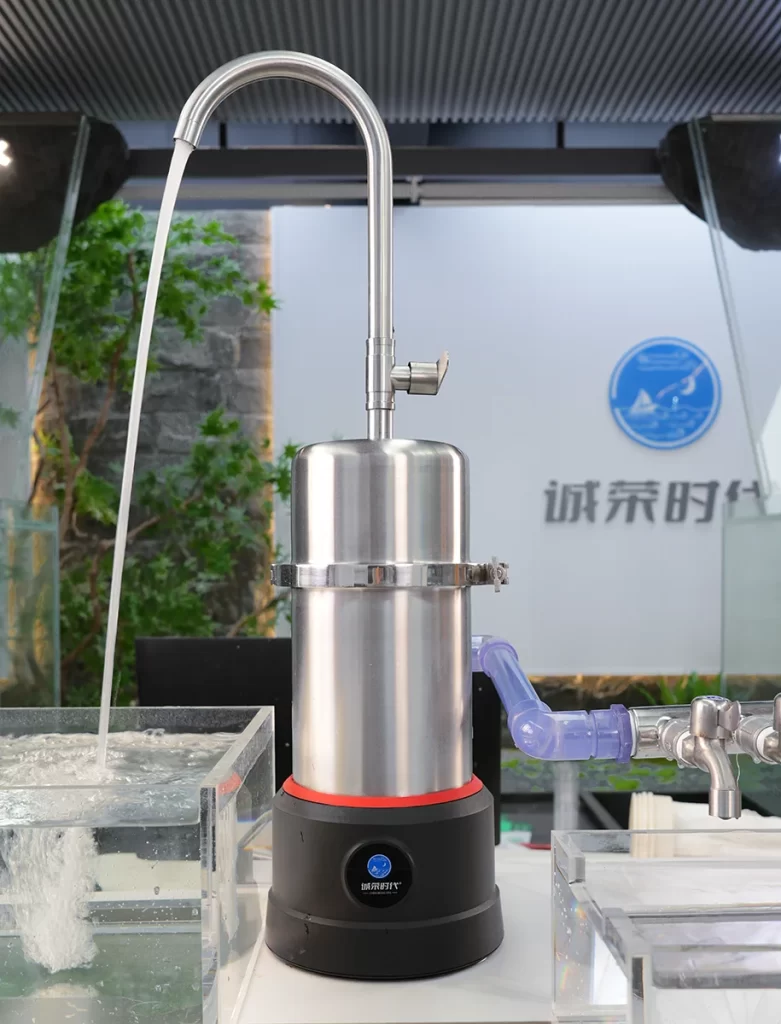
The other is the ChengrongTimes mineral-water-like water filter, which produces clean and healthy mineral-water-like water.
The reason why the ChengrongTimes mineral-water-like water filter is compared with RO is that the residual-chlorine-removing ultrafiltration membrane is the proprietary technology of Chengrong Ultrafiltration Factory.
ChengrongTimes mineral-water-like water filters can remove 99.99% of sediment and other particulate impurities, bacteria, viruses, and residual chlorine in water, while retaining minerals and trace elements in water, achieving the effect of mineral-water-like water. It is not only clean but also healthy.
How to choose when the TDS value is less than 300?
When the TDS value is less than 300, we recommend using the ChengrongTimes mineral-water-like water filter.
Because at this time, the minerals and trace elements in the water are not only beneficial to health but also make the water taste relatively good.
How to choose when the TDS value is greater than 300?
If the TDS value is greater than 300, calcium and magnesium ions in the water are more likely to form scale. Some customers may care more about water scale, so they can use an RO reverse osmosis water filter, because RO reverse osmosis water filters produce pure water.
However, more and more consumers are now realizing that although pure water produced by RO reverse osmosis is clean, it is unhealthy. Unless the water source is seriously polluted, there is no need to use an RO reverse osmosis water filter.
This is also why more and more RO reverse osmosis water filters are equipped with remineralization filter elements.
However, the effect of remineralization filter elements is definitely not as good as the natural minerals in water, because the synergistic effect among the various trace elements contained in natural minerals is more conducive to human absorption.
4. ChengrongTimes Water Filters Never Forgive Themselves in Quality and Service
Chengrong Ultrafiltration, Customers Have Never Had Concerns
No rust for ten years
No water leakage for ten years
After-sales service for ten years
ChengrongTimes® water filters never forgive themselves when it comes to quality.
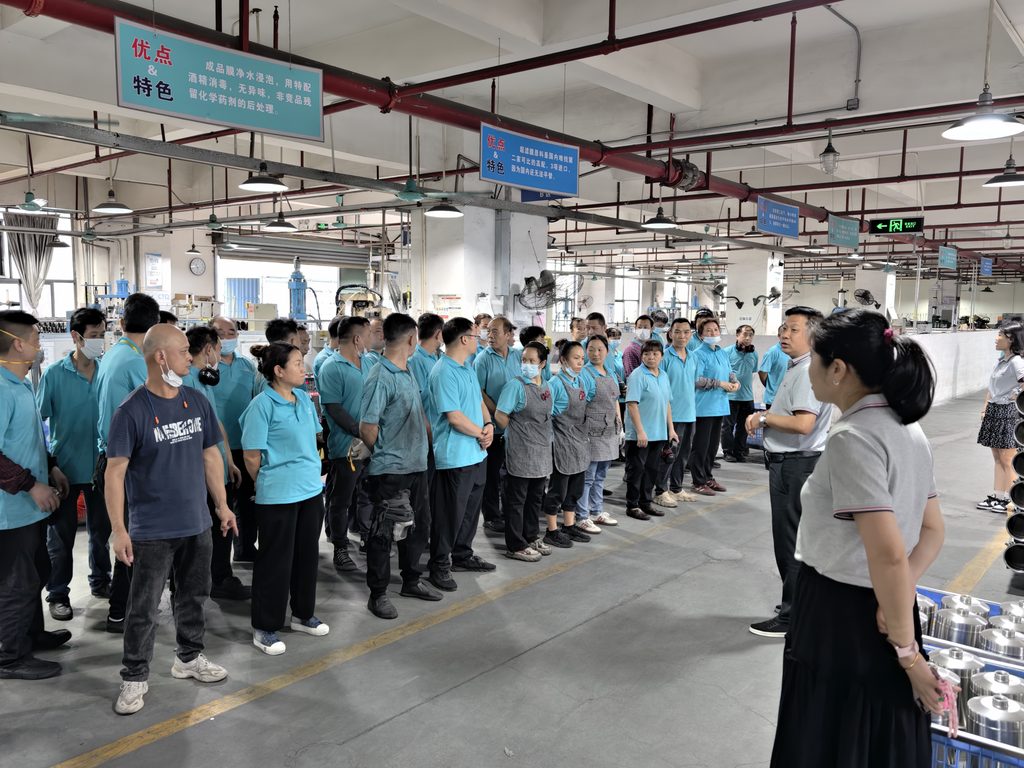
Shenzhen Chengrong, among the top three in the pipeline ultrafiltration industry, is the only full-supply-chain ultrafiltration factory in the industry, and an ODM/OEM factory behind multiple global first-tier brands.
After quietly working in pipeline ultrafiltration for 19 years, ChengrongTimes® arrived in the middle of 2025. Its quality is more insured than an insurance company, and its service is more customer-oriented than the customer.
Try one order. You won’t go bankrupt, and I won’t get rich. Chengrong Ultrafiltration—once you try it, it is difficult to resist.
5. Key Conclusions for Choosing a Whole-House Water Filter
If the entire whole-house water purification system is summarized simply, you can choose according to the following logic:
Step 1: Conduct a water quality test.
First confirm whether the raw water is safe, and then test the TDS value and hardness.
Step 2: Solve the whole-house water purification problem through the main incoming water pipe.
Whole-house water purification on the main incoming water pipe mainly solves the problem of sediment, rust, colloids, insect eggs, and other impurities. For turbid well water, mountain spring water, stream water, and other natural water sources in rural areas, ultrafiltration water filters are particularly suitable.
Step 3: Solve the drinking water problem through the under-sink kitchen water filter.
The under-sink kitchen water filter is mainly used for drinking, cooking, and making soup. Therefore, water source safety should be considered first, and then the appropriate water filter should be selected according to the TDS value and hardness.
Step 4: Consider whole-house water softening if water scale is serious.
Whole-house water purification and whole-house water softening are not the same thing. Ultrafiltration water filters mainly solve water impurity problems, while whole-house water softening mainly solves water scale caused by calcium and magnesium ions.
Step 5: Do not only compare prices when choosing an ultrafiltration water filter.
Filtration precision, membrane flux, water production capacity, actual water consumption, product quality, after-sales service, and whether the parameters are genuine should all be included in the selection criteria.
For customers pursuing a high-quality whole-house water purification system, ChengrongTimes ultrafiltration water filters have reached the TOP1% of the industry in manufacturing quality, product functions, and structural design, with a 5-year filter element warranty.
6. Whole-House Water Filter FAQ
Q1: What is the difference between a whole-house water filter and a kitchen water filter?
The whole-house water filter is mainly installed on the main incoming water pipe and is used to filter water entering the entire household piping system. It mainly intercepts impurities such as sediment, rust, colloids, and insect eggs.
The under-sink kitchen water filter is mainly used for drinking, cooking, and making soup, and has higher requirements for water source safety, taste, and health.
Therefore, a complete whole-house water purification system = main incoming water pipe microfiltration water filter + under-sink kitchen water filter.
Q2: Can an ultrafiltration water filter remove water scale?
An ultrafiltration water filter cannot remove water scale.
Ultrafiltration cannot change the nature of water. It can only make the water clearer and cleaner.
Water scale is mainly related to calcium and magnesium ions in water. If you need to reduce water hardness, you need to use a whole-house water softening system.
Q3: Can an ultrafiltration water filter filter bacteria and viruses?
The 0.01-micron ultrafiltration membrane, also called a PVC ultrafiltration membrane and internal pressure membrane, can not only make the water clearer but also intercept 99.99% of bacteria and viruses in the water.
The 0.1-micron microfiltration membrane, also called a PVDF supported membrane and external pressure membrane, can completely intercept fine mud, sediment, rust, colloids, and insect eggs in the water.
Q4: Why does water pressure drop 30%~40% after installing an ultrafiltration water filter?
There are mainly two reasons:
First, the membrane flux of the ultrafiltration water filter is too small, and the water production capacity cannot meet the household’s daily water consumption.
Second, some merchants have problems with falsely stated flow rates for sales performance.
ChengrongTimes recommends filter specifications according to the customer’s actual household water consumption, and its membrane flux and filtration precision are not falsely stated.
Q5: Are rural well water, mountain spring water, and stream water suitable for ultrafiltration water filters?
Ultrafiltration water filters are particularly suitable for filtering turbid well water, mountain spring water, stream water, and other natural water sources in rural areas.
However, if natural water sources are used for drinking, it is recommended to conduct a water quality test first, confirm that the water source is safe, and then choose an under-sink kitchen water filter.
Q6: What water filter should be chosen when the TDS value is less than 300?
On the premise that the water source is safe, when the TDS value is less than 300, we recommend using the ChengrongTimes mineral-water-like water filter.
At this time, the minerals and trace elements in the water are not only beneficial to health but also make the water taste relatively good.
Q7: What water filter should be chosen when the TDS value is greater than 300?
If the TDS value is greater than 300, calcium and magnesium ions in the water are more likely to form scale. If customers care more about water scale, they can use an RO reverse osmosis water filter because an RO reverse osmosis water filter produces pure water.
Q8: Is activated carbon needed for whole-house water purification?
It is not recommended to use activated carbon to remove residual chlorine in the whole-house water purification system on the main incoming water pipe.
Activated carbon is mainly used to adsorb odors and residual chlorine in water and improve the taste of water, while the household piping system is similar to a long and narrow water storage tank. A certain amount of residual chlorine in the water is necessary because residual chlorine can inhibit the massive growth of bacteria and viruses in the water.
Q9: What is the difference between whole-house water purification and whole-house water softening?
Whole-house water purification mainly solves problems involving impurities such as sediment, rust, colloids, and insect eggs.
Whole-house water softening mainly reduces water hardness through ion exchange resin and reduces water scale.
Therefore, the two solve different water quality problems.
Q10: What are the characteristics of ChengrongTimes ultrafiltration water filters?
ChengrongTimes ultrafiltration water filters have reached the TOP1% of the industry in manufacturing quality, product functions, and structural design, with a 5-year filter element warranty.
ChengrongTimes is the only full-supply-chain ultrafiltration factory in the industry, an ODM/OEM factory behind multiple global first-tier brands, and has quietly worked in pipeline ultrafiltration for 19 years. ChengrongTimes® arrived in the middle of 2025.
No rust for ten years, no water leakage for ten years, and after-sales service for ten years.
Try one order. You won’t go bankrupt, and I won’t get rich. Chengrong Ultrafiltration—once you try it, it is difficult to resist.
Conclusion
When choosing a whole-house water filter, what really matters is not blindly comparing brands and prices, but first understanding the water source, water quality, TDS value, hardness, household water consumption, and the design framework of the whole-house water purification system.
The main incoming water pipe solves the basic filtration problem for whole-house water use, the under-sink kitchen water filter solves the problems of drinking, cooking, and making soup, while whole-house water softening mainly solves water scale and water hardness problems.
For whole-house water purification on the main incoming water pipe, ultrafiltration water filters have obvious advantages in intercepting sediment, rust, colloids, insect eggs, bacteria, and viruses through the filtration capabilities of 0.1μm microfiltration and 0.01μm ultrafiltration.
For under-sink kitchen water purification, on the premise that the water source is safe, an appropriate water purification solution should be selected according to the TDS value and hardness.
If you are choosing a whole-house water filter, you might as well start with a water quality test and then decide what type of water filter should be installed.
Chengrong Ultrafiltration, customers have never had concerns.
No rust for ten years, no water leakage for ten years, and after-sales service for ten years.
ChengrongTimes® water filters never forgive themselves when it comes to quality.